Get Full Government Meeting Transcripts, Videos, & Alerts Forever!
Get email alerts on the Utility Securitization topic
No spam. Unsubscribe anytime.
House advances securitization bill with guardrails after floor amendments
Summary
Lawmakers approved House Bill 26 79 as amended, a bill that allows utilities to use securitization for certain costs but adds new guardrails narrowing when and how securitization may be used.
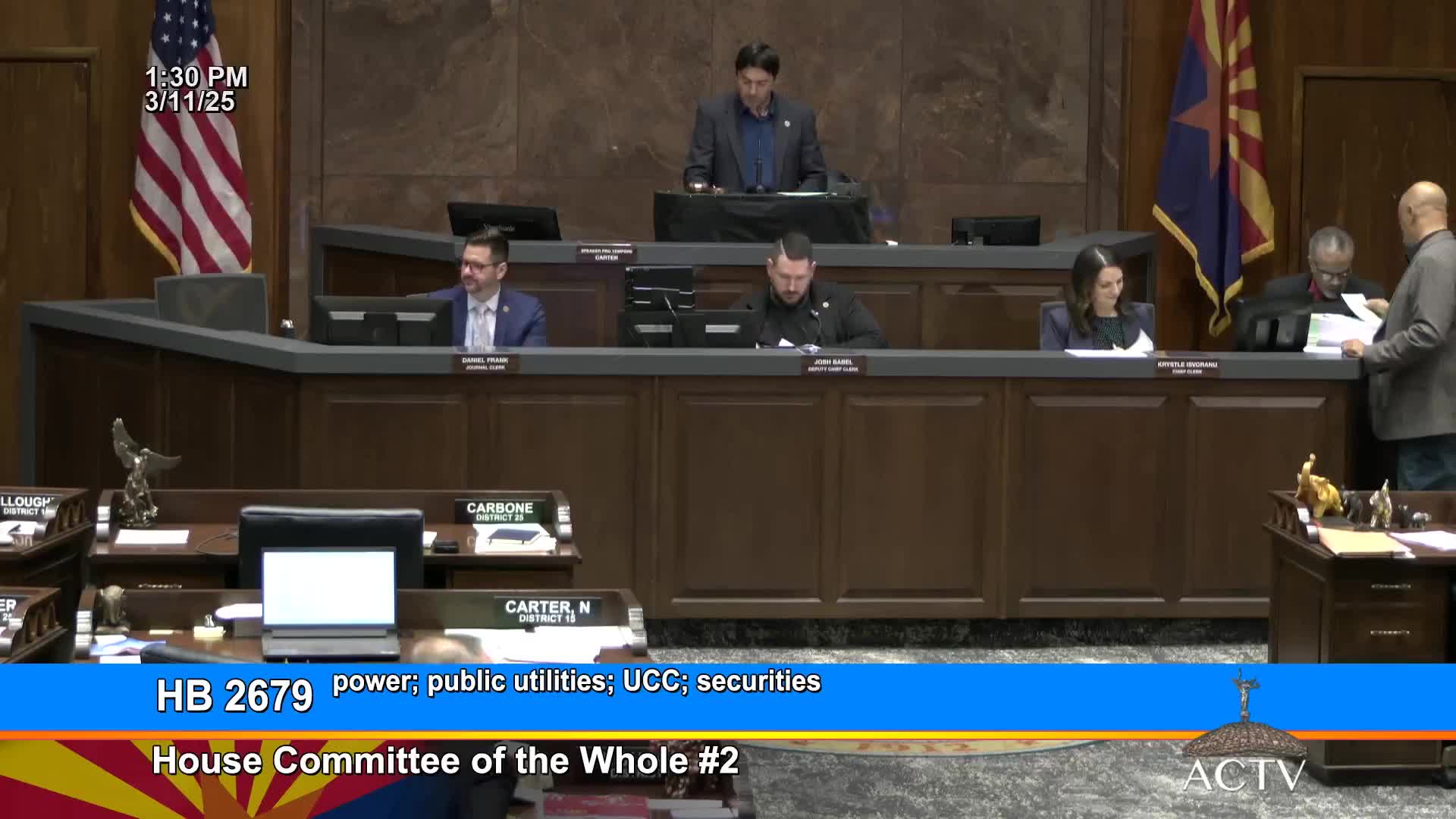
The Arizona House on the floor adopted House Bill 26 79 as amended, approving a securitization framework that members said is intended to free up lower-cost financing for utilities while adding new consumer protections.
The bill originally authorized broad securitization authority for electric utilities. Lawmakers debated multiple floor amendments focused on limiting which costs may be securitized and on strengthening review by regulators. Supporters said the changes preserve potential savings for ratepayers while opponents said the original draft was too sweeping.
Representative Vince Leach (Republican), the bill sponsor (Representative Griffin served as floor sponsor during committee), moved the bill through the Committee of the Whole and onto the floor; Representative Matthew Mathis offered two significant floor amendments aimed at tightening consumer protections. Mathis’s second amendment, which would have shortened securitization financing windows to five years and barred securitization of existing fuel and purchased power costs, failed on a division, with the tally recorded as 20 ayes and 36 nays.
Representative Paul Gress offered an amendment later adopted that imposes several constraints: fuel-cost securitization would be limited to narrow circumstances such as supply shortages, transportation disruptions, market volatility or substantial unanticipated load growth; the Arizona Corporation Commission (the commission) must make a finding that a significant event occurred to permit securitization for fuel; any securitization tied to retiring a plant must demonstrate that replacement resources provide net savings and at least equal resource adequacy; and entities affiliated with a utility are prohibited from buying bonds issued in the transaction. Supporters including Representatives Olson and Gress said those guardrails put the bill squarely “in the best interest of ratepayers.” Opponents warned the original draft could allow broad transfers of utility costs onto ratepayers if left unchecked.
After the Gress amendment was adopted, members voted to pass HB 26 79 as amended. The House action sends the amended bill to engrossing and then to the Senate.