Get AI Briefings, Transcripts & Alerts on Local & National Government Meetings — Forever.
Committee unanimously advances bill raising Industrial Commission wage-claim limit to $12,000
Loading...
Summary
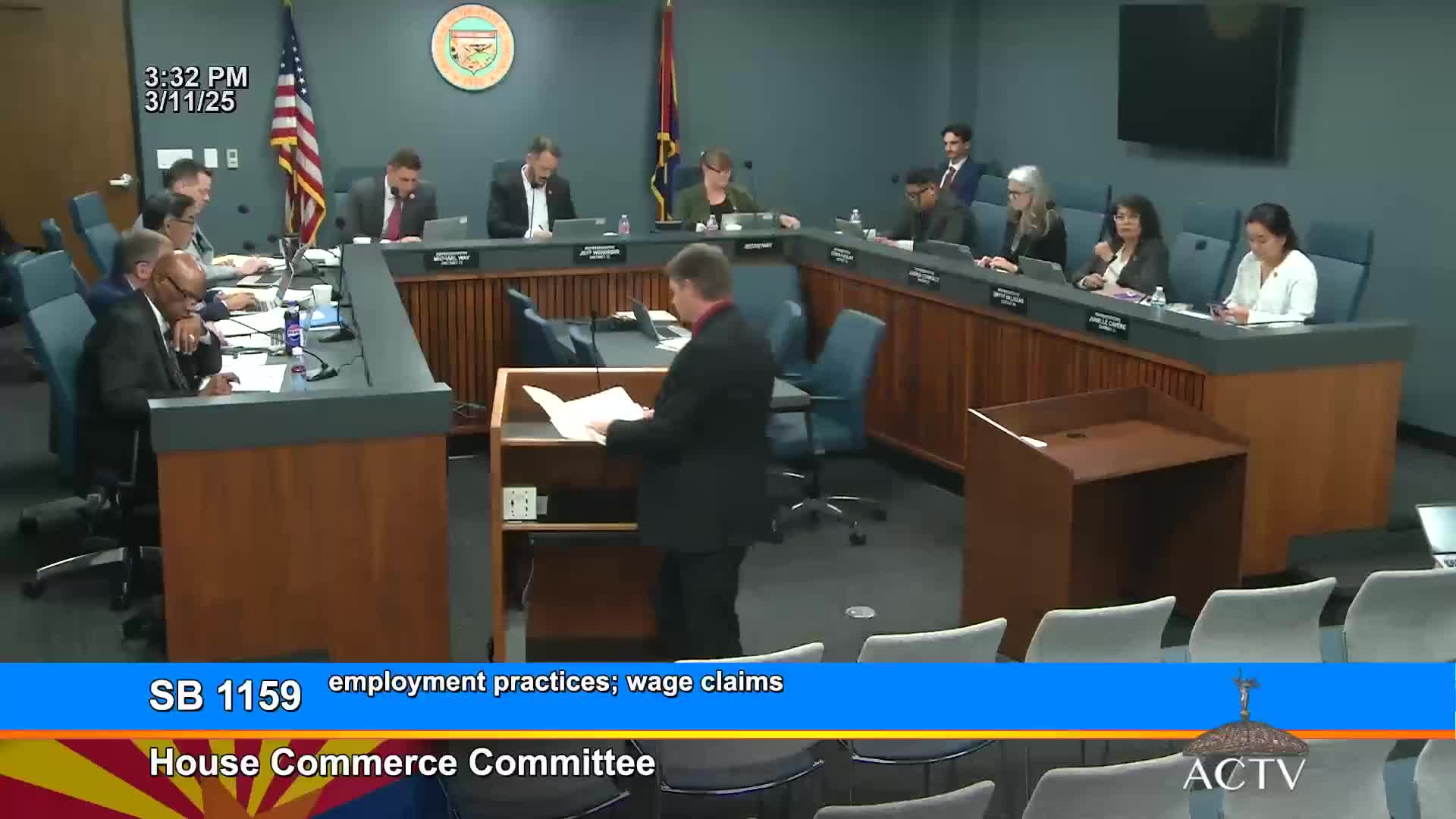
Senate Bill 1159, which would increase the Industrial Commission of Arizona's monetary limit for unpaid wage claims from $5,000 to $12,000, received a unanimous 10-0 due-pass recommendation after brief testimony from a labor representative.
The Arizona House Commerce Committee on Tuesday gave Senate Bill 1159 a unanimous due-pass recommendation, agreeing to raise the monetary limit for unpaid-wage claims filed with the Industrial Commission of Arizona (ICA) from $5,000 to $12,000.
Committee staff summarized the bill’s purpose, saying “an employee may file a claim against an employer for unpaid wages with the ICA if the amount of unpaid wages does not exceed $5,000. Senate Bill 11 59 increases the monetary limit for filing a claim for unpaid wages to $12,000.”
Cesar Corral, speaking on behalf of “thousands of carpenters and laborers in Arizona,” urged the committee to pass the bill, calling wage theft “a significant issue that harms hardworking individuals and their families.” “The bill provides necessary improvements to wage claim processes, making it easier for employees to seek and recover their rightful earnings,” Corral said.
Representative Villegas said he intended to vote yes but noted the Industrial Commission may need additional funding to handle the larger claims threshold and suggested that funding be considered as part of any floor amendment. “I’m gonna vote yes, but it was brought to our attention that the Industrial Commission may need more funding to support this change,” Villegas said.
The committee conducted a roll-call vote and recorded 10 ayes, 0 nays. Members voting in favor included Representative Aguilar, Representative Blackmon, Representative Cavera, Representative Connolly, Representative Diaz, Representative Hendricks, Representative Villegas, Representative Wilmeth, Vice Chairman Wei and Chairman Wenninger.
The committee recorded the recommendation by voice and roll-call; no amendments were adopted at the hearing and no opponent testimony was offered.