Get AI Briefings, Transcripts & Alerts on Local & National Government Meetings — Forever.
Committee amends statute to cover all FDA‑approved epinephrine delivery systems for schools
Loading...
Summary
House Education Committee adopted an amendment removing an emergency clause and returned Senate Bill 14‑40 with a due‑pass recommendation; the bill replaces references to "epinephrine auto injectors" with the broader term "epinephrine delivery systems."
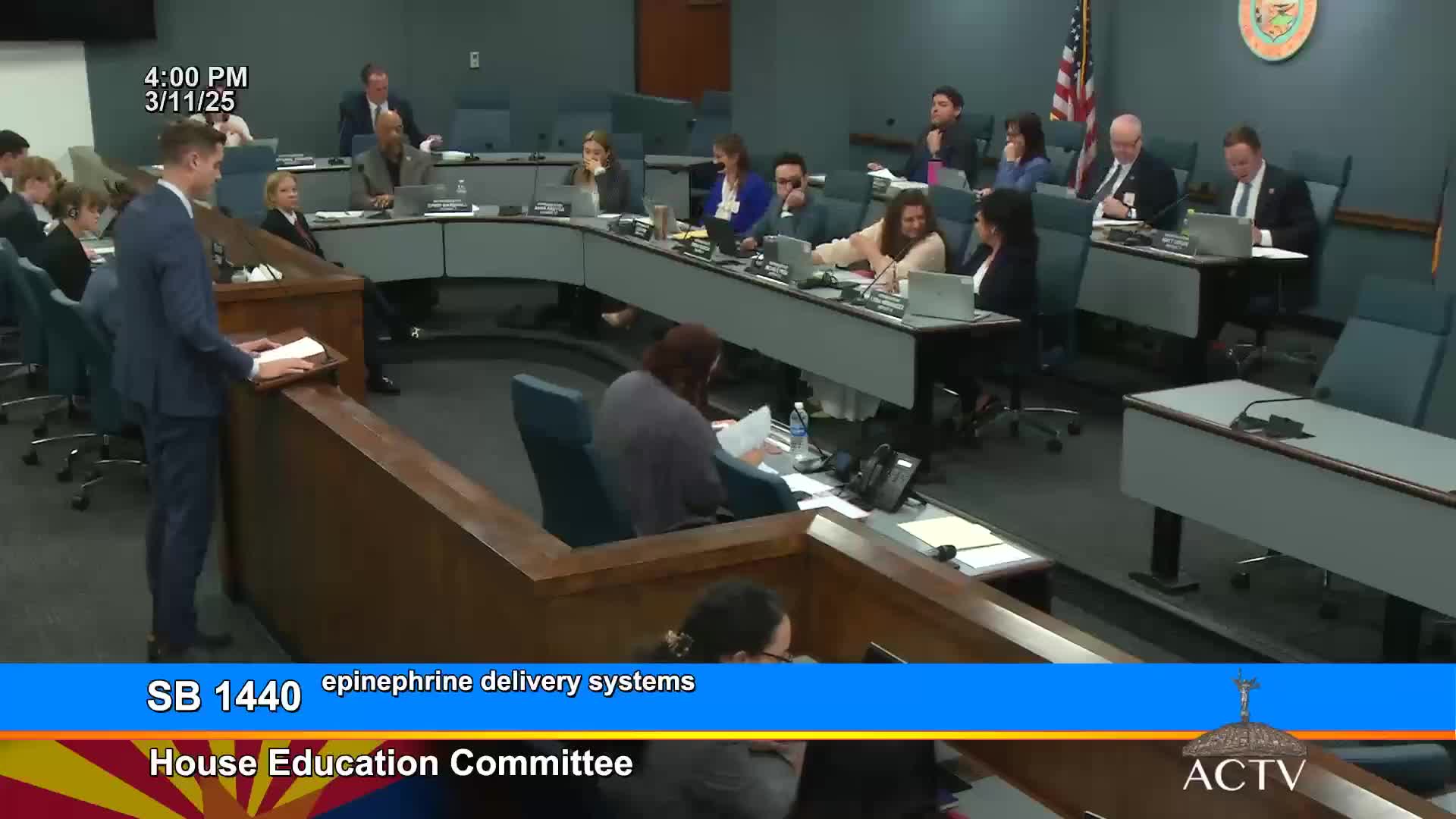
Senate Bill 14‑40 was returned with a due‑pass recommendation after the House Education Committee adopted a Gress amendment that removed the bill’s emergency clause.
Senator Karen Warner, the bill sponsor, told the committee the change modernizes statute to reflect new, FDA‑approved epinephrine delivery options — including needle‑free nasal sprays and prospective sublingual forms — so schools and the state’s stock epinephrine programs can accept and administer forms other than the traditional auto‑injector. "This bill updates Arizona's law to include all approved epinephrine devices, ensuring clarity for schools, emergency responders, and public institutions," Warner said.
Witnesses included parents and advocates. Lisa Cohen of the Kyra Rehn Foundation, who lost her daughter to fatal anaphylaxis, described the need for ready access to epinephrine in schools and urged lawmakers to update state law so school nurses and school medication programs can accept newer delivery forms. A lobbyist and parent described the logistical issue school nurses raised about accepting a nasal spray prescription under the current statute, which refers specifically to an auto‑injector.
The committee adopted the Gress amendment (which removed the emergency clause) and then approved the bill as amended. In committee discussion members said the change clarifies that Arizona’s school surveillance medication program (SSMP) and civil‑liability protections extend to all FDA‑approved epinephrine delivery systems. The committee returned SB 14‑40 as amended with a 12‑0 vote recorded in the transcript.