Get Full Government Meeting Transcripts, Videos, & Alerts Forever!
Get email alerts on the Artificial Intelligence Policy topic
No spam. Unsubscribe anytime.
Senate committee reviews HB 147, agrees to craft substitute to inventory state AI systems and consider SB 37 elements
Summary
A Georgia Senate committee heard authors and agency officials on House Bill 147, agreeing to draft a substitute that would require an annual inventory of government AI systems, clarify definitions and scope, and consider elements of Senate Bill 37 including a proposed advisory board and guidance for local governments. No formal vote was taken.
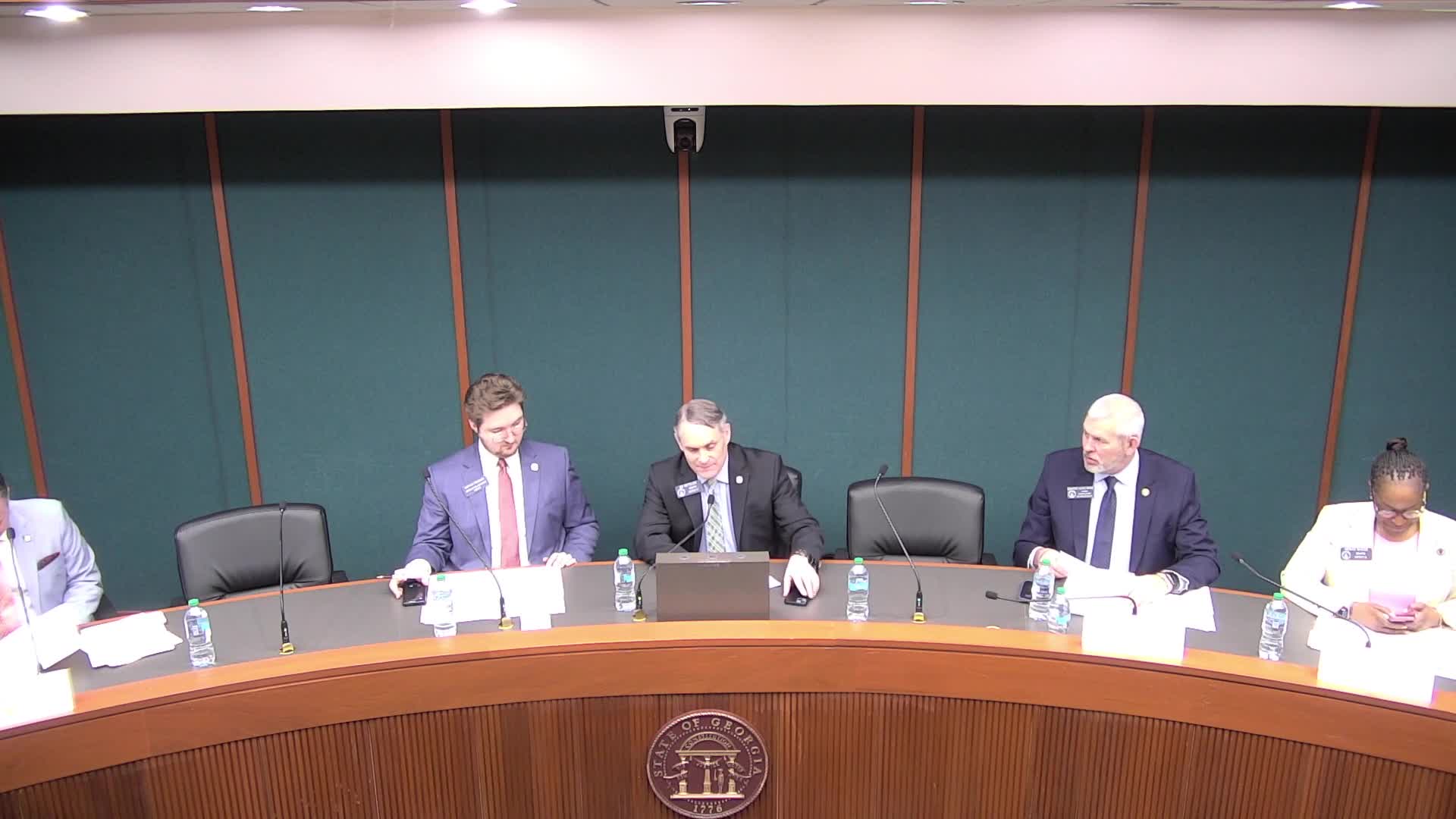
A Georgia Senate committee met to discuss House Bill 147, which would require an annual inventory of artificial intelligence systems used by state agencies, and agreed to work with the bill’s author and other senators to draft a substitute before taking action.
The committee chair opened the session saying “we've got before us, House Bill 147 by Representative Thomas,” and framed the meeting as a working discussion to collect questions and items for a substitute version. Representative Thomas, the bill’s author, told the panel the bill’s “posture today” is to have discussion around HB 147 and collect items the committee wants included or removed.
Why it matters: committee members and outside witnesses said the measure would create transparency about where AI is used in state government and establish guardrails for systems that influence official decisions. Several senators also raised whether the bill should be expanded to cover local governments and constitutional officers, and whether a new statewide advisory board or the Georgia Technology Authority (GTA) should lead implementation.
Key points from the discussion
- Inventory and scope: HB 147 (LC560266) directs an annual inventory of systems that “employ artificial intelligence” in use by an agency, beginning on a date cited in the draft. Committee members pressed the author on whether the inventory should cover only systems that make or materially support decisions (decision-driving systems) or include lower‑risk tools such as predictive text and Copilot-style features. Representative Thomas described the draft’s working definition as focused on systems that “make predictions, recommendations, or decisions influencing real or virtual environments.”
- De minimis level and decision threshold: senators repeatedly asked for clarity about a de minimis threshold—when a tool is too minor to include. Multiple participants suggested limiting reporting obligations to systems that affect decision making or materially influence outcomes, while still listing commercial off-the-shelf AI-enabled tools in the inventory so legislators can see what is in use.
- Georgia Technology Authority role and capacity: Cameron Fass of the Georgia Technology Authority told the committee, “I don't believe there's really any substantial cost for us to to compile this inventory. We're already working on that as we speak.” Fass said GTA already requires executive-branch agencies to vet AI tools before use under agency policy (not statute), is assembling an inventory, and expects to launch an AI lab within weeks. He explained GTA’s funding mix includes agency fees and income from the office of data innovations.
- Definition alignment and cross-bill coordination: Senators said they want consistent statutory language across multiple bills. Senator Albers, who sponsored Senate Bill 37, said SB 37—the “AI Accountability Act”—uses a definition that many committee members prefer and would help keep language uniform across other measures (several bills were referenced where a consistent definition would help enforcement and legislation coordination).
- Board, local governments and transparency: Senator Albers described SB 37’s approach, which would create a state advisory board to provide guidance across state and local governments, publish plans, and offer templates to help smaller jurisdictions. “This is called the AI Accountability Act,” he said, and added the board would be advisory rather than regulatory. The senator and other members discussed whether local governments should be required to publish inventories publicly or whether GTA could host a consolidated portal on their behalf.
- Data privacy and human oversight: committee members and sponsors emphasized data privacy and human oversight. Multiple speakers urged that systems which train on or retain personal identifying data require special protections. Representative Thomas and others stressed an “in the loop / on the loop / out of the loop” framework—favoring systems where humans remain involved in consequential decisions.
- Practical examples and risks: witnesses and senators gave examples where AI could help (e.g., speeding administrative processing for benefits or permitting) and where it risks harm (hallucinations, inaccurate biographical information, or facial recognition use). One senator said a municipal parking system could use sensors to call police for gunshots but avoid facial recognition for privacy reasons.
Committee direction and next steps
Committee members agreed not to take a final vote and to produce a substitute version of HB 147 that incorporates items raised during the hearing, including consideration of SB 37 provisions. The chair said the committee will “take the input we got today” and circulate a substitute; members expected to consider the substitute at the next meeting. GTA representatives offered to share existing policies, templates and their inventory work to inform a statutory approach.
What the bill does not (yet) resolve
The committee did not adopt final statutory language on three items that were central to the discussion: (1) a precise de minimis threshold for excluding low‑impact tools (the draft emphasizes systems that influence decisions), (2) the statute’s reach over constitutional officers and the university system (GTA’s authority covers executive-branch agencies but not all constitutional officers or the university system), and (3) whether local governments must publish their inventories on their own websites or may rely on GTA-provided templates or a central portal. Senators also flagged the need for consistent definitions across other pending bills.
Closing and process notes
There was no formal vote. The committee signaled it will craft a substitute bill and reconvene. GTA said it is already inventorying AI tools for executive branch agencies and has existing policies dating from 2023 requiring GTA review of agency AI deployments.
Ending note: Committee members said they want to balance transparency, data privacy and local control while avoiding overly prescriptive technical definitions that could become obsolete as technology evolves.