Get Full Government Meeting Transcripts, Videos, & Alerts Forever!
Get email alerts on the Special District Governance topic
No spam. Unsubscribe anytime.
Joshua City Council backs resolution supporting changes to special-district law to reduce TCEQ oversight and permit single-member districts
Summary
At a special meeting the Joshua City Council voted unanimously to approve a resolution backing proposed changes to the Texas Special District Local Laws Code that district representatives said would exempt some reviews by the Texas Commission on Environmental Quality for revenue bonds and allow the option of single-member director districts.
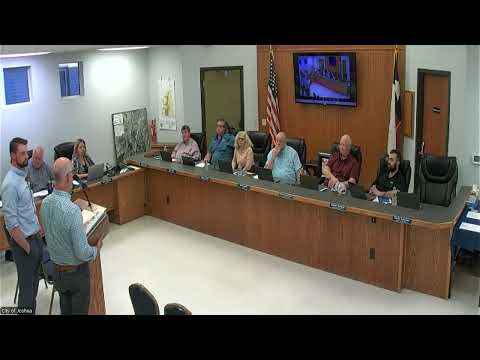
The Joshua City Council on Monday unanimously adopted a resolution supporting proposed amendments to the Texas Special District Local Laws Code that district representatives said would reduce duplicate Texas Commission on Environmental Quality (TCEQ) review of revenue-bond projects and permit the option of electing directors from single-member districts.
Josh, a representative of the Johnson County Special Utility District, told the council the district covers about 320 square miles and serves a mix of urban subdivisions and rural customers dependent on well water. He said duplicative reviews add cost and delay to capital projects: "it's really a duplication of what we have to do... it costs the rate payer about 25 to 50,000" and "at a minimum, it takes 3 months," slowing projects, he said.
That cost and delay led the district to ask state legislators to amend the Texas Special District Local Laws Code so the district would not need the additional front-end TCEQ approval for certain revenue-bond actions and large system improvements, proponents said. Scott, a district representative, said the draft language borrows from other districtsthat have already modernized their statutes: "we use that as a template to try to modernize that, to make it more in line with the other SUDs." He added the changes also include housekeeping to remove redundancy.
The proposed legislation would also allow a district board to move to single-member director districts in the future. District speakers said the change would be a board decision that would itself require a public, multi-step process, including notices and reviews to avoid diluting minority votes and, in some cases, Department of Justice review. "There's a lot of steps and a lot of public input that would be received before you would get to that point," Scott said.
Council members pressed for clarification on how single-member districts would work. The mayor said the TCEQ exemption "is a no-brainer" because it would save money for ratepayers, but expressed concern about ambiguity in the single-member district language and said he favored a blended approach if any change were later pursued: "I like the idea that we went to the assembly of the district to have the split where you have the at-large plus the set ones... that makes more sense." Other council members asked whether the measure would require a public vote (it does not, proponents said) and how unfilled seats would be handled (the board would fill unexpired terms, as today).
District presenters emphasized their request was for a resolution of support to assist the billnow prepared for filing in Austinand to provide local feedback sought by legislators. The district representative said Senator King had asked for input from impacted cities and that the resolution would help gain support in the Legislature, though the district could still pursue the bill without the city's resolution.
City attorney Jerry read the resolution into the record before the vote. "I moved to approve a resolution supporting the introduction in the current legislative session of a bill amending subchapter C of chapter 72.16 of the Texas Special District Local Laws Code and opposing that portion of subchapter B," he said as he read the motion text. Councilmember Mike moved to approve the resolution; Councilmember Johnny seconded. The council voted unanimously to approve the resolution; the transcript recorded the vote as unanimous but did not list an individual roll-call tally.
Proponents said the changes would reduce project delays and costs (they estimated $25,000$50,000 per TCEQ submission and multi-month delays) and allow future boards to consider electoral changes tailored to the district's mix of urban subdivisions and rural customers. Opponents and some council members said they wanted clearer language and assurances about the single-member district process before endorsing that portion of the proposal.
The council meeting concluded after the vote. City and district representatives said next steps include working with legislators in Austin and continuing public outreach if and when the board pursues single-member districts in the future.