Get Full Government Meeting Transcripts, Videos, & Alerts Forever!
Get email alerts on the Parking Transit Trolley topic
No spam. Unsubscribe anytime.
Downtown trolley pilot drew about 3,700 rides but served mostly weekend leisure trips, organizers say
Summary
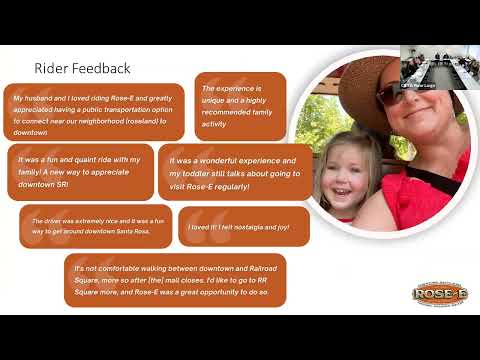
A 12‑seat electric trolley pilot run May–September 2024 attracted roughly 3,700 rides, City of Santa Rosa and Downtown Action Organization staff reported, but data showed the service mostly served weekend leisure and local users rather than acting as a regular last‑mile transit connection.
Cadence, a representative of the Downtown Action Organization, told the Santa Rosa City Economic Development Committee that the pilot “Rosie” trolley, which ran May 15–Sept. 29, 2024, recorded about 3,700 rides and cost roughly $65,000 to lease and operate (marketing costs were not included).
The pilot ran on a loop between Courthouse Square and Railroad Square and was funded and sponsored by four partners, Cadence said: the City of Santa Rosa, Visit Santa Rosa (which handled marketing), SMART and Sonoma Clean Power. The trolley contractor was Bruins Trolley Company.
Organizers said the ridership profile showed the service was used primarily for weekend recreational trips rather than commuting. “When we look at the program, we had about 3,700 riders,” Cadence said. “Sundays were the most popular, about 11 riders per hour, and the majority of survey respondents were local: 88% were from Sonoma County.”
Survey results presented by Cadence indicated that two‑thirds of riders completed the full loop and 36% of riders came downtown specifically to ride the trolley; 85 respondents said they rode “just for fun.” The pilot’s schedule was Wednesday–Friday 5–9 p.m., Saturday noon–9 p.m. and Sunday noon–4 p.m., which organizers said produced the observed weekend peak.
Committee members and staff discussed lessons learned and future options. Cadence said the pilot did not meet early expectations for last‑mile connectivity to SMART commuter services because it did not operate during typical commute hours and riders were often already downtown when they chose to board.
Cost and equipment questions were raised. Cadence said leasing and operating the vehicle cost about $65,000; purchasing a comparable small electric trolley would likely cost “north of $150,000,” she said. Staff and committee members discussed three possible approaches for future efforts: 1) run a similar leased electric trolley program again; 2) use a larger, known city trolley (Rosie) for periodic tourist/tour options; or 3) consider an electric tram or a shared‑ride app concept similar to Petaluma’s Luma Go.
Cadence and staff also said the trolley contractor used for the pilot was not one they would recommend contracting with again, and noted sponsorship constraints: Sonoma Clean Power would not support a gas‑powered vehicle. Staff said they would continue to explore leasing, conversion and alternative suppliers and would report back with cost estimates and options.
Committee members asked staff to continue outreach and to report potential next steps to a future meeting; staff indicated they would agendize follow‑up options for committee consideration.
Ending
Committee members praised the pilot for producing community interest and said they want staff to return with specific options (cost estimates, vehicle availability, schedule options and possible partnerships) before committing to another round.