Get Full Government Meeting Transcripts, Videos, & Alerts Forever!
Get email alerts on the Sb144 Pesticide Labeling topic
No spam. Unsubscribe anytime.
Committee advances bill clarifying pesticide labeling liability; supporters and opponents clash over safety and farmer access
Summary
The House committee advanced SB 144, which clarifies the limits of failure-to-warn claims for EPA-registered pesticide labels, after competing testimony from farm groups and public-health witnesses.
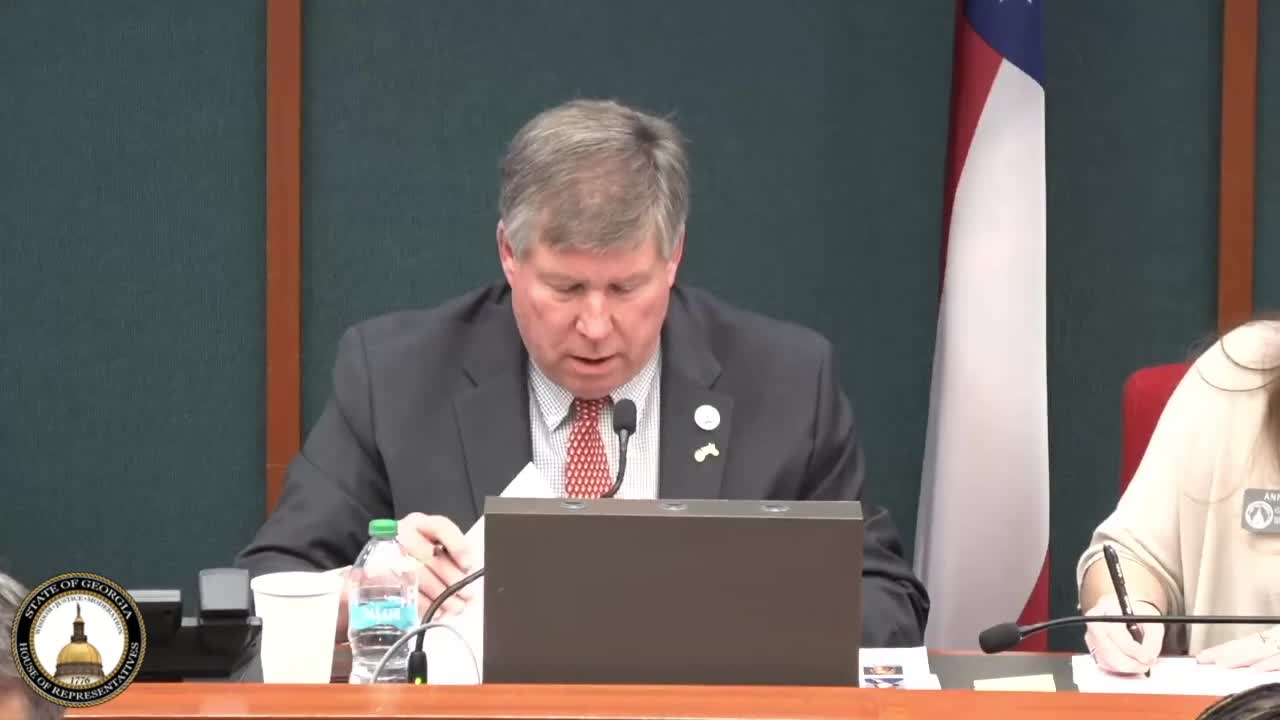
The House Agriculture and Consumer Affairs Committee voted to advance Senate Bill 144 after an extended hearing that drew farm groups, pesticide applicators and public-health advocates.
Sponsor Senator Watson described SB 144 as a limited, "surgical" change to state law that clarifies that manufacturers of EPA-registered crop protection products cannot be held liable solely for failing to warn of risks that the U.S. Environmental Protection Agency would not permit on a label. "The label is the law," Watson told the committee, describing the federal registration and labeling process and saying manufacturers cannot put on a label what the EPA does not approve.
Sen. Watson and other supporters said the bill does not provide blanket immunity: manufacturers remain liable if they misrepresent safety information or withhold known risks, and federal law (FIFRA) and existing remedies remain available in those cases. Will Bentley of the Georgia Agribusiness Council, Adam Bellflower of Georgia Farm Bureau and Mary Kay Woodworth of the Georgia Urban Ag Council urged support, saying the change prevents manufacturers and U.S. suppliers from exiting the market and protects farmerswho rely on labeled products.
Opponents urged caution. Dr. Laurie Altman, a pharmacist, told the committee she feared the bill would make it harder to hold manufacturers accountable for health harms and cited peer-reviewed studies and litigation involving glyphosate. Beekeeper Jodie C. Gonzalez and specialty grower Andrew Linker said they worried about off-target drift and consumer and worker exposures. "This bill limits the ability to hold pesticide manufacturers accountable if they fail to warn people about potential risk," Gonzalez said.
Committee members pressed the sponsor on specific text. Representative Lewis Ward asked whether the bill changes current liability when a manufacturer misrepresents product safety; the sponsor replied that intentional misrepresentation remains actionable. Representative Donahue and others asked about high-profile litigation (for example Roundup); the sponsor said the bill responds to legal risk created by a limited study that led to labeling litigation in other states and that it aims to preserve availability of crop protection tools.
After more than an hour of testimony, Representative Tyler Paul Smith moved that the committee give SB 144 a 2due pass2 recommendation; the motion was seconded and the committee approved the bill by voice vote. The chair recorded one member as opposed; the committee did not state exact roll-call tallies during the voice vote.
Ending: The committee forwarded SB 144 with a favorable recommendation. The bill's sponsor and supporters said they would provide written materials and letters of support from agricultural groups; opponents said they would continue to seek amendments to preserve consumer and worker protections.