Get Full Government Meeting Transcripts, Videos, & Alerts Forever!
Get email alerts on the Medicaid Third Party Recovery topic
No spam. Unsubscribe anytime.
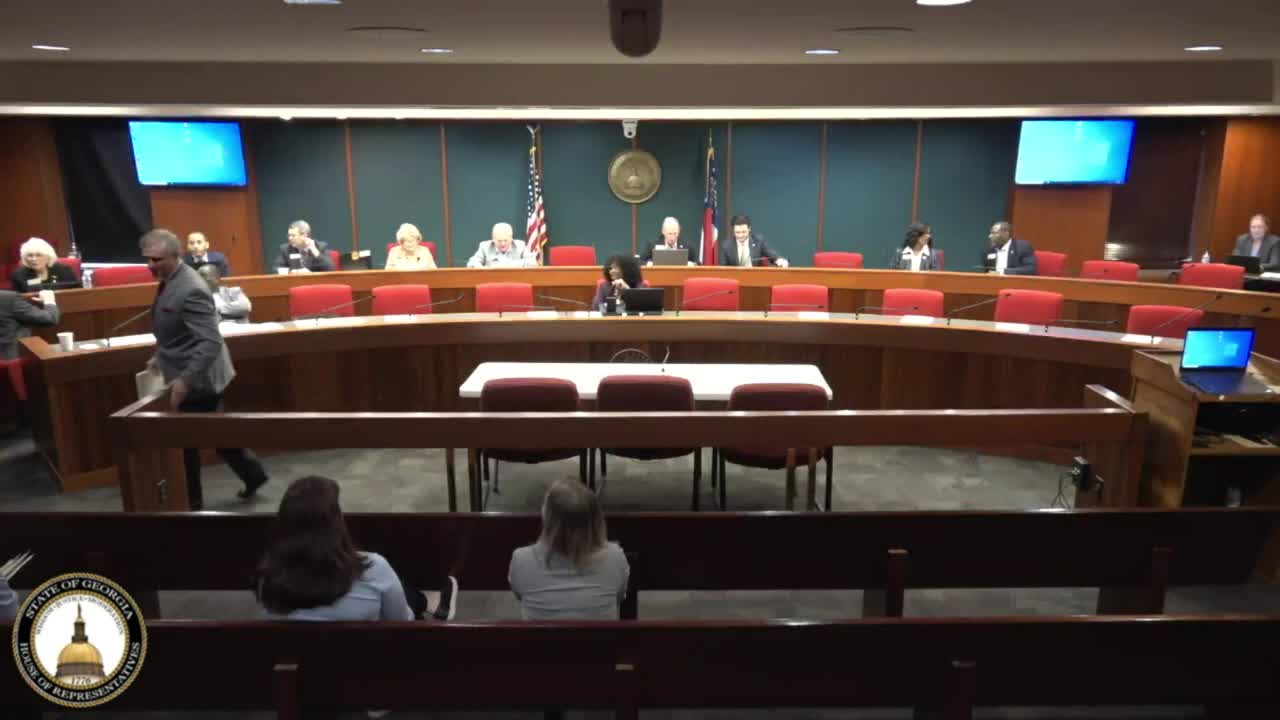
Committee advances bill to align Georgia Medicaid with federal rules on third-party payments
Summary
Senate Bill 276, presented by Sen. Echols and supported by Department of Community Health staff, was advanced by the House Insurance Committee to clarify that primary payers cannot refuse payment that should otherwise be paid before Medicaid (the payer of last resort); sponsors said the change implements provisions of the Consolidated Appropriati
The House Insurance Committee voted to advance Senate Bill 276 after the sponsor and Department of Community Health staff said the measure is needed to align state law with federal requirements in the Consolidated Appropriations Act of 2022.
Sen. Echols called SB 276 an agency bill for the Department of Community Health and said it “brings us into compliance with federal requirements, of the U.S. Consolidated Appropriations Act of 2022.” He said the change is intended to prevent third-party payers from improperly denying reimbursement when Medicaid has paid for services that another primary payer should cover.
Brandy Sylvan, identified in the hearing as director of government relations for the Department of Community Health, told the committee the bill clarifies that primary-payer sources cannot refuse to reimburse Medicaid merely because the state Medicaid program did not require a prior authorization. “If there is a primary paying payer source that is responsible for payment of services that Medicaid has already rendered, they can’t deny that reimbursement back to Medicaid because we did not require a prior authorization when they would have for that service,” Sylvan said.
Committee members asked whether the bill would impose penalties on third parties that fail to comply and how frequently the issue arises. Sylvan and the sponsor said the measure is intended to protect Medicaid program integrity and to allow the state to recover funds when appropriate; the transcript shows the department did not have a ready, specific penalty schedule to cite and offered to follow up with the committee on enforcement mechanisms.
Supporters said the change reduces the risk that federal Medicaid funding would be jeopardized by state noncompliance. Opponents were not recorded in the transcript.
A motion and second were recorded and the committee approved SB 276 by voice vote.
The transcript does not contain a roll‑call tally or a detailed enforcement penalty schedule; the department offered to provide follow‑up information to the committee on enforcement and penalty mechanisms.