Get Full Government Meeting Transcripts, Videos, & Alerts Forever!
Get email alerts on the Disability Wage 14c topic
No spam. Unsubscribe anytime.
Committee advances bill to phase out subminimum wages for workers with disabilities in Georgia
Summary
Lawmakers advanced Senate Bill 55, the "Dignity and Pay Act," which would phase out use of Fair Labor Standards Act Section 14(c) certificates in Georgia over two years, raising wages for affected workers to the federal minimum; advocates and disability‑rights groups testified in support.
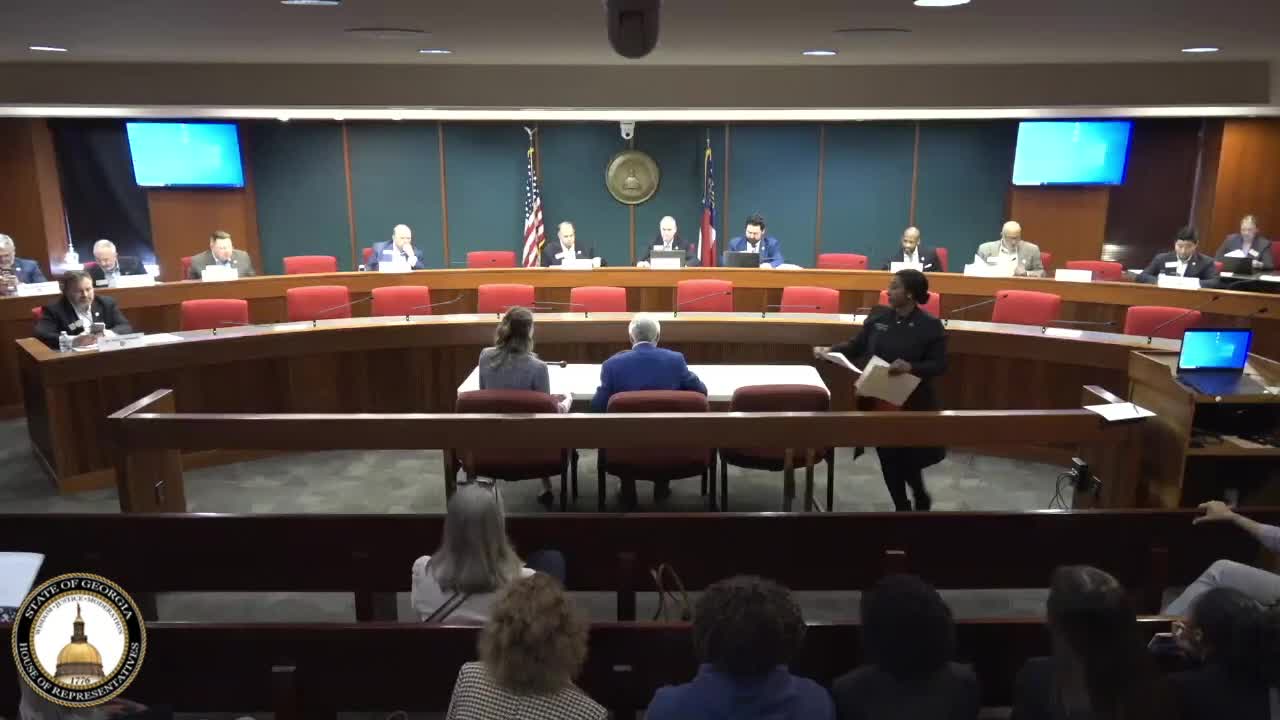
A Georgia legislative committee on Monday unanimously advanced Senate Bill 55 (LC 550416), a measure that would phase out use of Section 14(c) certificates under the Fair Labor Standards Act and require community rehabilitation programs that currently pay subminimum wages to raise those workers' pay to at least the federal minimum over a two‑year period.
"This bill is about stopping certain employers ... from paying people with physical and mental disabilities less than federal minimum wage," Senator Hickman told the committee, introducing the measure the hearing referred to as the "Dignity and Pay Act."
Testimony and documents submitted to the committee said roughly 250 Georgians working for community rehabilitation programs are still paid under 14(c) certificates, with some wages reported as low as 22¢ an hour. The sponsor said the bill would not immediately close sheltered workshops or end community rehabilitation programs; rather, it would require programs to increase wages to the federal minimum (cited in testimony as $7.25 an hour) within two years.
Advocates told the committee that federal and state transition resources exist to help programs move away from subminimum wages. Charlotte Dismore, executive director of the Georgia Council on Developmental Disabilities, and other witnesses said several organizations already are participating in pilot programs and grants intended to support transitions to competitive, integrated employment. The hearing record referenced a federal "subminimum wage to competitive integrated employment" grant that the administration of Governor Kemp applied for to assist transitions.
Leah Soller of the Georgia Council on Developmental Disabilities described personal observations from employment settings and said pay of a few cents an hour is undignified. "People at these vocational rehab facilities make as little as 22¢ an hour, which is 3% of the minimum wage," Soller told the committee. Cheryl Arnold, executive director of the Down Syndrome Association of Atlanta, described a personal case of helping an individual move from a workshop placement to community employment and said, "When we all know better, we do better."
Committee members asked whether phasing out 14(c) would cause programs to stop hiring people with disabilities. Sponsors and witnesses said other states that have eliminated subminimum wages have not seen a mass loss of jobs and that training and transition programs — including a University of Georgia program called Advancing Employment — are already assisting providers.
Several members noted Georgia's current state minimum wage figure discussed in the hearing ($5.15 an hour) and supported aligning wages to the federal level. The sponsor said the bill would bring Georgia in line with 13 other states that have phased out 14(c) certificates.
The committee recorded a motion to "do pass" on Senate Bill 55 (LC 550416); after a second and a voice vote, the motion carried.
Supporters urged the committee to advance the measure as a dignity and workforce policy that would expand access to competitive employment for people with intellectual and developmental disabilities. Opponents were not recorded in the provided transcript; one organization that had previously testified was described in testimony as resisting transition and was characterized by witnesses as an example of concern about exploitation.
The bill will move forward for further consideration.