Get Full Government Meeting Transcripts, Videos, & Alerts Forever!
Get email alerts on the Ems topic
No spam. Unsubscribe anytime.
SFFD reports ambulance offload delays, warns private BLS pilot strains resources
Summary
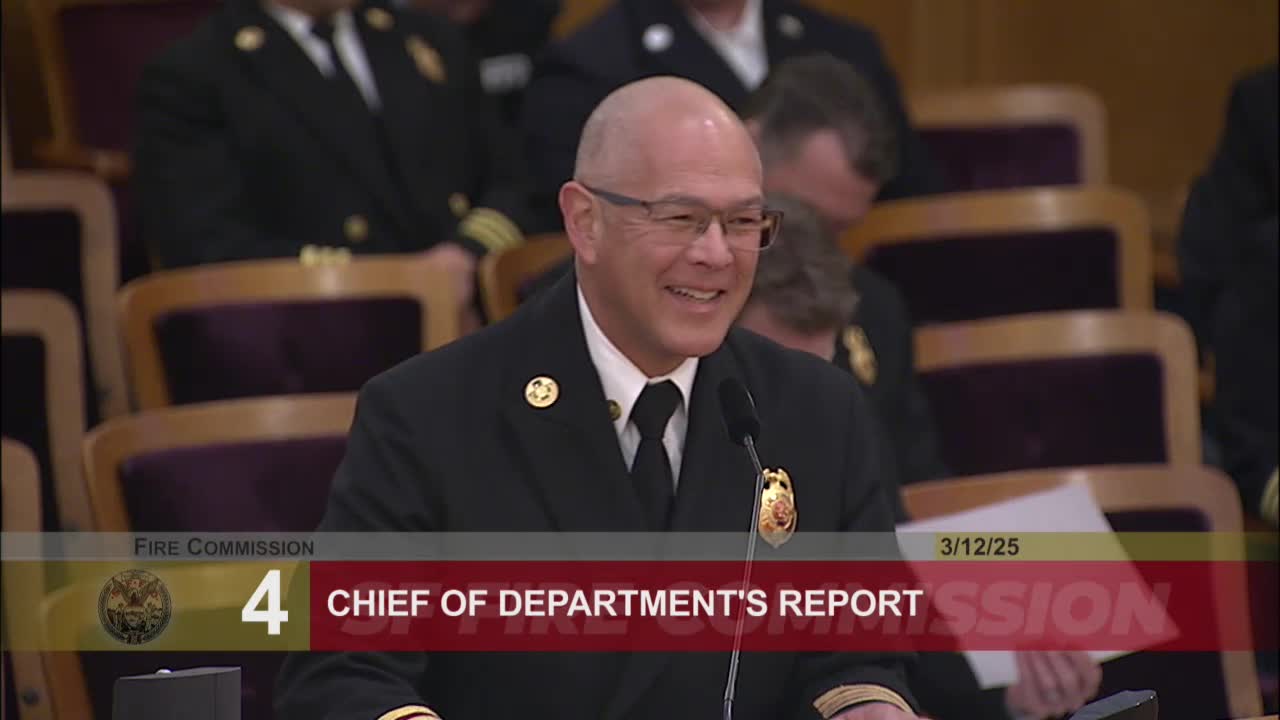
Deputy Chief Simon Pang told the San Francisco Fire Commission on March 12 that the department—s average ambulance patient offload time in February was about 50 minutes, above the state 30-minute benchmark, and that prolonged delays are reducing ALS capacity and causing "medic-to-follow" incidents.
Deputy Chief Simon Pang told the San Francisco Fire Commission on March 12 that the department’s average ambulance patient offload time in February was about 50 minutes, well above the state benchmark of 30 minutes, and that prolonged delays have reduced advanced life-support capacity in the field.
“On average our time to transfer care to the hospital was about 50 minutes,” Pang said, adding that the department saw numerous lengthy delays, including instances that exceeded two hours. He told commissioners the delays have produced more “medic-to-follow” incidents—situations where an engine or other ALS unit must accompany or follow a private ambulance because additional treatment is required—reducing the department’s surge capacity.
Why it matters: prolonged offload times (APOT) tie up San Francisco Fire Department ambulances and paramedics, reducing available ALS units for new calls and contributing to staff burnout. Pang said the problem has operational and patient-safety implications and recommended tighter data collection and direct talks with hospital leaders.
Pang said the department is holding internal town halls this week to verify the APOT data before discussing it with hospitals and that he has proposed an APOT summit with hospital leadership. “We want to make sure that our data is as accurate as possible,” he said, noting inconsistent on‑scene signature practices can make offload times appear shorter than they were.
Pang described the city’s new pilot that allows private ambulance companies to place basic life-support (BLS) ambulances into the 911 system and said the department views the pilot as a contributing factor to operational strain. “We are not fans of the pilot, the BLS ambulance pilot. We certainly don't want to become permanent policy,” he said, explaining that when a BLS crew encounters a patient who needs ALS care, a paramedic from an engine must be assigned, removing ALS capacity from engine companies.
Pang gave several clinical and system examples to illustrate the department’s workload and outcomes. He said the department achieved return of spontaneous circulation in about 46 percent of the cardiac arrests it attempted to resuscitate in February. He also described a high-profile rescue at the Caret Center at USF, where bystanders and SFFD crews revived a swimmer, and a recent ambulance delivery of twins in which responders provided neonatal support.
Commissioners pressed for details and asked how the commission and city can help. Commissioner Alan Lowe suggested billing private contractors when SFFD resources are deployed to incidents originally assigned to private ambulance providers; Pang said the department would explore reimbursement options with the finance director. Commissioners also urged that front‑line experience inform hospital discussions; Pang said attending ER nursing and triage leadership in any APOT summit would be a priority.
Data caveats: Pang said some transcripted numeric counts of delayed transports in February were internally inconsistent and that the department is verifying the raw logs; he urged commissioners to await the validated figures from the internal town halls before drawing firm conclusions.
The commission expressed support for the department’s efforts to tighten APOT measurement, pursue a hospital summit, and bring verified examples from the field to discussions with hospital leadership.
Ending: Pang said the department will return with refined APOT metrics and with specific cases to present to hospitals. Commissioners signaled willingness to assist in convening hospital partners and reviewing reimbursement or policy options.