
Committee debates abandoned utilities in rights-of-way, locating standards and hazmat billing after gas-line strike
Get AI-powered insights, summaries, and transcripts
Sign Up Free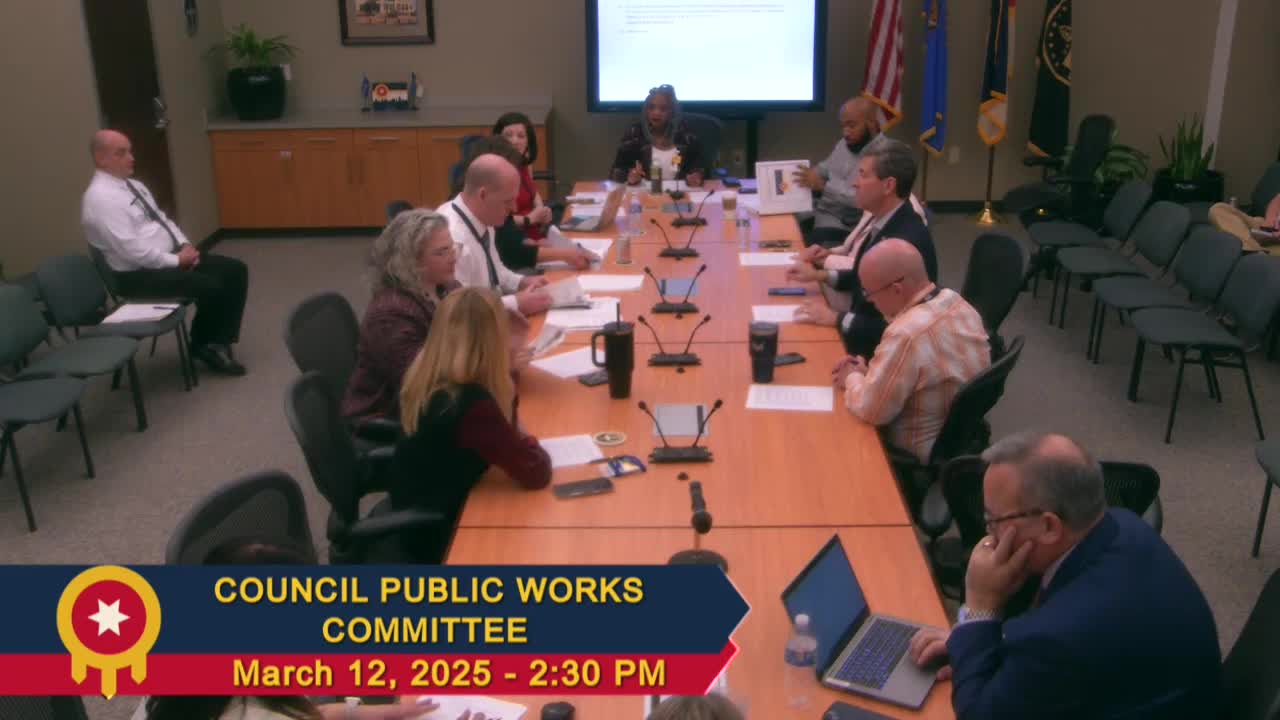
Summary
The Public Works Committee and Tulsa Fire Department discussed city practice for abandoned or unused utilities in rights-of-way, record drawings and locates, state excavation statutes requiring 'potholing' within a 24-inch tolerance zone, and a hazmat response billing dispute after a contractor struck an Oklahoma Natural Gas line.
City staff, legal advisors and the Tulsa Fire Department spent more than an hour discussing how the city handles abandoned utility facilities left in rights-of-way, how locates and record drawings are maintained, and who bears liability when excavators strike active lines.
Public Works staff said franchise agreements generally require above‑grade facilities to be removed, while underground (below‑grade) facilities often remain in place. Staff explained that utility record drawings are not available for every project and that field locators and the OKIE 811 system are the practical tools used to identify subsurface facilities. "We have a margin of error," Public Works staff said, describing the difficulty of pinpointing exact subsurface locations using atlas maps and locates.
City legal staff summarized the Oklahoma statute establishing a tolerance zone that extends 24 inches on either side of the facility’s centerline and said excavators must employ hand-dug test holes (potholing) to determine precise locations; the committee later read the statutory language aloud during the meeting. "The statute establishes a tolerance zone of 24 inches... the excavator will employ hand dug test holes to determine the precise location of the underground facilities in advance of the excavation," a legal representative said.
Committee members and staff discussed a recent incident in which a contractor (described in the record as Roto-Rooter or similar excavation contractor) struck an Oklahoma Natural Gas (ONG) line. Tulsa Fire Department hazmat personnel who investigated said the contractor had an expired locate ticket, failed to pothole in the required tolerance zone and used mechanized equipment, which ripped ONG’s 1¼-inch gas line. The hazmat captain said the contractor violated state statute in three separate ways on that call. ONG billed the excavator about $2,000 for damage and the city issued an additional mitigation/hazmat charge; the contractor disputed parts of the charge and the billing.
Tulsa Fire Department representatives explained how the department’s hazardous-materials incident fee is applied. The ordinance in the Tulsa code (Title 13, Chapter 4) establishes a response fee for hazardous-material incidents; the department’s practical billing is $1,800 per hour for hazmat-team response (or the code-specified amount), plus equipment costs. The committee sought clarity on how the emergency-billing amount is computed; the fire captain said the charge covers personnel, apparatus wear, consumables and on-scene monitoring. The department noted the city charter includes exemptions: the city will not bill ordinary consumer spills tied to normal vehicle operation or individual household use, but commercial incidents and negligent excavation that produces a hazardous-material release are billable.
Council members pressed for clearer written backup in future cases so that committee members who cannot attend the scene or prior investigation can review the full record. Staff agreed to produce more detailed memos and to contact ONG for clarification about the circumstances that led to the contractor’s violation and the timing of the locate ticket and markings.
No final policy changes were approved at the meeting, but committee members discussed potential areas for future attention, including education/outreach on calling OKIE 811 before digging, whether existing franchise agreements or the city’s right-of-occupancy ordinance should be amended, and whether the city should require additional documentation with billing to make decisions on appeals more transparent.