Get Full Government Meeting Transcripts, Videos, & Alerts Forever!
Get email alerts on the Home Energy Disclosure topic
No spam. Unsubscribe anytime.
Council hears regional proposal to require home energy scores at listing; city staff outline costs and timeline
Summary
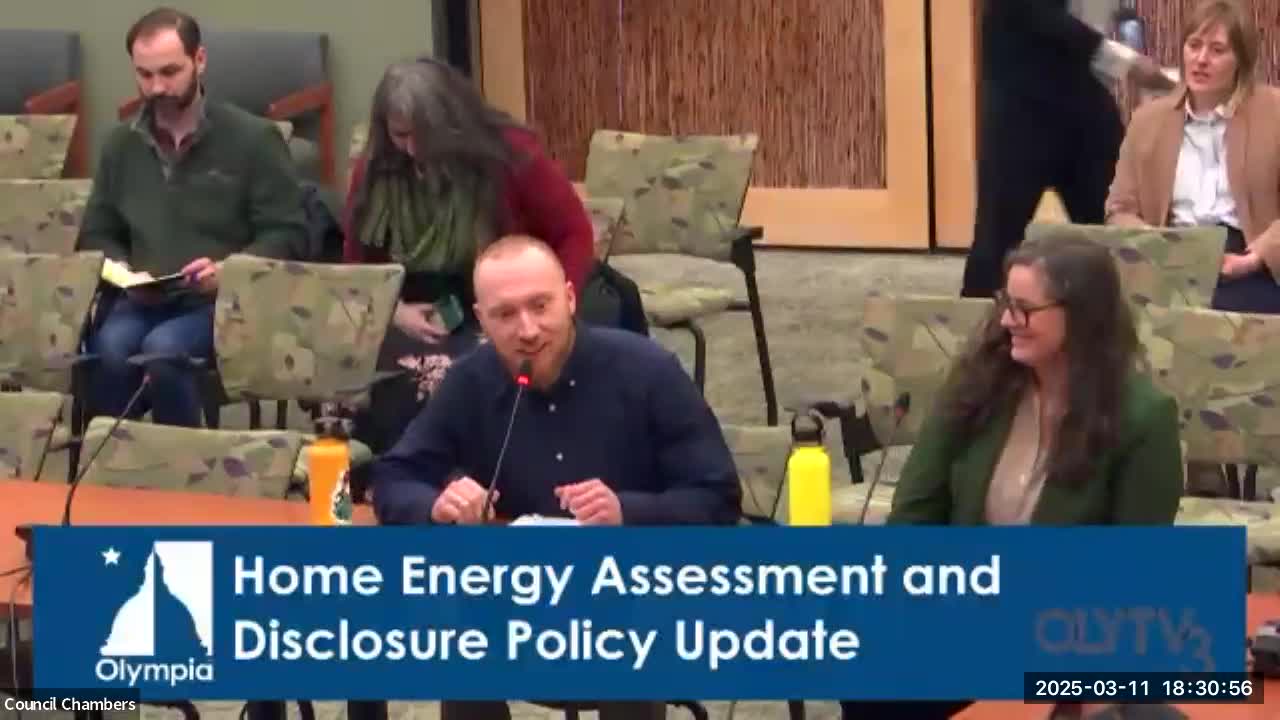
Jaren Burke, the City of Olympia climate program specialist, and Pamela Braff, director of climate programs, briefed the council on a regional model ordinance and program to require home energy assessment and disclosure using the U.S. Department of Energy Home Energy Score.
Jaren Burke, the City of Olympia climate program specialist, and Pamela Braff, director of climate programs, briefed the council on a regional model ordinance and program to require home energy assessment and disclosure using the U.S. Department of Energy Home Energy Score.
Burke said the proposed regional policy would require sellers to obtain a Home Energy Score report and include the score in all listings for a dwelling unit at the time the home is listed for sale. The report is based on asset-based characteristics (building shell, major equipment, number of stories and other features) and does not measure occupant behavior. The Home Energy Score produces a 1-to-10 rating, shows estimated bill savings from recommended improvements, and is typically produced by a trained assessor in about an hour at an estimated cost of $150–$300.
The policy draft shared with council applies to single-family detached homes, duplexes, triplexes and similar small-multifamily types that the Home Energy Score model can assess; stacked multifamily buildings and manufactured homes currently fall outside the model's scope, staff said. Exemptions in the draft include buildings on federal or tribal land and transfers that are not true sales (for example, transfers between spouses); staff said they will clarify other jurisdictional exemptions (state or county-owned buildings) in the ordinance language.
Burke outlined a proposed regional approach to implement the requirement: partner jurisdictions would execute an interlocal agreement to share one-time launch costs and contract with a national service provider (the draft identified Earth Advantage as a candidate) to build the data platform, connect the requirement with the Northwest Multiple Listing Service (Northwest MLS) and the green building registry, and provide assessor training and quality assurance. The estimated regional launch cost was $81,000; with equal cost sharing among the adopting jurisdictions Olympia's share would be $20,250 (which Burke said is included in the city's 2025 budget). If Olympia adopted the program alone, the full one-time cost would fall to the city, staff said.
Staff proposed a May 1, 2026 effective date to allow time to develop the supporting program, increase assessor capacity, create a public program web page, and set up a subsidized-assessment protocol. The draft also allows jurisdictions to subsidize assessments for low-income sellers or exempt low-income residents when funding is not available.
Councilmembers asked about enforcement and integration with listings platforms. Burke said adding violation language to the ordinance would support creation of a required field in Northwest MLS so sellers could not complete a listing without attaching the report; staff described enforcement effort as likely minimal if that MLS field is required. Councilmembers also asked about contingency plans if federal or DOE services were interrupted; staff said other home-rating models exist and that the Department of Energy and some vendors are developing alternative integrations and backups.
Other cost details shared with the council included a preliminary estimate of ongoing program costs. Staff estimated Olympia's ongoing share for program management and subsidies at roughly $9,000 per year under equal cost sharing; that figure could rise if fewer jurisdictions participate. Councilmembers raised questions about assessor fees, quality assurance charges, and the practical cost to homeowners; staff said contractors' market rates should be vetted locally during program development.
Staff framed the policy as a regional initiative aligned with the Thurston Climate Mitigation Plan; Burke said residential energy is a significant source of community emissions and that better information about existing housing stock is a barrier to addressing building emissions. The regional team will return with ordinance language and details for council consideration; staff emphasized the proposed timeline to allow time for the interlocal agreement, vendor selection, platform setup and community outreach.