Get Full Government Meeting Transcripts, Videos, & Alerts Forever!
Get email alerts on the Transportation Commute Trip Reduction topic
No spam. Unsubscribe anytime.
City, TRPC brief Olympia council on updates to Commute Trip Reduction plan
Summary
City staff and the Thurston Regional Planning Council reviewed an updated Commute Trip Reduction plan, highlighting changes in work patterns since the pandemic, coordination with regional transit providers, and outreach to employers; the council will consider the plan for approval April 8.
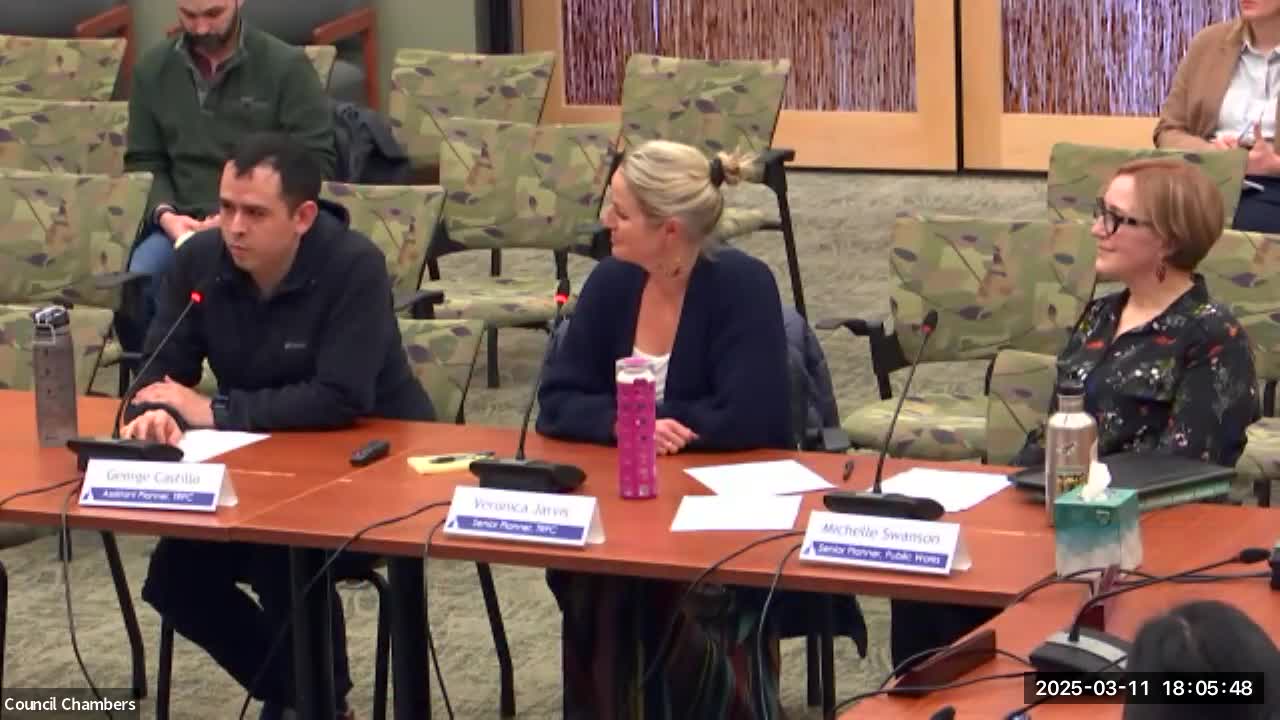
Michelle Swanson, the City of Olympia senior planner for Public Works and Transportation, and staff from the Thurston Regional Planning Council briefed the Olympia City Council on updates to the region's Commute Trip Reduction (CTR) plan at the March 11 study session.
The briefing outlined the purpose of the CTR effort — enacted statewide in 1991 to reduce peak congestion and related emissions — and explained that Olympia plays two roles: as a jurisdiction that oversees employer compliance and as a large downtown employer implementing commute-reduction policies internally.
Swanson said Olympia has long used tools that reduce single-occupancy vehicle travel, noting past decisions such as building City Hall with limited employee parking and expanding metered parking downtown. "Owning a vehicle is costly and not everyone is able to drive, so it makes Olympia more equitable when it's easier to get around without a vehicle," Swanson said.
Veronica Jarvis and George Castillo of the Thurston Regional Planning Council (TRPC) described the regional CTR program, which requires larger worksites and state agencies in Thurston County to prepare plans to encourage carpooling, transit, biking, walking and telework. TRPC staff emphasized that the CTR program is different in Thurston County because it includes many small state agency worksites that would not be covered in other regions.
TRPC presented summary survey results for Olympia worksites showing a substantial shift toward telework: presenters cited a result of 58% of respondents working from home, 35% driving alone, and 7% using other modes (biking, walking, carpool, transit)—although they cautioned that a change in survey methods limits direct comparisons with pre-pandemic data. TRPC and city staff said the survey includes follow-up questions identifying mode-specific barriers, such as safety, work shifts that don't align with transit schedules, and darkness on winter commutes.
Councilmembers asked about how the CTR update connects to other city planning efforts and to regional transit service. Jarvis and Castillo said coordination with local transit — including Inner City Transit and neighboring providers — and integration with Olympia's transportation and comprehensive plans are central to the update. They highlighted regional projects such as transit signal prioritization on Martin Way and federal funding for multimodal improvements on Fones Road as examples of alignment.
Councilmembers also discussed specific corridors, including Capitol Way, and city staff said designs are underway to add bike lanes on segments between Union and the southern city limits as part of a paving and reconfiguration project.
TRPC told the council the updated local CTR plans will be presented to the council for approval on April 8; after local adoption they expected the TRPC board to act on the regional package. Councilmembers generally acknowledged the presentation and asked staff to continue coordination between the CTR update, the transportation master plan, and transit agencies.