Get Full Government Meeting Transcripts, Videos, & Alerts Forever!
Get email alerts on the Fire Department Promotion Seniority topic
No spam. Unsubscribe anytime.
FPC committee reviews plan to add seniority preference for heavy equipment operators in fire promotions
Summary
Milwaukee Fire Department staff told the Fire & Police Commission Testing and Recruitment Committee they will propose adding seniority/preference points for heavy equipment operator (HEO) experience on lieutenant and captain promotional exams and will ask the commission to review the scoring structure before finalizing numbers.
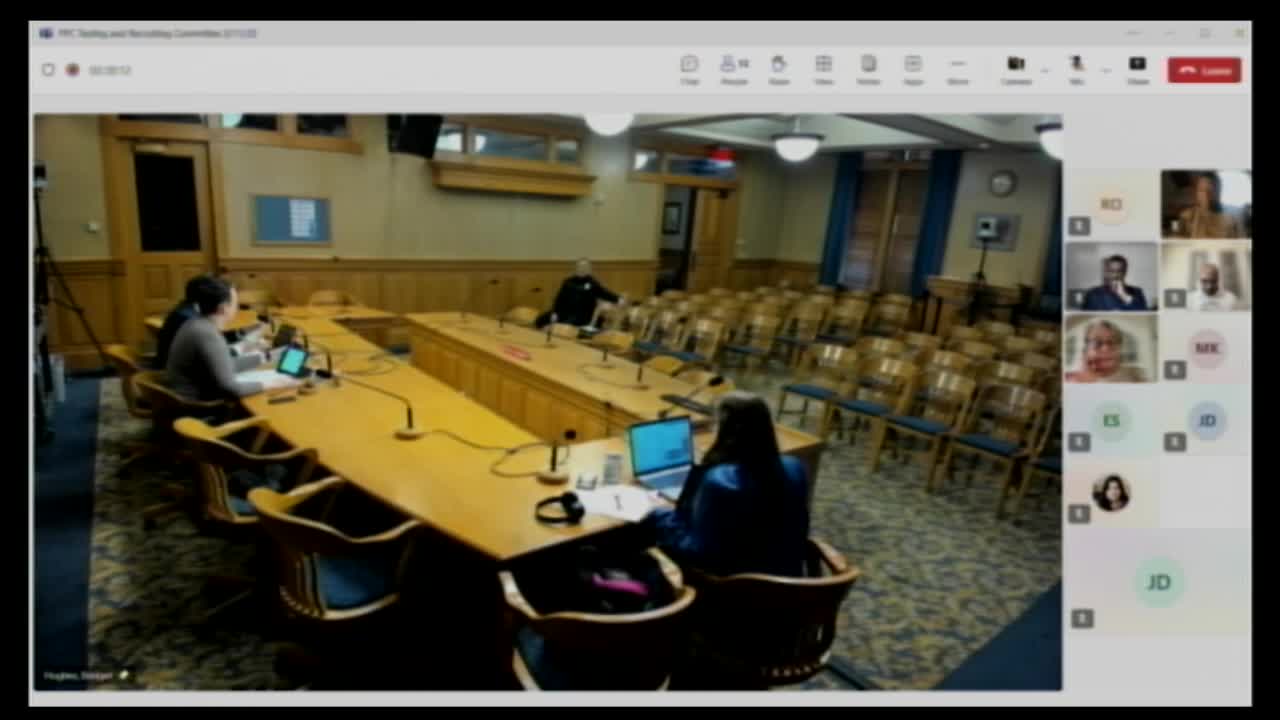
The Fire and Police Commission (FPC) Testing and Recruitment Committee on March 11 heard a Milwaukee Fire Department proposal to award additional seniority or preference points for experience as a heavy equipment operator (HEO) on later promotional exams for fire lieutenant and captain.
The proposal, presented by Assistant Chief Josh Parrish and FPC Executive Director Leon Todd, is intended to encourage department members to serve as HEOs by recognizing that that experience can make candidates more competitive on subsequent promotional lists. "Seniority is actually a percentage of your total score," Assistant Chief Josh Parrish said, describing the existing scoring structure and why staff want the commission to review the math before assigning additional points.
The change is part of a broader effort to address staffing shortages at the HEO rank. "We have 18 vacancies out of 139 total authorized positions," Director Leon Todd said as background on why the department is seeking incentives. Department staff said they have run multiple recruitments without producing the number of internal candidates they want for the HEO rank.
Committee members and staff discussed technical details of how seniority and preference points are applied. Parrish and staffing services manager Molly Keither Steele explained the difference between the department's current seniority component — which operates as a percentage of an applicant's total score — and additive preference points used in other contexts. "There's a difference between seniority points as they're done now and true preference points, which are always additive," Parrish said, noting the committee should avoid choosing arbitrary point values without analysis.
Staff described how HEO experience can influence longer-term career progression and how adding points at later ranks (for example, captain) could create an upstream incentive: "If we put points at the captain's level, does that become a strong enough attractor for people to do the thing two steps before because it will make them a more competitive candidate at this later point in their career?" Parrish said.
The draft job announcement also contains an administrative change to the continuous-service requirement for promotional eligibility. Staff clarified the bulletin would require four years "immediately preceding the date of the written exam," language added to respond to a prior lawsuit that had turned on breaks in continuous service. The committee was told the draft also would treat unpaid absences totaling more than 30 days for non‑disciplinary medical or disability reasons as continuous service for eligibility so long as the applicant has the required years of actual service.
Committee members asked for more analytical modeling before any point values are adopted. "Just adding numbers arbitrarily is always a bad idea," Parrish said. Staff said they will perform an analysis with the commission to determine how proposed point values would shift eligible lists and to propose an appropriate cap and structure before bringing a final change to the full commission.
No formal change or vote on the HEO preference-point proposal occurred at the committee meeting; staff said the item is being developed for later presentation to the full FPC.