Get Full Government Meeting Transcripts, Videos, & Alerts Forever!
Get email alerts on the Comprehensive Plan Update topic
No spam. Unsubscribe anytime.
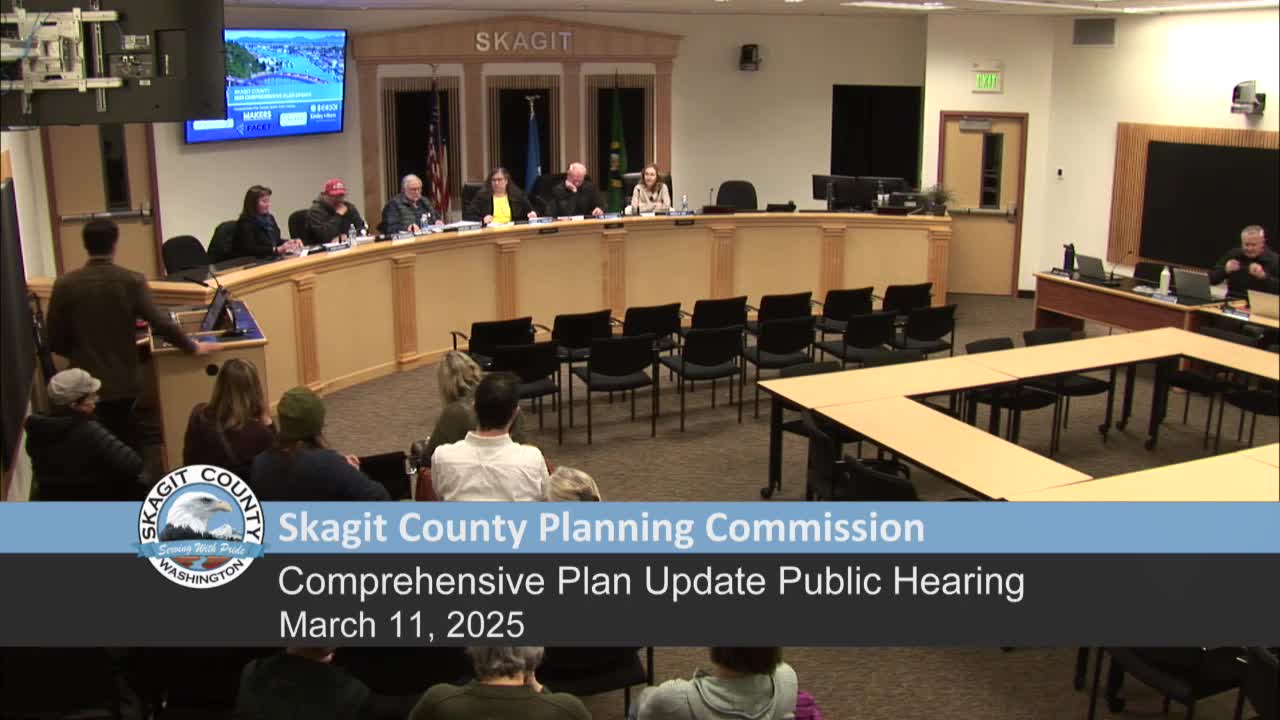
Skagit County planning commission hears wide-ranging public concerns on 2025 comprehensive plan update
Summary
At a March 11 public hearing, residents, tribes and industry groups urged stronger environmental protections, clearer agricultural safeguards and steps to boost housing and active-transportation options. Commissioners set deliberations for April 8; the formal update remains under review.
The Skagit County Planning Commission on March 11 heard more than a dozen public commentators on the county’s 2025 periodic comprehensive plan update, with speakers urging stronger environmental protections, clearer agricultural safeguards, and actions to expand housing options and active-transportation safety.
Staff opened the public hearing with an overview of the process and timeline. Robbie Eckroth, a planner with Skagit County Planning and Development Services, summarized the Growth Management Act requirement for a decennial comprehensive plan update and told the commission that the county’s public comment period opened Feb. 13 and closes March 13 at 4:30 p.m.
The hearing featured sustained comment from tribal representatives and conservation groups who said the draft plan lacks enforceable environmental safeguards and updated scientific data. Heather Spore, environmental policy manager for the Swinomish Indian Tribal Community, said the draft is deficient on climate and shoreline protections and urged stronger, mandatory language: "Without scientific facts about sea level rise or future climate change projections nor meaningful discussion of climate impacts facing this gadget, the draft plan does not meet the express intent and purpose of RCW 36.70A.070, WAC 365-195, or the legal obligations established in House Bill 1181," Spore said. She requested removal or revision of an appendix section she described as providing a "grossly inaccurate portrayal of tribal presence and stewardship" and said the tribe will submit written comments.
Agricultural stakeholders likewise urged restoring firmer, prescriptive language in resource sections. Michaela Staples Hughes, an agricultural industry executive and board member of the Western Washington Agricultural Association, said the draft replaces "shall" with passive language in multiple natural-resource policies and that change weakens enforceability. "These small grammatical changes have major policy implications," she told commissioners, and she urged the planning commission to restore the stronger language and to review those edits closely.
Conservation and land‑trust speakers supported stronger climate and shoreline policies and asked the county to use the best available science. Molly Doran, executive director of Skagit Land Trust, praised staff outreach but pressed for tightened policies on sea-level rise, floodplain management and soft-shore stabilization. "The impacts of climate change are already here, and the cost of inaction is far too high," Doran said.
Public commenters also raised distinct concerns about housing and transportation. Jessica Winn, a Mount Vernon mortgage lender, urged the commission to emphasize infill development, smaller lots and responsible reuse of nonconforming properties as cost-effective options to expand affordable housing without sprawl. Ann Winx, a longtime county resident and cyclist, recommended making active-transportation improvements — including prioritizing the North Fork Bridge safety project and turning some maintenance policies into actionable items — so that bicycling and walking become safer countywide.
Industry and resource commenters urged stronger recognition of extractive and open-space programs. Anne Parker, who identified a family quarry business in eastern Skagit County, asked for clearer protection for mineral resource overlays to safeguard aggregate operations that supply regional infrastructure. Randy Good, speaking for Friends of Skagit County, asked the county to clarify that the 2009 Open Space Concept Plan is nonregulatory and to explicitly reference the Farmland Legacy program and the Conservation Futures Advisory Committee in the draft.
Multiple speakers recommended the county create an environmental advisory board to help implement and monitor plan policies. Martha Bray and representatives of Evergreen Islands both said an advisory body with ecological expertise would complement existing boards focused on agriculture, forestry and parks.
Throughout the hearing, staff reiterated that the comprehensive plan’s policies will inform later updates to development regulations, including the critical areas ordinance and the shoreline master program, which are separate and may be updated later. Eckroth said staff will compile written comments received during the public comment period and provide responses for the Planning Commission in advance of deliberations.
Procedural items and next steps: the commission approved the minutes of its Feb. 25 meeting by motion and voice vote earlier in the session. Planning staff said the March 12 meeting will be canceled because the commission received the testimony present on March 11; the Planning Commission’s formal deliberations on the comprehensive plan are scheduled for April 8, with April 15 reserved if needed. Following commission deliberations and recommendation, a revised draft will be sent to the Board of County Commissioners for additional public hearing and consideration.
No formal changes to the comprehensive plan were adopted at the March 11 hearing; the session was limited to receiving public testimony and clarifying next steps.