Get Full Government Meeting Transcripts, Videos, & Alerts Forever!
Get email alerts on the Airport Concessions topic
No spam. Unsubscribe anytime.
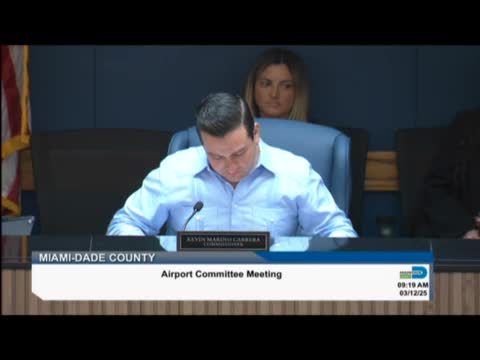
Airport committee advances 15-year concession agreement at Miami International Airport with $215M minimum investment
Summary
The Miami‑Dade County Airport Committee voted March 12 to advance item 2C, a proposed concessionaire agreement for Miami International Airport that would set a 12‑year base term with a three‑year construction window and require a minimum $215,000,000 in tenant investment.
The Miami‑Dade County Airport Committee voted March 12 to advance item 2C, a proposed concessionaire agreement for Miami International Airport that would set a 12‑year base term with a three‑year construction period and require a minimum $215,000,000 investment by the concessionaire consortium.
The item would allow concessionaires to convert the term to 15 years if they commit an additional 30% investment at the start of the extension; county staff estimated the package would produce roughly $332,000,000 in total investment and about $1,100,000,000 in revenue to the airport over the 12‑year base term. "That term consists of a 12 year base term, which includes a 3 year construction period within that 12 years. The minimum investment amount by the concessionaire is just $215,000,000," Director Couthiere said in presenting the proposal.
Why it matters: committee members said the plan would accelerate upgrades to passenger areas and concessions while raising guaranteed investment levels compared with some existing contracts. Commissioner Cohen Higgins, who moved the item, said the agreement also includes a living‑wage commitment for concession employees: "These concessionaires are agreeing to continue paying living wage for the next 15 years." Supporters described the package as a way to modernize spaces quickly and preserve local food‑and‑retail flavor at MIA; critics said the length of extension and bid‑waiver path risk entrenching longtime vendors and urged stronger terms for inclusion and direct leases.
Key provisions and numbers
- Term and investments: a 12‑year base term with an embedded three‑year construction period; a minimum $215,000,000 initial investment; a midterm required investment of $52,000,000; and an additional roughly $65,000,000 (about 30%) if the 3‑year option is exercised, producing a combined investment estimate of approximately $332,000,000.
- Revenue and annual impact: staff said the airport's existing concessions program generates about $91,000,000 annually and that the new agreement would push annual receipts to more than $100,000,000; staff estimated roughly $1.1 billion in revenue to the airport over the 12‑year base term.
- Rent and fees: the agreement levels rent across spaces, setting an 8% floor and requiring incremental increases to an industry average of about 13–14% after the construction period. It also imposes a 0.5% customer experience fee, an infrastructure maintenance fee, and a marketing fee that would fund advertising and a secret‑shopper program.
- Space and investment split: the concessionaires agreed that roughly two‑thirds of investment will go to brick‑and‑mortar improvements and about 35% to equipment. The current food‑and‑beverage/retail mix at MIA was described as about 46% food and beverage and 54% retail; the agreement calls for shifting that toward an industry target of about 65% food and beverage and 35% retail.
- Per‑space minimums and enforcement: the agreement sets minimum build‑out costs (for example, staff said $1,000 per square foot for food and beverage for the first 1,500 square feet and a minimum of $850 per square foot for retail). Staff also described enforcement tools: liquidated damages provisions and the ability to reclaim a space if a tenant has not completed required build‑out "within a hundred and 20 days" after a specified date; Director Couthiere said the county can take the space back on day 121 for contractor delays not caused by the government or force majeure.
Committee discussion: equity, competition and speed
Committee members broadly agreed the airport needs upgrades but differed on process and equity. Commissioner Hardeman warned against long extensions without stronger inclusion terms: "When we select people to have these benefits without competition or to extend benefits without competition, we are in fact choosing winners and losers," he said, urging more direct leases, joint‑venture equity increases and clearer data on square footage that would convert from retail to food and beverage.
Supporters said the length of term was driven by the scale of the required capital and the need to amortize improvements. Commissioner Gonzales used a lease analogy to argue that major build‑outs require long‑term certainty: "I'm not gonna go into a new building and redo the entire office ... if I got a 2 year lease," he said. Chairman Cabrera and other members stressed the agreement includes stronger penalties and faster timelines than past extensions and noted that pursuing a full competitive procurement now could take years and delay improvements.
Process notes and next steps
Committee members asked staff for supplemental data before the full board vote: staff agreed to provide the current percentage of minority partnerships among concessions and square footage details for spaces identified for reconcepting. The committee also referenced a separate item (2D) directing the administration to put Terminal K and Central Terminal out to bid to create additional competition; staff confirmed those procurement steps will run in tandem with the concessionaire agreement.
Committee action
Commissioner Cohen Higgins moved the item. The committee approved the motion by voice vote; no roll‑call tally was recorded on the committee floor. The item will return to the full Miami‑Dade County Commission for final consideration.
Ending
Committee members said they will continue negotiating specific equity and inclusion measures with concessionaires before the item reaches the full commission. Staff and members agreed on expedited follow‑up reporting on minority participation rates, the exact square footage to be reconcepted and the timeline for required build‑outs so the board can review detailed terms prior to final action.