Get Full Government Meeting Transcripts, Videos, & Alerts Forever!
Get email alerts on the Acf Forklift Staffing topic
No spam. Unsubscribe anytime.
CARB seeks permanent regulatory staff for Advanced Clean Fleets and zero-emission forklift rules; committee questions timing and waiver uncertainties
Summary
CARB requested conversion of multiple limited-term positions to permanent status to implement the Advanced Clean Fleets (ACF) and airport shuttle rules and the zero-emission forklift rule. The agency said the work is long-term, linked to state implementation plan (SIP) commitments and federal waiver uncertainty complicates enforcement.
CARB asked the Assembly committee to convert limited-term positions to permanent staffing to implement the Advanced Clean Fleets (ACF), airport shuttle and zero-emission forklift rules.
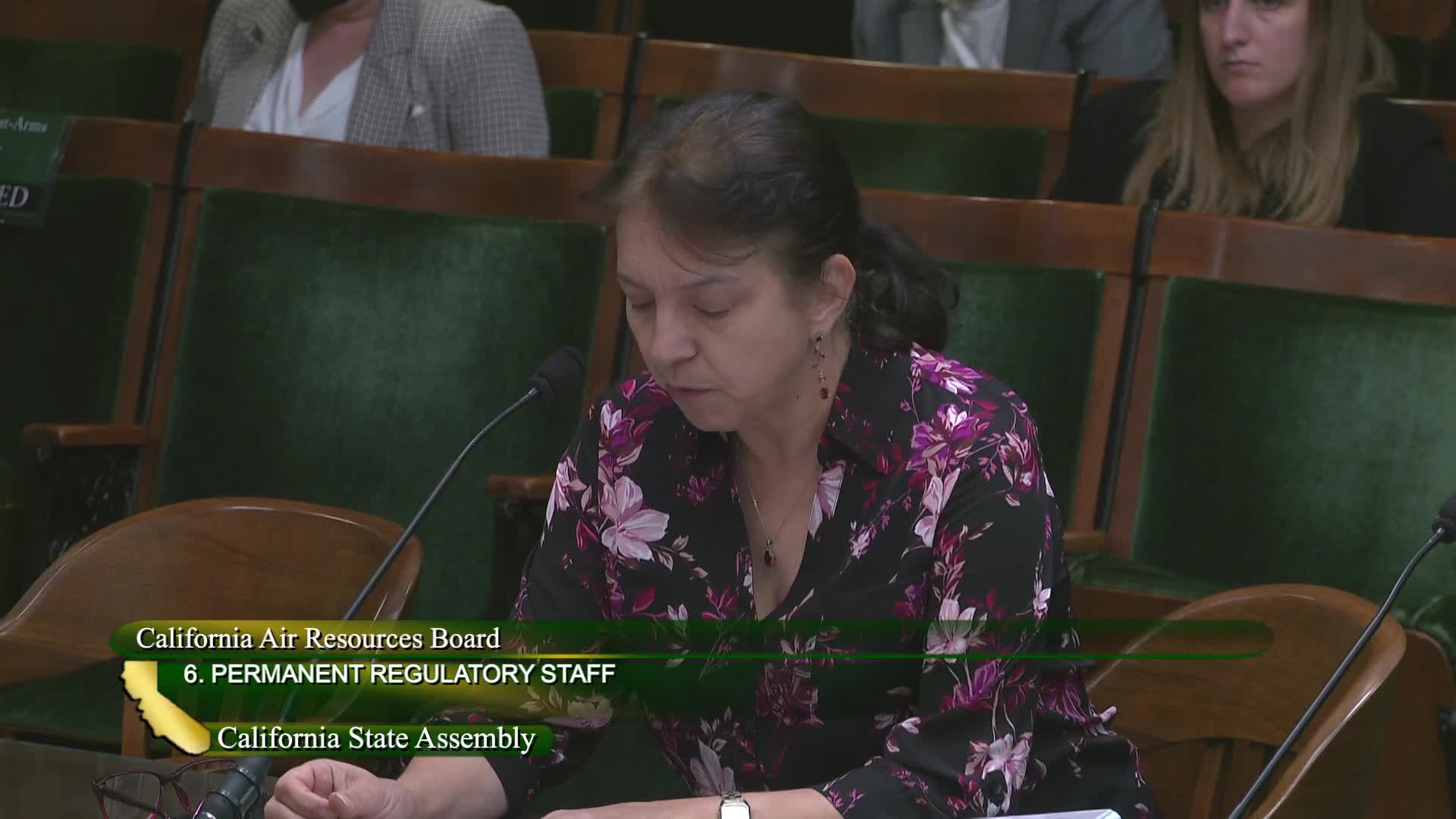
Kim Horoi Rogalski, branch chief in CARB's Mobile Source Control Division, described the ACF and airport shuttle rules as provisions that require certain fleets to purchase increasing percentages of zero-emission trucks and said those rules are a key part of California's federal ozone state implementation plan. CARB requested $5.8 million and 32.5 permanent positions to implement the ACF/airport shuttle elements and $3.5 million and 17 permanent positions for the forklift rule. CARB said the ACF waiver request to EPA was withdrawn but that other elements (airport shuttle and state/local government elements) do not require a waiver; CARB described the forklift rule as a multi-decade phaseout with compliance milestones through the 2030s.
CARB said positions are needed for reporting and compliance assistance, outreach and processing exemption or extension applications; the agency argued the work is long-term and said limited-term hires would expire and risk loss of expertise acquired through recent recruitment. CARB also said it would not immediately enforce private-entity provisions for the forklift rule until federal waivers and the program framework are resolved, but it would encourage voluntary compliance and complete preparatory implementation steps (fact sheets, online reporting) that can be used if and when enforcement authority is available.
The Legislative Analyst's Office and several assemblymembers asked whether the requested staffing is appropriate given waiver uncertainty and the state's broader vacancy reductions and budget pressures. LAO recommended careful consideration and asked CARB to explain why permanent positions, rather than a phased approach or alternative allocations, are the most cost-effective way to secure the long-term work.
The committee asked CARB to supply additional documentation on workload, existing limited-term positions, and what the agency would accomplish with permanent staffing versus limited-term authority before making a final funding decision.