Get Full Government Meeting Transcripts, Videos, & Alerts Forever!
Get email alerts on the Worker Safety Debris Removal topic
No spam. Unsubscribe anytime.
Army Corps and Cal/OSHA say worker safety is top priority as massive LA debris removal continues
Summary
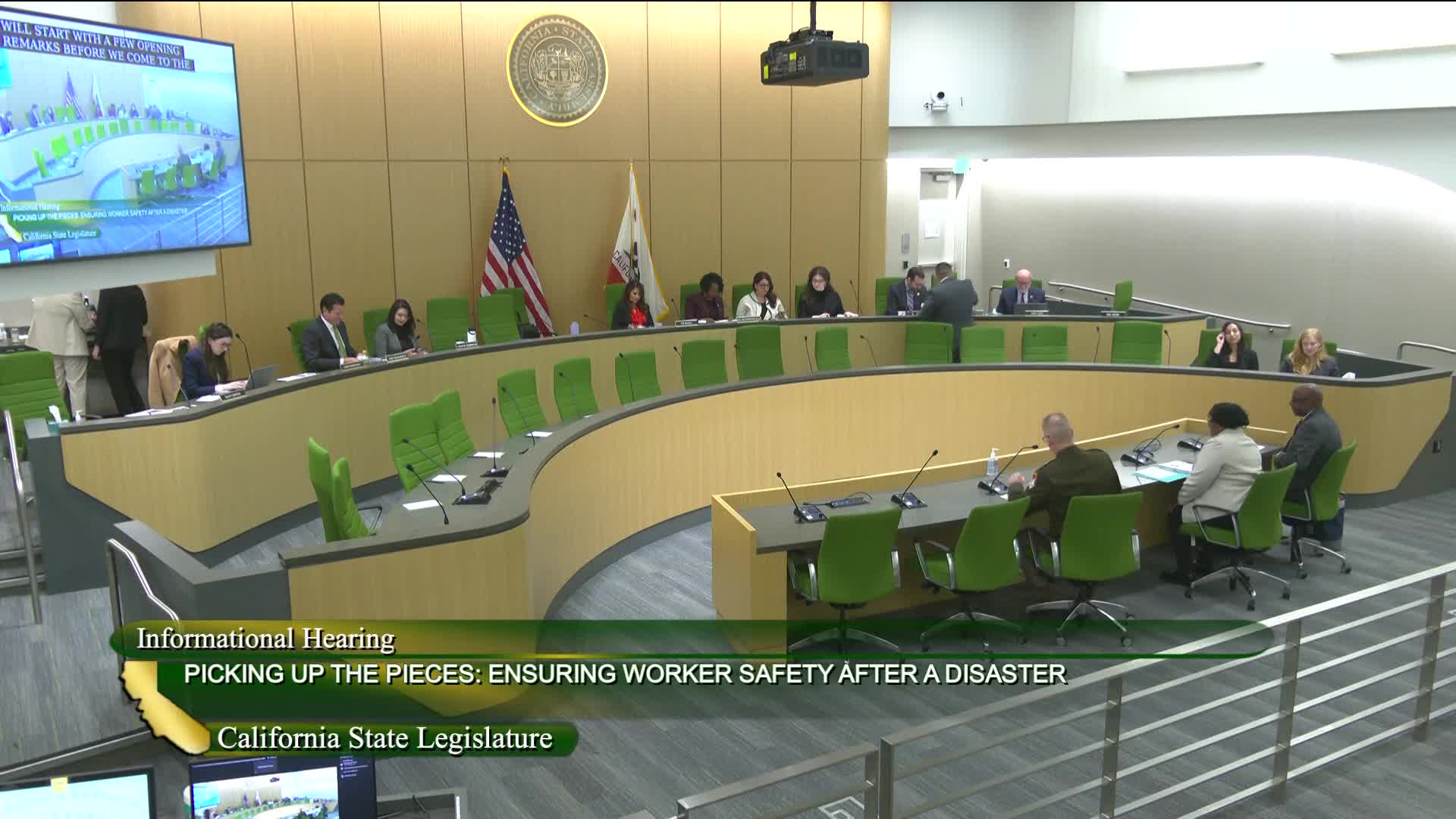
Federal and state agencies described safety protocols as the Army Corps ramps up residential debris removal in the wake of Los Angeles wildfires, while Cal/OSHA said it is conducting on‑the‑ground outreach and investigating complaints from workers and residents.
Colonel Jim Hondura, commander of the U.S. Army Corps of Engineers South Pacific Division, said the Corps has prioritized worker safety as it leads phase 2 residential debris removal after the Los Angeles wildfires and has set up field offices and crews across the region. The Corps has received thousands of signed rights of entry from homeowners and estimates millions of tons of debris must be removed.
The Corps began phase 2 work on Feb. 11 and, as of the hearing, had received 3,771 rights of entry for private property debris removal; 3,573 of those parcels were assigned to contractors and 242 parcels had been completed and signed off, Hondura said. He described on‑site controls including sorting, dust suppression and personal protective equipment, and said the Corps is embedding safety professionals with contractors and coordinating with state agencies.
The scale of the task is large: Hondura estimated roughly 4.25 million to 4.5 million tons of debris must be removed. "Nothing will ever be more important than the safety and well‑being of the workers conducting these vital missions," said Colonel Jim Hondura, South Pacific Division commander.
Deborah Lee, Chief of the Division of Occupational Safety and Health (Cal/OSHA), told the committees the agency has deployed staff to the field, distributed multilingual outreach materials and is conducting both compliance assistance and enforcement. "Workers performing wildfire cleanup may potentially be exposed to hazards such as slips and trip hazards, heat illness related exposures and respiratory hazards," Lee said, adding that employers must provide proper personal protective equipment and appropriate training.
Cal/OSHA said it has dedicated 34 staff to the response and typically has 12 field inspectors on site on any given day in impacted zones. The agency reported it received 66 complaints related to the fires and workplace conditions in January and February and that it is conducting investigations; it is also operating a bilingual call center.
Hassan Adan, Regional Manager for Cal/OSHA Region 4, described early coordination with Cal Fire and local partners and said the agency is working with community‑based organizations to reach workers who may be reluctant to contact government. "We did inform them that we're here to support. If they need any technical assistance dealing with safety and health, we're here to help, not just enforcement," Adan said.
Panelists and lawmakers pressed for clarity about who is working on sites and how contractors are vetted. The Corps identified a prime emergency‑response contractor under the Advanced Contracting Initiative and said the prime must award a percentage of subcontracts to small and disadvantaged businesses and is required to submit a site safety and health plan that covers prime and subcontractor work. The Corps said it will provide a list of subcontractors working under that prime to legislators.
Lawmakers and union representatives also raised questions about PPE distribution early in the response and the need for consistent HAZWOPER (Hazardous Waste Operations and Emergency Response) and other safety training for workers handling ash, demolition and other hazardous materials. Derek Erwin, an LA County firefighter and cancer researcher, urged continued investment in occupational health monitoring, noting that firefighting exposures are linked to elevated cancer risk: "The International Agency for Research on Cancer actually classifies firefighting as a group 1 carcinogen," Erwin said, calling for expanded state research funding.
The Corps and Cal/OSHA said they perform on‑site air monitoring and dust suppression during operations and transport debris to permitted facilities; the Corps said ash and asbestos are directed to landfills permitted for those materials and that metal and concrete are sent for recycling. Officials agreed to provide lawmakers additional detail on disposal sites, monitoring during transport and the full list of contractor subcontractors identified under Corps contracts.
The Corps reminded homeowners that participation in the federally funded debris removal program requires submitting a right of entry and that the county deadline for enrollment was March 31. The agencies said phase 2 work is expected to run roughly a year but will proceed parcel by parcel as rights of entry are processed.
As work continues, legislators emphasized enforcement resources and ongoing community outreach, and asked for regular reporting from the Corps and Cal/OSHA on contractor lists, training verification and complaint outcomes.
The joint committees said they would follow up with the Corps and Cal/OSHA for more detailed documentation on subcontractors, monitoring protocols and enforcement actions.