Get Full Government Meeting Transcripts, Videos, & Alerts Forever!
Get email alerts on the Zev Incentives Infrastructure topic
No spam. Unsubscribe anytime.
Lawmakers, stakeholders press for continued funding of ZEV incentives, HVIP and charging programs
Summary
Committee reviewed the governor's ZEV package, including funding for community-based transportation projects, drayage trucks, emerging opportunities and vessel investments. Members and many stakeholders urged continued or increased funding for incentives such as HVIP, Clean Cars for All, school and transit bus programs, and support for e-bike and
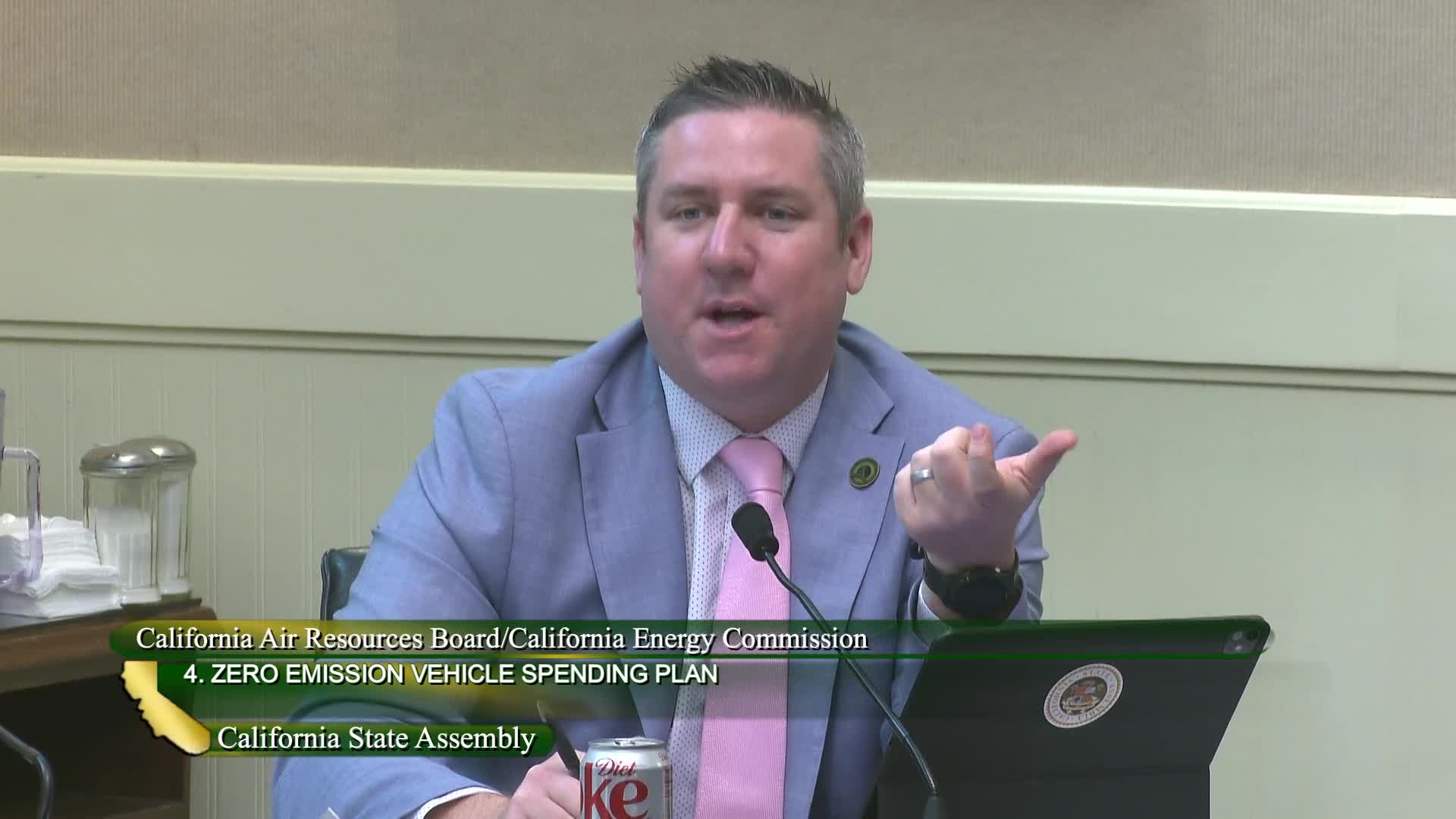
The Assembly Budget Subcommittee No. 4 reviewed the governor's proposed zero-emission vehicle (ZEV) budget package and heard requests from a wide range of stakeholders asking that incentive and infrastructure funding be maintained or increased.
Michelle Buffington, interim division chief for CARB's Fiscal Services Division, summarized the administration's ZEV proposals and said that funds appropriated to CARB in prior years are largely encumbered and are being developed into projects. For FY2025, CARB proposed $250 million for CARB programs, including $100 million for sustainable community-based transportation equity projects and $48 million for zero-emission drayage trucks. CARB estimated that the $100 million allocation could support roughly 1,300 zero-emission vehicles and equipment deployments and that the $48 million for drayage could support roughly 2,800 zero-emission drayage trucks.
Committee members and many public commenters urged restoration or augmentation of incentive programs. Multiple speakers urged funding for the Hybrid and Zero-Emission Truck and Bus Voucher Incentive Project (HVIP), warning that leaving the program with little or no funding next year would stall adoption of zero-emission medium- and heavy-duty trucks. Local air districts, community groups and transit agencies urged support to avoid program gaps for Clean Cars for All, electric school buses, transit bus transition funding and community-based mobility projects.
CARB staff provided program-level updates: the agency reported that about 96% of funds appropriated to CARB in the prior four years of the ZEV package have been encumbered; CARB also reported lessons learned from an e-bike pilot and the need to improve application technology and outreach for low-income applicants. The Energy Commission told the subcommittee that demand-side grid support programs have a robust pipeline and could expand with additional funding.
Several members urged the administration to pursue longer-term, stable funding sources for incentives and infrastructure, with at least some members tying that request to ongoing cap-and-trade reauthorization discussions. Public commenters included industry groups, air districts, community choice aggregators and environmental organizations; many emphasized that program continuity is key to market certainty and to ensuring equity for disadvantaged communities.
The subcommittee did not take final action on program allocations but asked CARB and other agencies to provide additional programmatic detail and cost-effectiveness analyses ahead of the May revision.