Get Full Government Meeting Transcripts, Videos, & Alerts Forever!
Get email alerts on the Cap And Trade Spending Plan topic
No spam. Unsubscribe anytime.
Budget analysts flag cap-and-trade revenue decline; committee reviews governor's GGRF spending plan
Summary
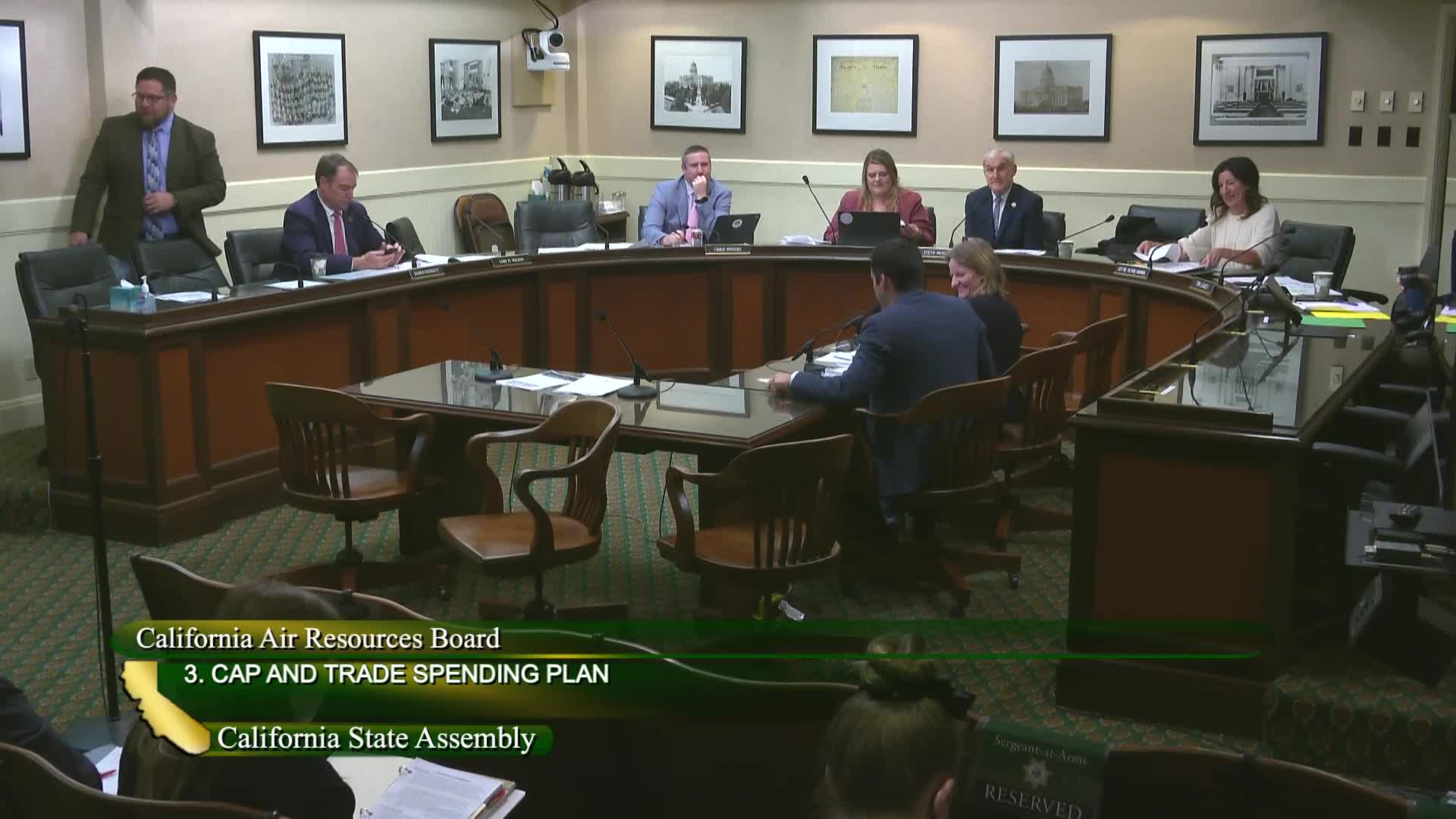
The subcommittee reviewed the governor's cap-and-trade spending plan and the latest estimates of auction revenues and fund condition for the Greenhouse Gas Reduction Fund (GGRF).
The subcommittee examined the governor's cap-and-trade spending plan and the near-term condition of the Greenhouse Gas Reduction Fund (GGRF).
Brandon Merritt of the Department of Finance told the panel that estimated auction revenues for fiscal year 2024—625 were roughly $4.1 billion, about $600 million lower than the estimate used in the 2024 Budget Act, and that the February 2025 auction produced about $851 million, below earlier projections. The governor's budget projects $4.2 billion for 2025—626 and proposes roughly $1.8 billion in discretionary GGRF expenditures for that year, largely maintaining the 2024 spending plan with a small modification: a transfer of $81.2 million to the motor vehicle account.
The Legislative Analyst's Office told the committee it largely supports sticking with the previously approved spending plan but urged monitoring of revenues because recent auctions have trended lower than expected. LAO also highlighted two shifts that could affect long-term priorities: a move of some funding from GGRF to Proposition 4 allocations and proposed use of GGRF to shore up the motor vehicle account in the short term. LAO warned that while those moves may be useful near term, they reduce the pool of dollars available for other priorities and raise questions about additionality.
Members raised wildland fire risk and the increased costs California now faces, asking the administration to consider whether GGRF and Prop 4 allocations should be adjusted to better address wildfire impacts and mitigation. Several public commenters and air districts urged restoring or increasing funding for specific programs, including AB617 community air protection, the farmer program and clean cars for all, as priorities that produce near-term air quality and public-health benefits in disadvantaged communities.
The Department of Finance said it would continue to refine the fund-condition picture through the May revision and that any adjustments would be considered then. The subcommittee asked Finance and CARB staff to provide updated fund condition statements and to consider trade-offs among competing priorities before decisions are finalized in the May revision.