Get Full Government Meeting Transcripts, Videos, & Alerts Forever!
Get email alerts on the Regulatory Fees Carb topic
No spam. Unsubscribe anytime.
Assembly panel questions broad fee authority sought by California Air Resources Board
Summary
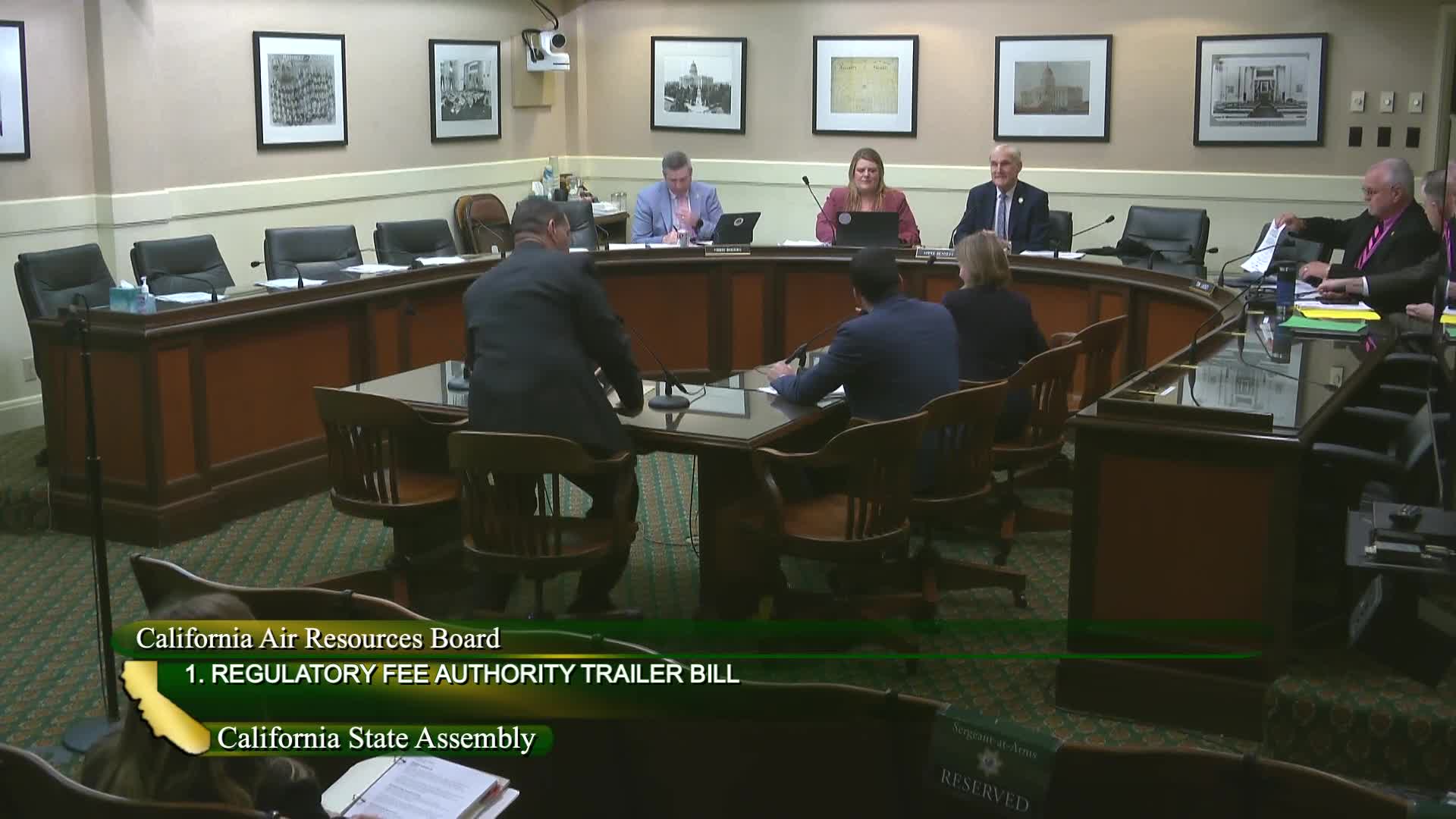
The California Assembly Budget Subcommittee No. 4 spent much of its hearing probing a trailer bill request that would give the California Air Resources Board authority to assess and collect regulatory fees from entities that emit toxic air contaminants and other pollutants.
The California Assembly Budget Subcommittee No. 4 spent much of its hearing probing a trailer bill request that would give the California Air Resources Board authority to assess and collect regulatory fees from entities that emit toxic air contaminants and other pollutants.
Brandon Merritt, Department of Finance, described the proposal as statutory authority for CARB to "assess and collect fees from emitters of toxic air contaminants and other pollutants to recover CARB's reasonable costs in developing, implementing and enforcing its statutory authority to regulate these harmful pollutants." Merritt emphasized the fees would be intended to cover CARB's reasonable costs, not to function as a separate pollution tax.
Helen Kerstein of the Legislative Analyst's Office recommended rejecting the trailer bill, calling the request "very broad." Kerstein told the committee that, unlike typical fee proposals that target a single program and specify purpose and amount, this language would allow CARB to raise fees across an entire division and for future activities that have not yet been defined. "It makes it really hard to weigh the pros and cons," she said.
CARB staff defended the proposal as matching costs to the entities responsible for them. David Garcia, legislative director for CARB, said the agency would still need a budget change proposal (BCP) and legislative appropriation before it could actually spend collected funds: "If we tried to collect a fee before the legislature approved a BCP ... we would be stuck in a situation where we would then have to refund all of the money that we had collected," Garcia said, explaining why CARB intends to set compliance dates that allow time for the BCP process.
Committee members focused on the proposal's breadth and its implications for legislative oversight. Several members, including Assemblymember Rogers and Assemblymember Petrie-Norris, said setting fees is a core legislative responsibility and warned the request could function like a delegation of taxation without sufficient guardrails. "It feels like you're asking us for a blank check," Petrie-Norris said.
CARB officials pointed to existing public processes — stakeholder engagement, board consideration and economic impact analysis — and to legal constraints such as Proposition 26 as limits on fee-setting. CARB also offered concrete examples of fees previously tied to specific regulations: the transport refrigeration unit fee (about $15 per unit per year) and commercial harbor craft fees (about $1,200 per vessel per year) as part of program-specific implementation packages that had gone through BCPs.
The subcommittee did not adopt or vote on the trailer bill language at the hearing. Members requested more specificity and possible guardrails to preserve legislative oversight while acknowledging the policy rationale of attaching cost recovery to regulated activity. The committee asked staff and CARB to continue negotiations before the May revision and to present alternatives that narrow the authority or add legislative safeguards.
What happens next: committee members signaled they want narrower, program-specific proposals or explicit safeguards in any trailer bill language before approving wide-ranging fee authority; staff and CARB said they will continue to negotiate those changes and return with clarifications.