Get Full Government Meeting Transcripts, Videos, & Alerts Forever!
Get email alerts on the Earned Sick And Safe Time Amendments topic
No spam. Unsubscribe anytime.
Committee reviews wide-ranging changes to Minnesotaearned sick and safe time; amendment adopted and bill laid over
Summary
House File 1325, a package of amendments to Minnesotaearned sick and safe time, drew testimony from state agencies, business groups, public employers and labor unions on March 12; the committee approved an authorA2 amendment and laid the bill over.
The House Workforce, Labor and Economic Development Finance and Policy Committee on March 12 heard more than a dozen witnesses about House File 1325, a bill that would alter how Minnesota's earned sick and safe time (ESST) law is applied to minors, part-time and seasonal workers, small employers and public employers. The committee approved an authorA2 amendment and laid the bill over for further consideration.
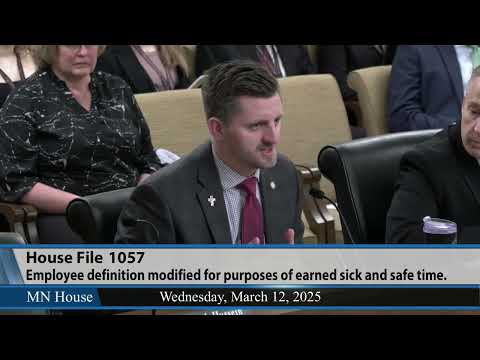
Representative Schultz, the bills author, said the package aims to make the ESST law "workable and flexible" for small businesses, schools, counties and cities. "Listening to the needs of small business owners and locally elected leaders across Minnesota, I have heard the concerns of unfunded, 1 size fits all mandates, which is exactly the challenge we are seeking to address today with Earn Sick and Save Time," Schultz said.
The Minnesota Department of Labor and Industry opposed the measure. "This bill would exclude minors, part time and seasonal workers and others from earned sick and safe time coverage," Commissioner Nicole Blissenbach told the committee. She said the DLI estimates that the proposed exclusions would remove protections for roughly "800,000 Minnesotans," about 30% of the workforce, and warned that removing coverage in whole categories would leave some workers with fewer protections than before ESST took effect.
Employer groups urged changes to ease administrative burdens. Lauren Schochhorst of the Minnesota Chamber of Commerce said small businesses lack HR expertise and face compliance complexity; John Beshe of the National Federation of Independent Business urged measures such as 90-day waiting periods, documentation rules and proration for front-loaded hours. The League of Minnesota Cities and multiple county and school-district representatives asked for clarifications to avoid disruptions to essential public services, and the League supported removing a bargaining requirement tied to a weather-related exemption for emergency employees.
Labor unions, nurses and worker advocates opposed the proposed carve-outs and delays. Brian Elliott of SEIU Minnesota said the bill would "take sick and safe time and its accompanying protections away from many hundreds of thousands of workers who've already been earning this benefit for 14 months." John Welsh, a nurse and union representative, said the law has reduced disciplinary action for nurses who previously came to work sick because they feared losing time or pay.
Several public-employee witnesses, including school HR staff and district associations, said practical problems had emerged since ESST took effect in January 2024. Those witnesses urged targeted fixes such as proration for new hires and clearer rules for substitutes and stipend positions rather than broad rollbacks.
The committee voted by voice to approve an author's A2 amendment that sponsor Schultz requested to shape the bill. After additional member discussion, the chair renewed a motion to lay the bill over for further consideration; the committee carried the motion by voice vote.
Committee members expressed conflicting priorities in floor debate: some said ESST remains a vital baseline protection that should not be reduced for groups of workers, while others emphasized reducing unintended administrative burdens on small employers and public employers. Representative Leila Pinto urged legislators to center the policy's human impacts, saying workers should not be treated differently depending on employer size or type.
Whathappens next: The bill, as amended, was laid over for further consideration and may be revised or returned with additional amendments at a later committee meeting.