Get Full Government Meeting Transcripts, Videos, & Alerts Forever!
Get email alerts on the Earned Sick And Safe Time topic
No spam. Unsubscribe anytime.
Committee Hears Farm Exemption to Minnesotaearned sick and safe time; bill laid over
Summary
A House committee heard testimony on House File 1057, which would exempt certain small farms from Minnesotaearned sick and safe time requirements. Supporters said small family farms need relief; the Department of Labor and Industry warned of public-health and enforcement problems. The committee laid the bill over for further consideration.
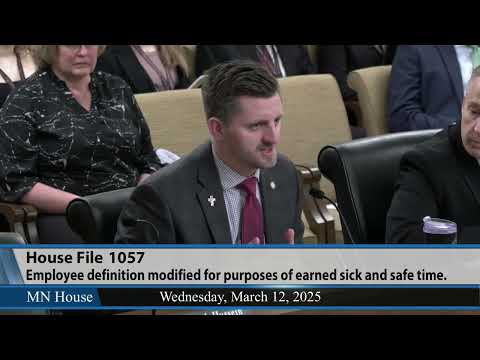
House File 1057, a proposal to exempt some small farms from Minnesota—earned sick and safe time (ESST), was discussed March 12 before the House Workforce, Labor and Economic Development Finance and Policy Committee and was laid over for further consideration.
Representative Anderson introduced the bill, describing it as a targeted exclusion for small and family-run operations. "What my bill does, House File 10 57, would be to add 1 other, relatively small exclusion for farms that would, have fewer than 5 or fewer full time employees," Representative Anderson said, adding that many small farms lack human-resources staff and face seasonal labor demands.
The bill drew mixed testimony. Nicole Blissenbach, commissioner of the Minnesota Department of Labor and Industry, told the committee the department opposed the measure. "The earn sick and safe time law sets a floor for all employees in the state," Blissenbach said, and she warned that exempting groups of agricultural workers would reduce protections and create enforcement complications because farm employment is highly seasonal. She told members the department estimates "about 1,500 establishments and 2,500 employees" would be affected by the proposed change, and cautioned that the estimate is likely an undercount.
Darren Broton, executive director of the Minnesota Agri Growth Council, testified in favor. He described broad economic stress in agriculture and urged the committee to consider the bill as a modest, bipartisan way to ease burdens on family farms. "Minnesota is among many states, in the midst of a great farm recession," Broton said, adding that family farms operate differently from other employers and that coverage requirements can be disruptive during planting and harvest.
Bruce Clavin, representing several farm groups including the Minnesota Association of Wheat Growers and Minnesota Turkey Growers, also supported the bill and noted the statute already includes a 28-day seasonal exemption meant to cover brief harvest help.
Committee members pressed both witnesses. Representative Frazier and others questioned whether small farms had documented harm from the existing law; Representative Anderson cited anecdotes from farmers who said compliance pulled them into unemployment insurance and raised annual costs. Commissioner Blissenbach and worker advocates cautioned that ESST also serves public-health goals, allowing workers to stay home when contagious and helping control outbreaks.
There was no final vote on the billbeyond the committeemotion to lay it over. The chair renewed a motion that House File 1057 be "laid over for further consideration," and the committee carried that motion by voice vote.
The committee record shows a continuing debate between members who said the bill would protect small family operations with limited administrative capacity and those who said the change would remove a baseline protection for vulnerable workers and complicate enforcement because of seasonal hiring.
Votes at a glance: The committee took voice votes to approve procedural steps and to lay the bill over; no final passage or defeat occurred during the March 12 hearing.
Whathappens next: The bill remains laid over for future consideration by the committee; further hearings or amendments may follow.