Get Full Government Meeting Transcripts, Videos, & Alerts Forever!
Get email alerts on the Housing Support topic
No spam. Unsubscribe anytime.
Committee reviews bill to standardize housing support contracts across counties
Summary
Legislators heard testimony on House File 13‑37, a proposal to align access to Minnesota'funded housing support for eligible people regardless of the residential setting; the committee laid the bill over for further work.
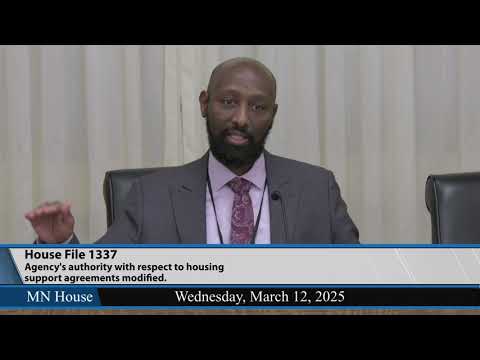
Representative Isaac Noor introduced House File 13‑37 to the House Human Services Committee, asking the panel to consider changes to the statewide housing support program (formerly GRH) so eligible Minnesotans are not denied assistance because of the type of residential setting where they live. The committee moved the bill and laid it over for possible inclusion.
The measure would require counties to contract for housing support for people who meet eligibility criteria, irrespective of whether they live in assisted living, a customized living provider (CRS), or other licensed settings. Noor told the committee the program serves “over 20,000 individuals” and “spends over $200,000,000,” and said the current county‑by‑county administration produces uneven access.
Why it matters: housing support helps people at risk of institutional placement or long‑term homelessness remain in community settings. Witnesses described operational gaps that result from county discretion over contracting and said the result can be that some providers or settings cannot access state housing dollars even when the resident is otherwise eligible.
Matthew Bergeron, speaking for the Residential Providers Association of Minnesota, told the committee that although the funds are state dollars, “that individual can only access those funds if they are residing at a setting that has a contract with the local county.” Bergeron described barriers for small providers in metropolitan counties, where volume, administrative workload or blanket exclusions (for example, excluding single‑family homes) can block access to contracts.
Matt Freeman, human services policy analyst for the Association of Minnesota Counties, said counties are concerned about administrative capacity and oversight responsibilities. “Counties don't currently have, or all counties don't currently have staff capacity for all the housing support agreements that would be a result of this bill,” Freeman said, and he urged consideration of resources for counties to implement any change.
Marcus Klimenko, Hennepin County area manager for housing stability, described Hennepin County''s approach as a managed growth model that uses requests for proposals to evaluate provider qualifications, transportation access and experience serving specific populations. Klimenko said counties sometimes decline new providers because of quality or logistical concerns.
The committee did not vote on policy language. Representative Knorr moved that House File 13‑37 be laid over for possible inclusion; the motion was approved and the item was filed for further consideration.
The bill drew bipartisan interest and several members urged continued stakeholder work to balance statewide eligibility rules with counties' responsibility for oversight and contract management. Committee members and witnesses repeatedly raised two implementation issues that remain unresolved: (1) how counties would be resourced for expanded contract administration, and (2) how to write statutory language that preserves beneficiary eligibility without compelling counties to accept providers that do not meet local standards.
Votes at a glance: House File 13‑37 — motion to lay over made by Representative Knorr; outcome: laid over for possible inclusion.