Get Full Government Meeting Transcripts, Videos, & Alerts Forever!
Get email alerts on the Artificial Intelligence Governance topic
No spam. Unsubscribe anytime.
Committee approves bill to regulate state use of artificial intelligence, adds election disclosure rules
Summary
A House committee approved Senate Bill 4 with a committee substitute that establishes an AI governance framework for Kentucky state agencies and narrows new disclosure rules for AI-generated political audio and video within 45 days of an election.
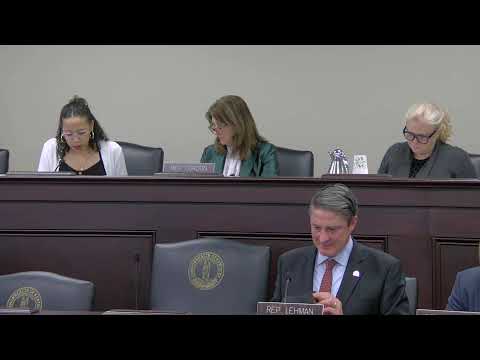
Senators and representatives in the House Standing Committee on Small Business and Information Technology on Monday advanced Senate Bill 4 with a committee substitute that would create a risk-based governance framework for how Kentucky state agencies use artificial intelligence and would require disclosures for certain AI-generated political audio and video within a limited pre-election window.
The committee substitute directs the Commonwealth Office of Technology to oversee agency AI risk assessments, requires cabinets and agencies to report AI uses and benefits to the Office of Technology, and ties election-focused disclosure requirements to existing penalties in Kentucky law. The substitute removes images from the disclosure requirement and limits the disclosure rule to audio and video used within 45 days of a primary or general election.
Sen. Amanda Mays Bledsoe, who led the state'wide AI task force, told the committee the bill intentionally targets only state government use: "I just wanna say it more than once. This is only looking at how state government uses artificial intelligence." She said the measure is a first draft of a governance framework and acknowledged the technology will evolve faster than legislation. Representative Josh Bray, who co-chaired the task force, urged the committee to balance constitutional concerns and government efficiency, saying the bill is modeled on provisions that have withstood legal challenges elsewhere.
Michael Adams, Kentucky secretary of state, described the changes made in the committee substitute and framed the bill as a "light touch" compared with existing federal campaign disclaimer law. "The original version of this bill provided for an ad to be taken down by a judge. That's been changed. There is no prior restraint here. This is just requiring a disclaimer," Adams said.
Opposing testimony came from Michael Frazier of the Foundation for Individual Rights and Expression, who said the measure raises First Amendment concerns and is likely to face judicial scrutiny. "There is no artificial intelligence exemption to the First Amendment," Frazier told the committee, arguing that existing defamation and fraud laws are better-suited to address injurious false speech than the broader disclosure regime in SB 4.
Committee members pressed on implementation and cost. Representative Tejashvi Kulkarni asked whether the Commonwealth Office of Technology would need additional resources. Sen. Bledsoe said the substitute largely formalizes guidance COT is expected to produce and that the reporting requirement is intended to provide transparency on agency AI use rather than create new operational programs. Representative Andrew Layman and others urged that the office be given adequate time and resources to produce a meaningful report, noting a December reporting deadline in the substitute could be difficult to meet.
A motion to adopt the committee substitute was made by Representative Lawrence and seconded by Representative Pfister. The committee voted to advance the measure; multiple members recorded "aye" and the committee reported the bill with a favorable recommendation to the full House.
The measure now proceeds to the House floor for further consideration.