Get Full Government Meeting Transcripts, Videos, & Alerts Forever!
Get email alerts on the Public Safety And Infrastructure topic
No spam. Unsubscribe anytime.
Manhattan CB2 raises alarms as dozens of roadway-cafe FDNY waiver requests concentrate on a few blocks
Summary
Residents and board members told Manhattan Community Board 2 on March 11 they are concerned about dozens of FDNY emergency-travel-lane waiver requests for roadway cafes concentrated on narrow streets; the board pressed for clearer, coordinated guidance from DOT and FDNY.
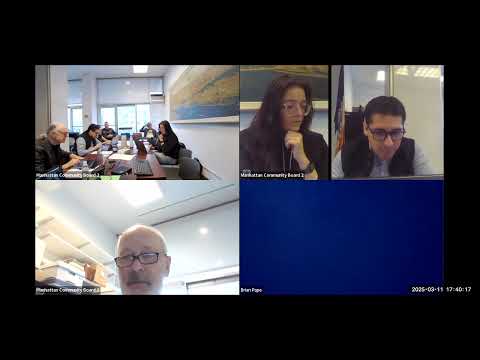
Manhattan Community Board 2 members and residents raised traffic- and safety-related concerns March 11 after hearing that dozens of applications in the board area request FDNY waivers to reduce required emergency-travel lanes for roadway cafes.
Residents and several board members said the concentration of waiver requests on a handful of blocks — including stretches of Mulberry Street and Thompson Street and parts of Sullivan Street — creates cumulative safety and access risks that have not been reviewed holistically. "There are now so many waivers on Thompson between Bleecker and West Third that it’s creating a hazardous situation," said Leslie Clark, a longtime West Village resident, during public comment.
The meeting included repeated questions about roles and oversight. Chair Valerie Dela Rosa and other board members said the board had asked DOT and FDNY for a single forum to explain how waivers will be assessed, citing cases where applicants were told different things by different agencies. The board noted examples on Mulberry Street where multiple applicants are seeking waivers that would leave only narrow clear travel lanes when considered together.
Staff and several applicants said DOT has been handling referrals and that FDNY has issued conditional sign-offs in some cases; FDNY staff did not attend the meeting. Michael Kelly, representing several applicants, told the group many waiver requests are being handled on a site-by-site basis by FDNY and DOT. Neighbors and board members pushed back: “You cannot treat each of these in isolation when eight or more are concentrated on one block,” said Bob Eley, a local resident who testified.
Board members asked for clearer, documented criteria from FDNY and DOT about when a waiver is appropriate and for a single technical point of contact to resolve conflicts such as where multiple roadway cafes adjoin on the same street. The board also asked DOT to provide more accurate plan packages; members and public commenters flagged several applications where the plans DOT sent the board did not match the application materials (for example, plans missing a second roadway or showing the wrong drawings).
Why it matters: roadway cafes convert street space into permanent or seasonal dining sheds and — when waivers are granted — change the minimum travel width FDNY expects for emergency response. Board members and neighbors said the practical consequence is not only narrower lanes for engines and ladder trucks but also more sidewalk crowding, fewer clear walking routes and harder access for deliveries and waste collection.
What the board asked for: the working group asked DOT and FDNY to (1) provide written criteria that the agencies are using when they consider waivers, (2) meet with the board so staff and members can pose specific, local questions about the most affected blocks, and (3) ensure application bundles sent to the board match the DOT referral so the board and public are reviewing the same plan.
The board closed the public hearing on the subject and collected written comments and photographs from several neighbors showing recent configurations they said were in violation of rules or caused neighborhood problems. The board will follow up with the agencies and with applicants who were told to correct enclosures or documentation.
Ending note: The scope of waiver requests in the board’s area and the lack of a single, public technical guidance from FDNY or DOT were the dominant takeaways from the meeting. Board leadership said they will escalate the request for an interagency briefing so that neighbors and local elected offices can see the technical rationale used by FDNY and DOT.