Get Full Government Meeting Transcripts, Videos, & Alerts Forever!
Get email alerts on the Cannabis Market topic
No spam. Unsubscribe anytime.
Legislators press Department of Cannabis Control as report finds production up but industry value and revenue falling
Summary
Lawmakers held a joint informational hearing with the Department of Cannabis Control to review a department report showing licensed production up while wholesale and retail prices — and the gross sales value of the licensed market — have fallen.
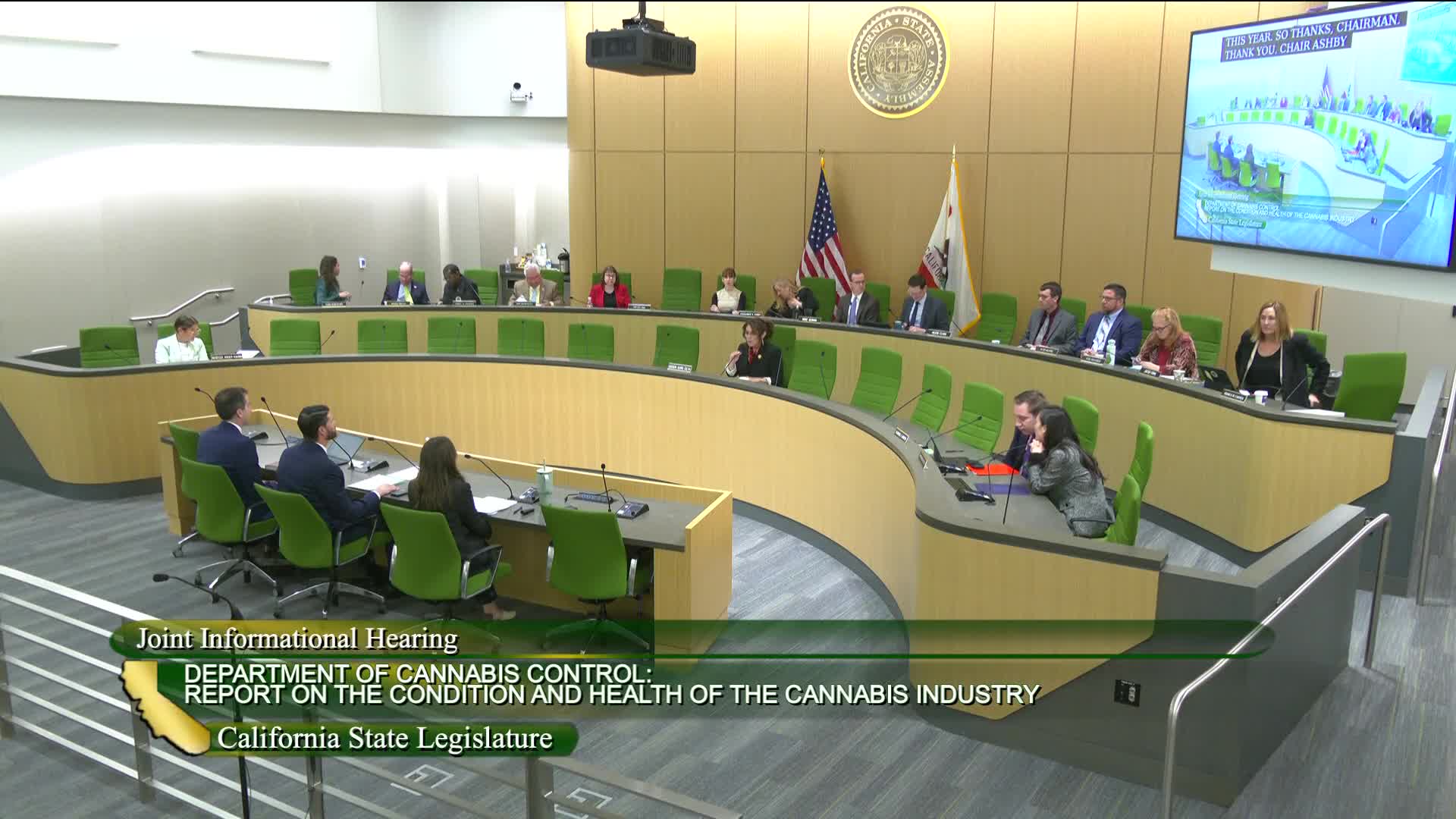
Lawmakers held a joint informational hearing with the Department of Cannabis Control to review a department report on the condition and health of California’s cannabis industry, focusing on market trends, enforcement against illicit sellers, testing standards and the potential impact of an upcoming state excise tax increase.
The Department’s chief deputy director, Clint Kellum, and deputy director of government affairs, Christina Dempsey, outlined the state’s regulatory evolution and enforcement work. Economist Duncan McEwen of ERA Economics summarized market data, saying that licensed production moving through the regulated supply chain has risen while wholesale and retail unit prices have fallen and “the overall gross value of the industry is down.” The panel and legislators repeatedly tied those trends to competition from a persistent illicit market, enforcement capacity, and costs borne by licensed businesses.
The nut of the hearing: production and quantity processed through licensed channels are increasing, but price declines have outpaced those volume gains — shrinking tax receipts and making it harder for licensed firms to cover costs. McEwen told the committees that licensed production was about 1,400,000 pounds in 2024 and that the licensed market likely supplies roughly 38–40% of statewide consumption; illicit production remains a substantial share of total California production.
Officials and witnesses offered numbers and examples. Dempsey said the department’s enforcement staff of 87 has seized “over $2,200,000,000 worth of product” from the illegal market since the department’s 2021 formation and that enforcement tools now include notices to comply, citations, embargoes and mandatory recalls. She described the department’s “seed to sale” tracking, a statewide product sampling program and coordination with the multiagency enforcement task force USITEF created under Governor Newsom.
At the same time, members of the Legislature and industry trade groups warned that licensed firms are closing and blamed a mix of taxes, fees and illicit competition. Multiple industry speakers said excise collections and taxable sales have declined since 2021 — assertions the groups submitted as written comments at the hearing — and urged lawmakers to prevent an automatic excise-tax increase scheduled for July 1 that would raise the state rate from 15% to 19%.
Senators and assembly members pressed three recurring issues: enforcement against unlicensed grow sites and retail operations, laboratory testing and product safety, and whether state equity and grant programs have moved provisional licensees to annual licensure fast enough. Senator Nilo, invoking recent medical literature, urged more attention to public-health effects of higher-potency products and said the hearing’s focus on market mechanics must be balanced with demand-side health concerns. Assemblymember Quirk Silva and others pressed the department about enforcement staffing and coordination with local district attorneys, calling enforcement capacity a limiting factor in reducing the illicit market.
On testing and product safety, Dempsey acknowledged gaps flagged in outside reporting and said the Department of Pesticide Regulation is expanding pesticide lists used in testing; she added the department is pursuing regulatory and laboratory changes to strengthen pesticide monitoring. The department also said it has increased compliance actions on ‘‘attractive-to-children’’ packaging and advertising in the legal market.
Industry witnesses described business distress. Representatives from retail and manufacturing trade groups told the committee that licensed retail numbers have fallen sharply in recent years and that many businesses face unpaid tax liabilities and thin margins. Local trade organizations and growers reported individual counties where many small growers plan to suspend licenses or sell land. Some witnesses urged tax relief and broader legal retail access, noting that 42% of jurisdictions ban retail sales and that limited legal access can push consumers to the illicit market.
Officials described several state programs aimed at equity and local transition. Dempsey said the department reduced provisional licenses from 8,360 at inception to roughly 1,500 (about 17% of businesses) as local permitting and CEQA requirements were met; the department also referenced equity fee waivers, deferrals and a community reinvestment grant program administered through GO-Biz. Legislators and local stakeholders reported delays in grant and grant-amendment processing and said those delays have impaired some equity transitions.
The hearing produced no formal votes. Members tasked the department and its analysts with follow-up on employment and workforce composition, the department’s grant timelines, and more details about enforcement reimbursements, prosecution coordination and the projected impact of the excise-tax change. Committee chair closed by saying the hearing was a starting point for further legislative work this year.
Ending: Lawmakers and industry representatives left the hearing aligned on a narrow set of priorities — stronger enforcement against the illicit market, clearer and broader legal retail access, improved testing and laboratory standards, and stabilization of tax policy — but they disagreed on the mix of policy tools. The departments and witnesses committed to follow-up briefings and written submissions, and multiple members indicated they will pursue legislation or budget proposals during the session to address enforcement resources, tax policy and equity program administration.