Get Full Government Meeting Transcripts, Videos, & Alerts Forever!
Get email alerts on the Wildfire Response topic
No spam. Unsubscribe anytime.
Committee backs SB 90 to allow Prop 4 grants for mobile water tanks and emergency generators for wildfire response
Summary
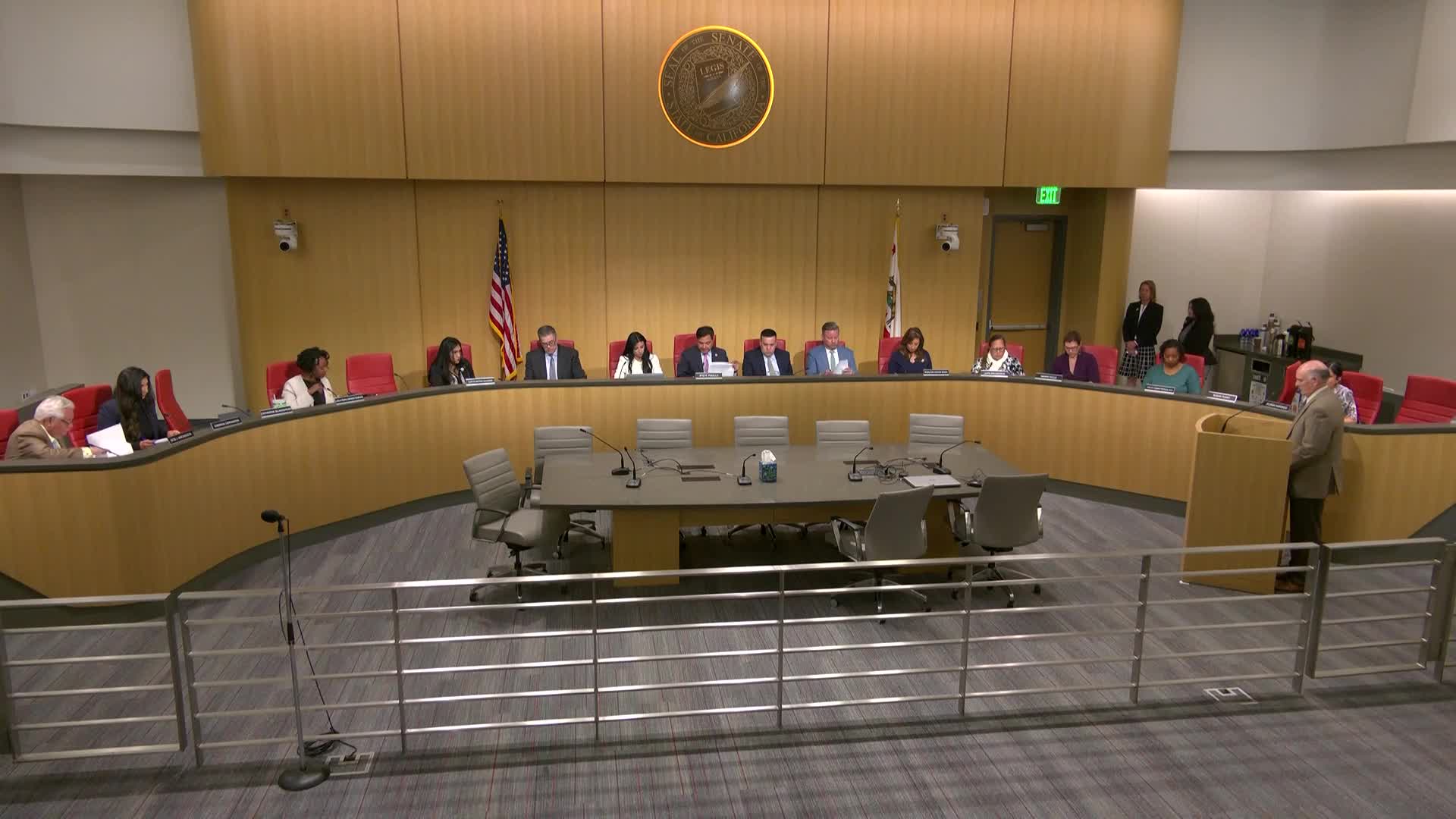
The Senate Committee on Governmental Organization passed SB 90 as amended, clarifying that Proposition 4 grants may fund pre‑positioned mobile water storage tanks and emergency backup generators to support firefighting and local water systems.
The Senate Committee on Governmental Organization voted to pass SB 90 as amended, sending the bill to the Natural Resources and Water Committee. The measure would clarify that grant funding under Proposition 4 may be used for pre‑positioned mobile water storage (rigid dip tanks) and backup emergency generators to support firefighting operations and local water systems.
Senator Henry Dupas, the bill’s author, told the committee the change would “provide a tool for our toolbox in fighting wildfires,” noting that mobile dip tanks can reduce helicopter round‑trip refill times from 10 minutes or more to roughly five minutes. He said the tanks and mobile storage are a cost‑effective complement to aviation resources and named local examples where tanks were deployed.
James Lee, general manager of Crescento Valley Water District, testified that mobile tanks were a “game changer” during recent fires: his district acquired two tanks and deployed them outside its service area to support Los Angeles County operations. Lee described the tanks as portable reservoirs that can be pre‑positioned or moved to provide nearby water and reduce helicopter turnaround time.
Spencer Street, representing the city of Sierra Madre and a bill cosponsor, described that city’s experience during the Eaton Fire: a backup generator failed, leaving water pumps inoperable and forcing the city to secure a rental generator, a process the city said took 16 hours during an emergency. Street argued that grant funding for backup generators would help small municipalities maintain firefighting capability and public safety during outages.
Committee members discussed funding tradeoffs. Senator Richardson asked whether covering tanks and generators under Prop 4 would reduce funds available for other priorities such as home and community hardening; she suggested the author consider increasing grant funding or designating a percentage of funds for the new items. Senator Dupas said funding decisions would be handled in the budget and that mobile tanks are generally cheaper and faster to deploy than permanent reservoirs that require environmental review.
The committee recommendation included support with amendments and the measure passed out of committee to Natural Resources and Water. The committee record shows broad support from municipalities and water districts, and the author agreed to work with members on grant criteria and project prioritization to limit competition with home‑hardening projects.
Supporters framed SB 90 as a resilience and response measure that can extend firefighting capability across jurisdictions, while members emphasized implementation details such as grant prioritization, matching funds and the interaction with existing CalFire and local grant programs.