Get Full Government Meeting Transcripts, Videos, & Alerts Forever!
Get email alerts on the Compounding Regulations Access topic
No spam. Unsubscribe anytime.
Board of Pharmacy compounding rules draw criticism as patients, veterinarians and firefighters report access gaps
Summary
At a joint Assembly and Senate sunset review hearing on the California State Board of Pharmacy, board officials defended ongoing compounding rulemaking while veterinarians, compounding pharmacists, firefighters and patient advocates said the board's enforcement and proposed regulations have narrowed access to compounded medications including nebulized glutathione and methylcobalamin.
At a joint Assembly and Senate sunset review hearing on the California State Board of Pharmacy, board officials defended an ongoing revision of compounding rules while dozens of stakeholders — including veterinarians, community compounders, firefighters and patient advocates — said the changes and earlier enforcement actions have narrowed access to certain compounded medications.
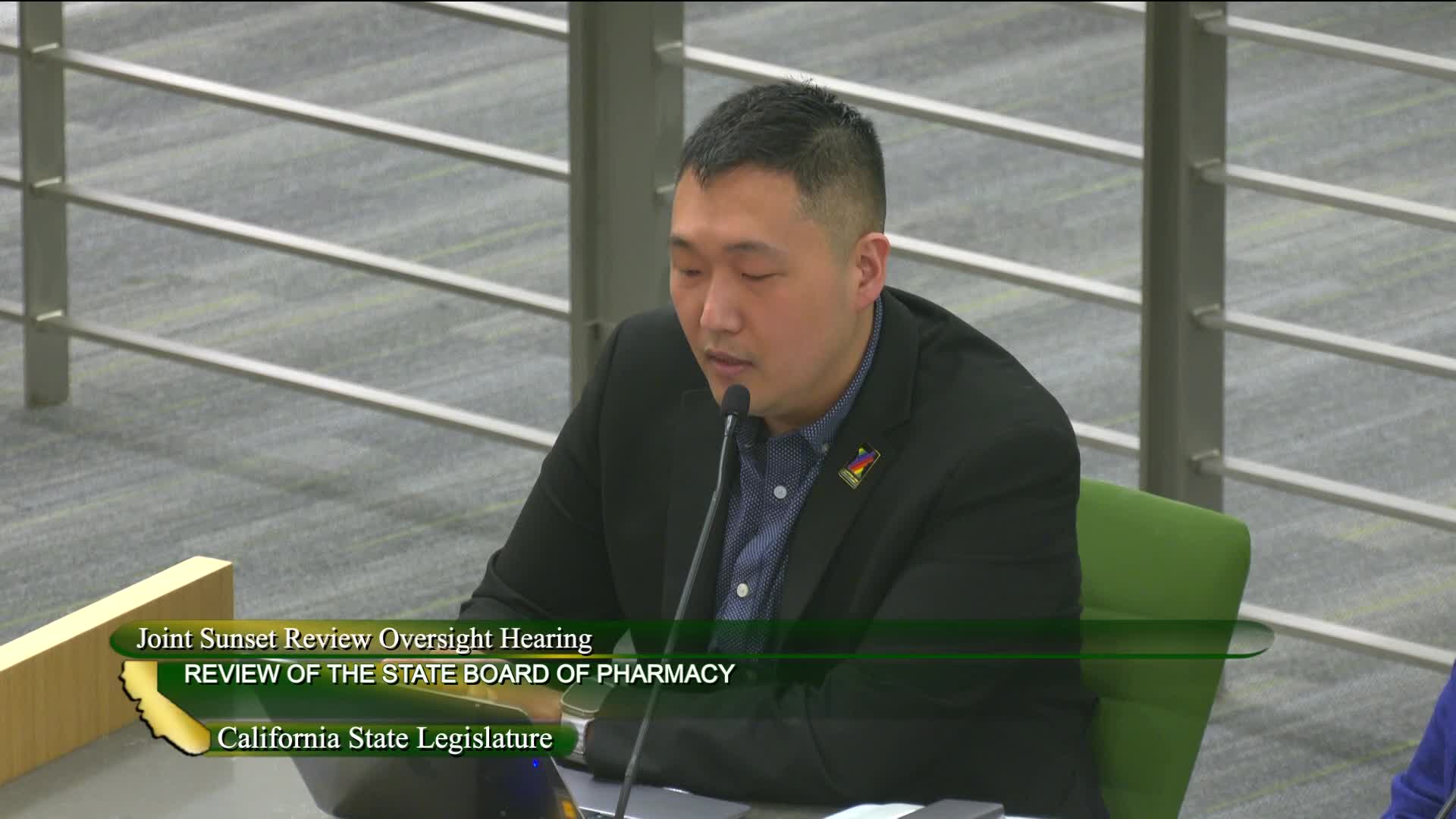
Board president Seung Oh told committee members the board—s compounding rulemaking aims to provide "a clear path" for pharmacies to provide medications safely and that the board is not banning substances such as glutathione or methylcobalamin. "A regulatory attempt is and has always been to provide a clear path for the regulated to be able to provide medications safely," Oh said, adding that the board has modified proposed text multiple times in response to public comment.
Stakeholders said the reality on the ground looks different. Grant Miller, director of regulatory affairs for the California Veterinary Medical Association, told the committee that California is unique among states in losing access to veterinary drugs produced only through compounding. "Excessively stringent Board of Pharmacy regulations for compounding pharmacies have shrunk the number of California veterinary compounding pharmacies to just a few," Miller said, linking that decline to shortages of critical ophthalmic and other veterinary medicines.
Compounding pharmacists and patient advocates said the decline is dramatic. One community compounding pharmacist who testified said California had "over a hundred compounding pharmacies" about a decade ago but now has "only a handful"; a later speaker estimated sterile 503A compounding pharmacies may be "less than 20". Several speakers urged adding a practicing community sterile compounding pharmacist to the board to fill an expertise gap.
Firefighter and patient groups focused heavily on nebulized glutathione. Jackie Jorgeson, executive director of the Volunteer Fire Foundation, said the foundation has delivered nebulized glutathione to thousands of firefighters after recent wildfires and that patients need multi-dose, at-home regimens that currently are unavailable because no California compounding pharmacy will fill those prescriptions. "They need 30 to 60 doses of self-administered glutathione, but they can't get it," Jorgeson said. Multiple physician prescribers and first responders testified that lack of access has forced clinicians and patients to seek treatment across state lines.
Many witnesses tied access problems to both the board's enforcement actions and the process of rulemaking. A number of compounding pharmacists said they were told by board staff in 2020 and afterward to stop compounding methylcobalamin and glutathione despite following federal and state law; speakers described lawsuits and costly legal defenses. Several speakers recommended stronger legislative oversight of board enforcement and requested that the Legislature require board reporting on enforcement outcomes and defer more consistently to court or administrative-judge findings.
Board staff and members described an extensive public-engagement process in regulation development, including multiple public meetings, a 45-day comment period and several rounds of modified text. "We are currently on our fourth modified text," the board—s representative said, noting additional comment periods after each modification. The board emphasized federal law, FDA guidance and United States Pharmacopeia (USP) chapters as reference points for compounding policy.
Several medical groups — including physician organizations — warned that some proposed compounding language could affect physician office compounding and interfere with patient care in medical settings. The California Medical Association asked the committees to consider whether proposed pharmacy regulation language could impose pharmacist-centric requirements in physician offices, a concern board members said they are reviewing.
The compounding debate intersected with broader fiduciary and enforcement concerns. Multiple speakers urged the Legislature to direct a formal oversight review, appoint a community sterile compounding pharmacist to the board, and examine whether current enforcement practices have led to unintended access harms.
The board said it remains committed to consumer protection and to revising regulation text in response to public comments; stakeholders urged stronger transparency and clearer enforcement standards as part of that process.
Ending: The board's modified compounding text is out for public comment and remains on the board's rulemaking schedule. Witnesses asked the Legislature for additional oversight and for at least one board seat with community compounding expertise; committee members indicated they would continue to monitor the issue as the rulemaking and litigation proceed.