Get Full Government Meeting Transcripts, Videos, & Alerts Forever!
Get email alerts on the Small Farm Support topic
No spam. Unsubscribe anytime.
Small farmers and Punjabi American growers urge more outreach, financial assistance and transition planning under SGMA
Summary
Representatives of the Punjabi American Growers Group and the UC Davis Small Farm Water Justice Clinic told the committee that limited outreach, translation gaps and scarce implementation funding have left many small growers unprepared for allocations and potential land‑use transitions under SGMA.
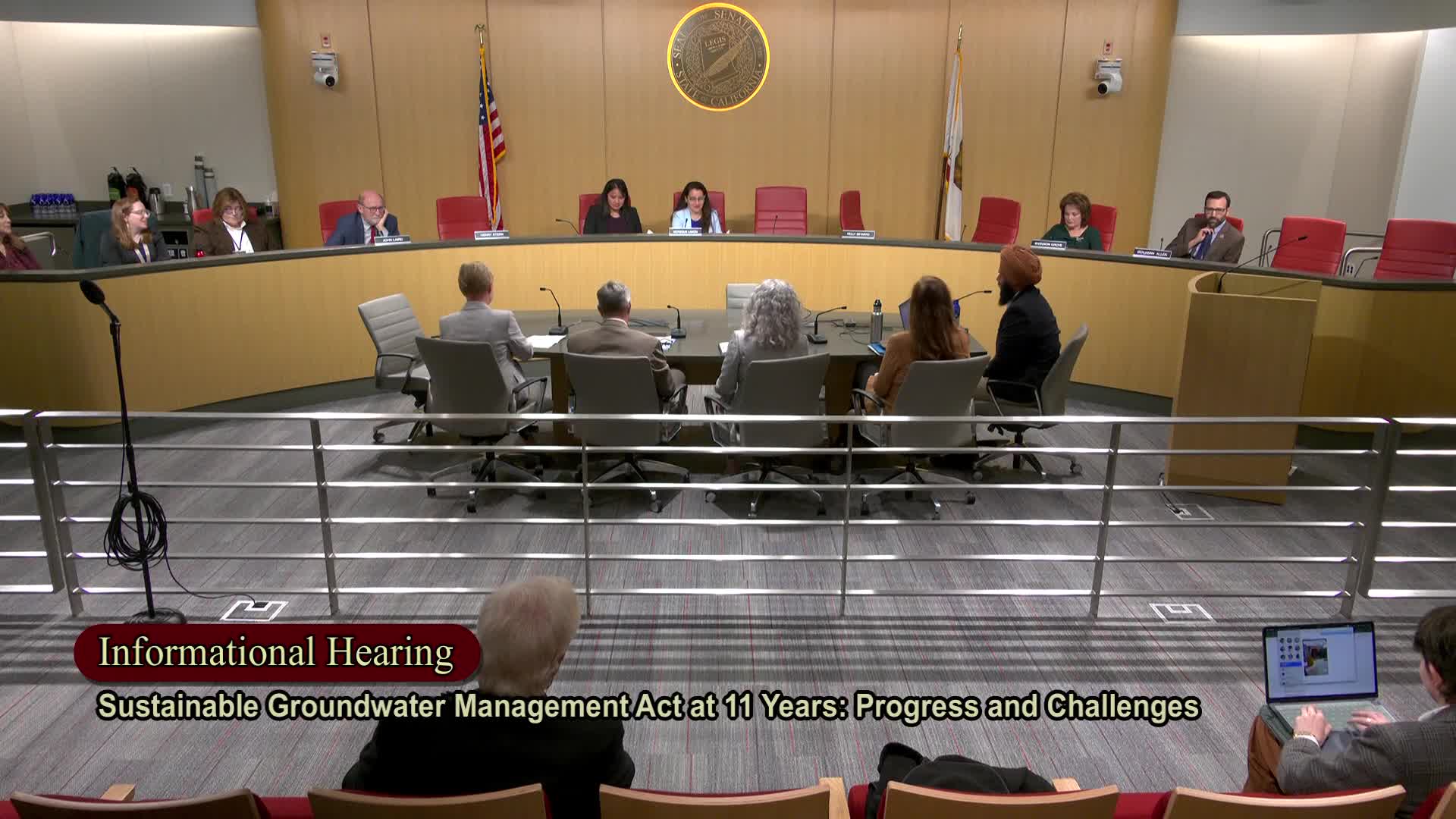
At the Senate hearing, Arshdeep (Arjdeep in transcript) Singh, president of the Punjabi American Growers Group, described how many family growers in the San Joaquin and Central Valley learned about SGMA late and said outreach in Punjabi and other languages was insufficient during plan formation and early implementation.
Singh said many small growers planted permanent crops (for example, pistachios and almonds) after receiving bank financing during the late 2010s, then found themselves facing much lower allocations when GSPs were implemented. He said available assistance programs are too small relative to the scale of potential land‑use change; he cited one estimate shown at a workshop that, within some regions, one to 1.5 million acres of agricultural land may be at risk and noted a multi‑benefit land repurposing program solicitation would be relatively small compared with overall need.
Christopher Maude, a UC Davis law student with the Small Farm Water Justice Clinic, summarized legal assistance the clinic is providing to small farmers: appeals to GSAs and county boards, variance applications and direct representation in basin‑level matters. He told the committee the clinic is preparing follow‑up materials for the Legislature with recommended actions to protect small farmers and to avoid disproportionate outcomes.
What they asked: Speakers urged the Legislature to fund more robust technical assistance and translation, create or expand financial programs to support transitions or adoption of water‑saving technologies, and require GSP guidance to explicitly consider small‑farmer impacts and workable variance processes for newly established farms.
Ending: Committee members and witnesses agreed outreach and targeted assistance will be critical to avoid abrupt losses of farm livelihoods and to reduce pressure that otherwise may fuel litigation or uncoordinated adjudications.