Get Full Government Meeting Transcripts, Videos, & Alerts Forever!
Get email alerts on the Cuyama Valley topic
No spam. Unsubscribe anytime.
Cuyama Valley residents and service providers tell Senate SGMA has not yet cut basin pumping; small users bear uncertainty
Summary
Lynn Carlisle of the Cuyama Valley Family Resource Center told the Senate committee that the basin’s GSP requires about a 60 percent pumping reduction but that no mandatory cuts have occurred to date.
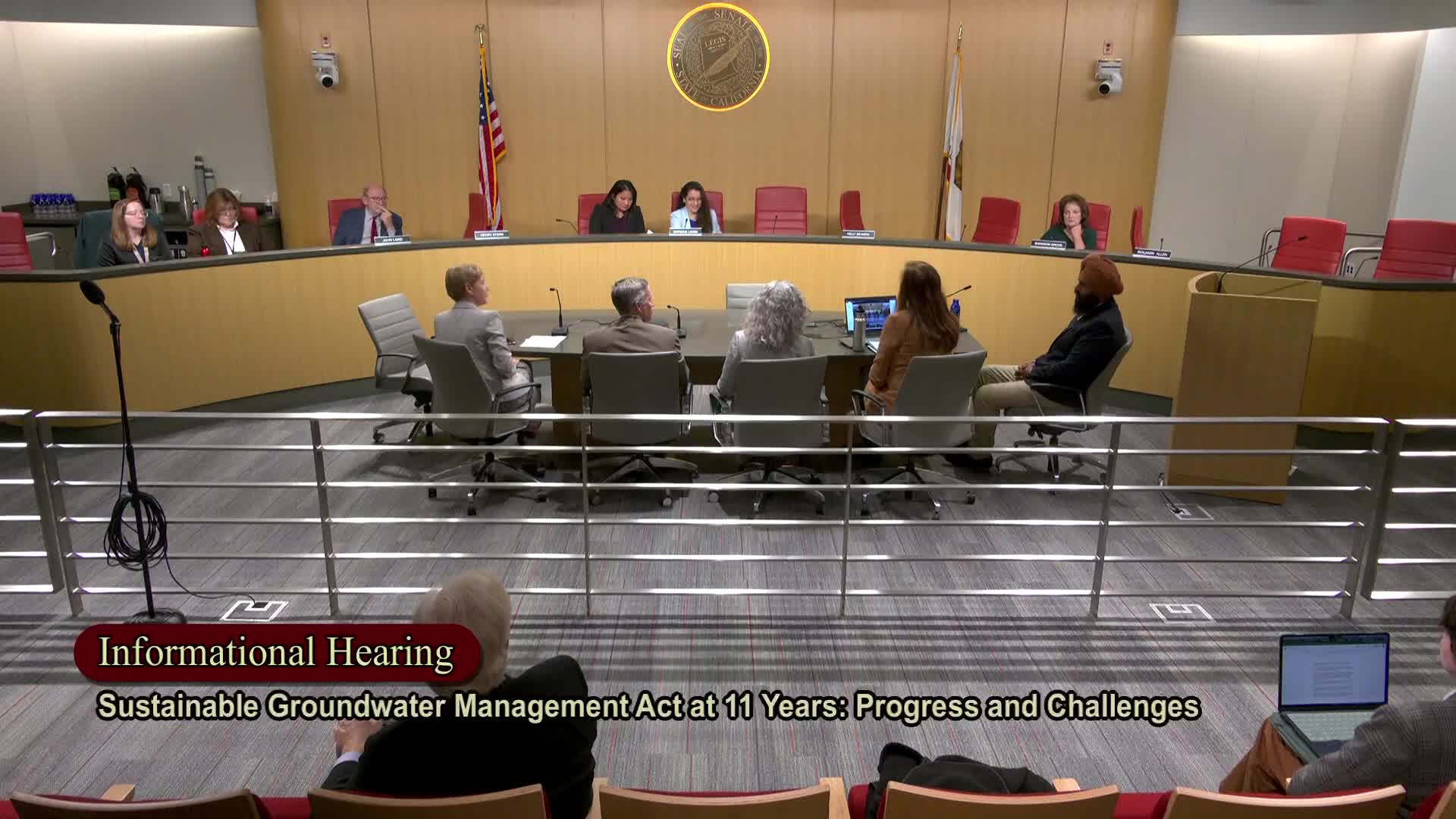
At a Senate Natural Resources and Water Committee hearing, Lynn Carlisle, executive director of the Cuyama Valley Family Resource Center, told legislators that after a decade of SGMA implementation the Cuyama Valley still has not begun the required pumping reductions in its central management area.
Carlisle described the basin as isolated and economically disadvantaged, with a population she estimated at about 1,800 people. She said the GSP’s five‑year update estimates basin pumping at roughly 42,400 acre‑feet per year, with a sustainable yield of about 16,800 acre‑feet—meaning the plan’s authors estimate a need to reduce pumping by roughly 60 percent to reach balance. Carlisle said the top two pumpers in the basin together account for roughly 69 percent of all groundwater extracted, while very small users (those pumping under 100 acre‑feet per year) represent roughly 2.4 percent of total pumping.
Carlisle described how the basin’s largest pumpers formed the Cuyama Basin Water District and later joined litigation seeking adjudication of the basin. She said small farmers and other local residents lack the resources to engage in lengthy GSA technical meetings and that the GSA’s advisory committee recommendations are “largely ignored.” The resource center noted concrete local harms: a small school district has paid legal fees of about $30,000 so far to participate in the adjudication while also facing staffing cuts to balance its budget.
Carlisle told the committee an early GSP submission was judged deficient, revisions followed, and the basin’s recent five‑year periodic review has generated public comment. She said the GSA in one recent meeting granted an immediate one‑year variance to a family farmer who otherwise would have received an allocation far below his estimated need to maintain recently planted orchard crops.
What they asked: Carlisle urged the Legislature and state agencies to consider targeted guidance for basins with dominant pumpers, to require GSPs to explicitly account for impacts on small farmers and disadvantaged residents, and to expand legal and technical support for small water users and local public agencies that must participate in adjudications.
Ending: Committee members said they would take the concerns raised about unequal water use, the timing of plan implementation and the costs of adjudication under consideration for follow‑up oversight and possible targeted assistance.