Get Full Government Meeting Transcripts, Videos, & Alerts Forever!
Get email alerts on the Illicit Market Enforcement topic
No spam. Unsubscribe anytime.
Lawmakers press DCC on enforcement capacity as illicit cannabis market persists
Summary
Legislators pressed Department of Cannabis Control officials about limited enforcement capacity, coordination with local prosecutors and resource gaps as illicit cannabis production and illegal retail remain large parts of California—9s market.
Legislators at a joint informational hearing challenged Department of Cannabis Control leaders about enforcement capacity after the department—9s report showed an ongoing large illicit cannabis market and substantial enforcement activity since creation of the agency in 2021.
"We don't have enough enforcement agents across the state to really get into the places we need to," Assemblymember Quirk-Silva said during questioning, reflecting a wider concern from multiple members who said illegal retail operations are reopening quickly after local closures and that violent crime and other harms have been linked to unlicensed activity.
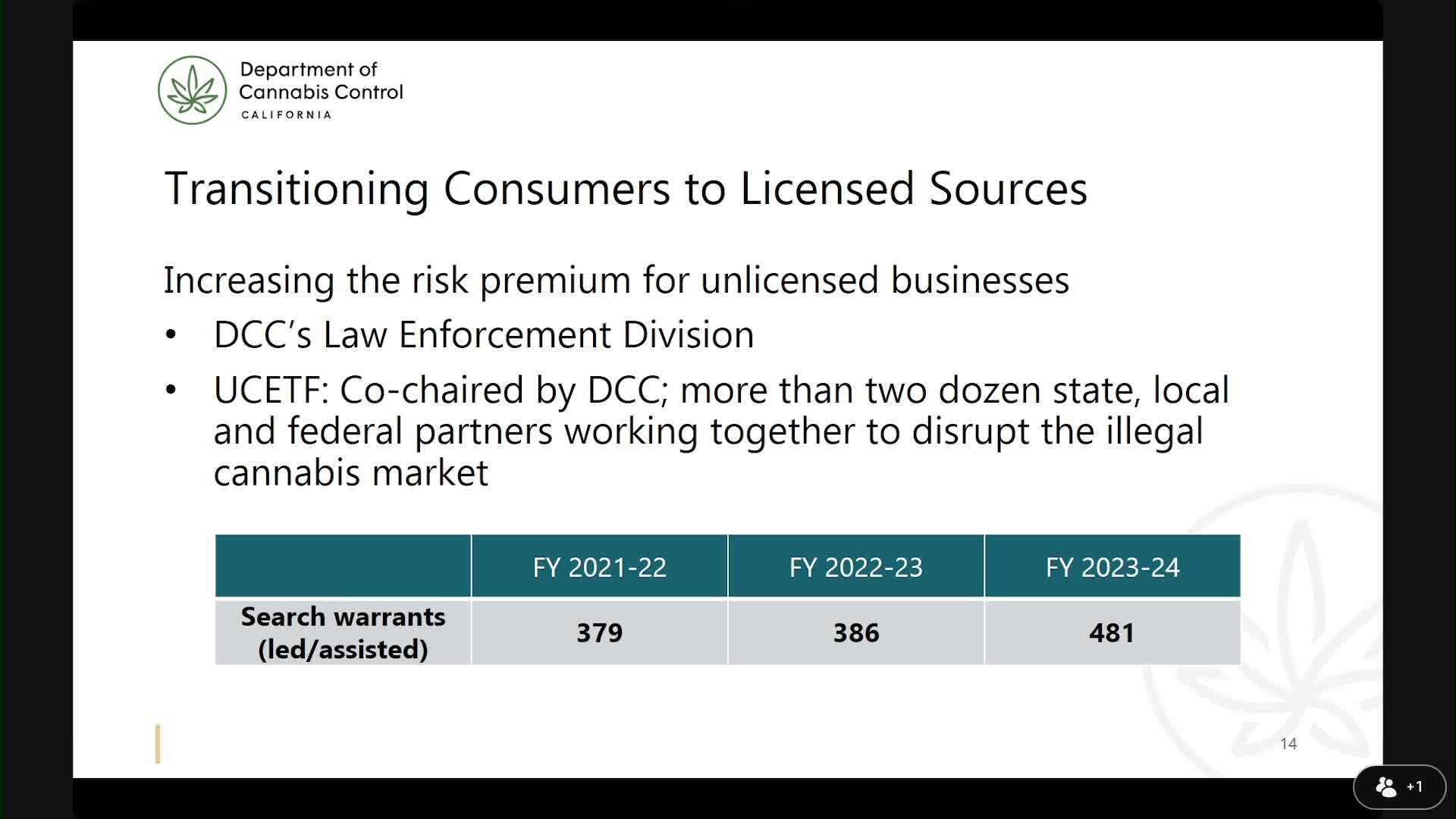
Christina Dempsey, deputy director of government affairs for the Department of Cannabis Control, noted the department—9s enforcement division has 87 staff dedicated to illegal cannabis investigations and that since July 2021 the division has reported seizures of more than $2.2 billion in illicit product. Dempsey described the department—9s role in co-chairing the state—9s Illegal Cannabis Enforcement Task Force (USITEF), which coordinates more than two dozen local, state and federal agencies.
But multiple lawmakers said operational and funding gaps remain. Senator Archuleta and others asked whether current enforcement activity is adequate to disrupt large-scale illicit production and to deter illegal retail. Dempsey said enforcement is critical but complicated: many of the highest-cost enforcement activities are financed through license fees for the regulated market, which can increase costs for licensed operators and create tensions between enforcement spending and industry competitiveness.
Several questions focused on prosecution and cost recovery for enforcement. Lawmakers said successful long-running compliance cases in other regulated areas have benefited when local prosecutors and state attorneys general could recover fines and redirect funds to future enforcement. Department officials said identifying the ultimate beneficial owners of illicit operations is often difficult and time consuming, which slows criminal or civil enforcement that could yield cost recovery.
Dempsey and Kellum described steps to improve coordination with federal partners and local prosecutors. The department highlighted monthly and quarterly coordination meetings, participation in multiagency task forces and an upcoming multi-day Sacramento event bringing local law enforcement together with state partners to discuss enforcement strategies.
Why this matters: committee members representing jurisdictions with many retail closures said limited enforcement and uneven prosecution let illegal shops re-open quickly, undermining the regulated market and public safety. Several members requested reports and follow-up briefings on enforcement outcomes and coordination with district attorneys and federal partners.
The record shows enforcement is a central lever lawmakers may use to influence the licensed market—9s competitiveness, but department officials told the committee enforcement alone will not fix industry dynamics without complementary steps: lower licensed costs, greater legal retail access, and public education to shift consumers to the regulated market.