Get Full Government Meeting Transcripts, Videos, & Alerts Forever!
Get email alerts on the Cannabis Market Economics topic
No spam. Unsubscribe anytime.
State economist: licensed cannabis production rising while prices and gross market value fall
Summary
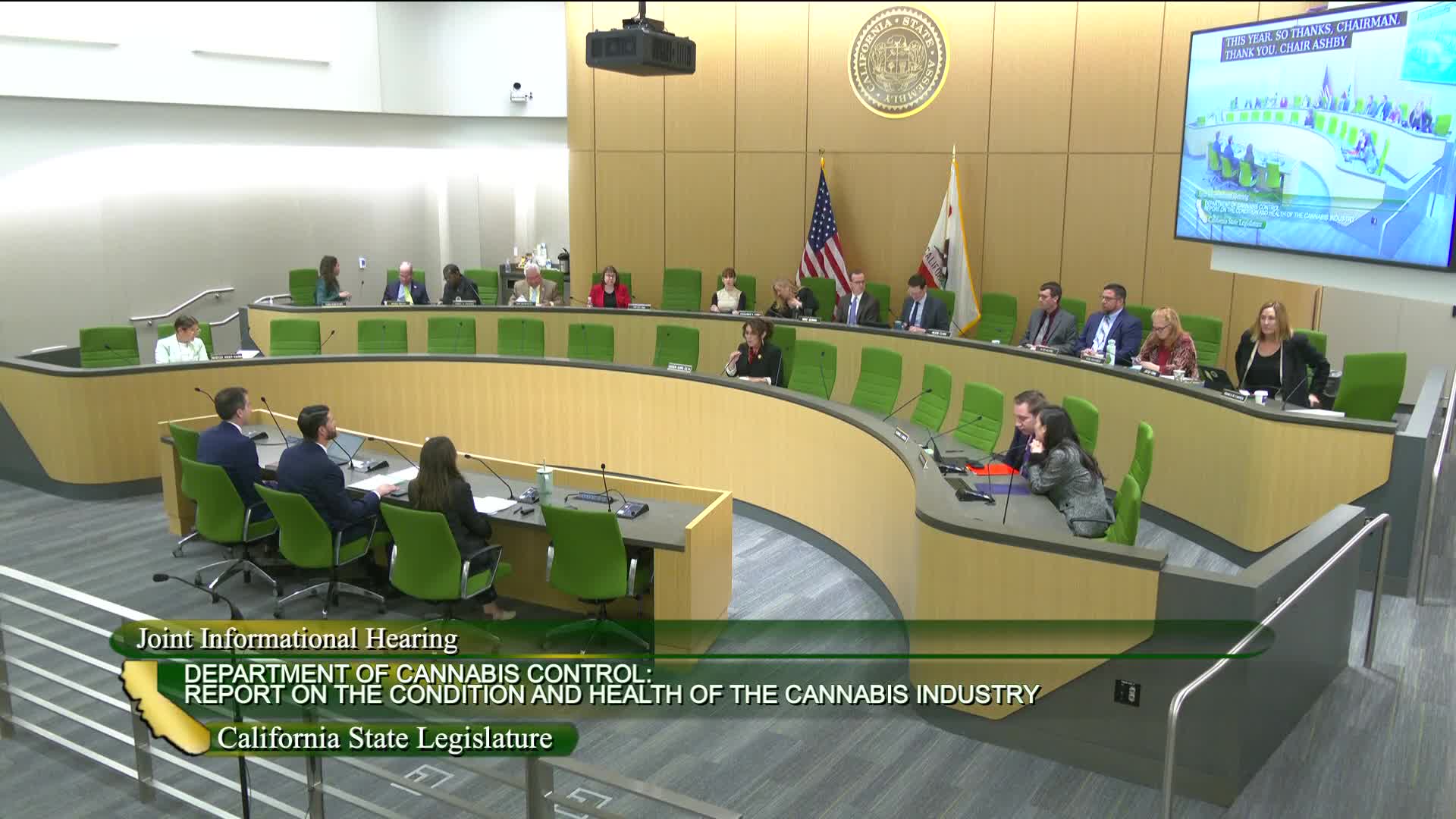
At a joint informational hearing, the Department of Cannabis Control and an outside economist told California legislators licensed cannabis production is increasing while wholesale and retail unit prices have fallen, reducing the industry—9s gross value even as quantity sold rises.
Licensed cannabis production in California has increased in recent years even as wholesale and retail unit prices have fallen, producing a decline in the industry—9s overall gross value, Department of Cannabis Control officials and the department—9s economist told a joint Senate and Assembly hearing.
"Total number of licenses is down," said Duncan McEwen, the economist who prepared the market analysis for the department, "but total production going through the licensed market is increasing and has increased by double-digit percentage points year over year. Unit prices at wholesale and retail are down by more than the increase in units produced, so gross value is down." McEwen summarized his presentation by saying the licensed market is growing in quantity but faces headwinds that limit revenue growth.
Clint Kellum, chief deputy director of the Department of Cannabis Control (DCC), and Christina Dempsey, the department—9s deputy director for government affairs, presented the report requested by the Legislature. Dempsey walked lawmakers through the regulatory history that led to creation of the Department of Cannabis Control in July 2021 and the state—9s licensing and enforcement framework.
The economists—9 analysis, which the department summarized at the hearing, showed that licensed production reached about 1,400,000 pounds (dry flower weight equivalent) in 2024 and that licensed consumption now accounts for roughly 38—5% of in-state consumption, up from about 33% in 2020. McEwen said the remainder of demand is supplied by unlicensed or illicit channels, which remain a substantial share of the California market.
McEwen described how price and quantity moved at different points in the supply chain. "Wholesale prices fell substantially in 2021 and 2022," he said. Since 2022 prices have largely stabilized and showed a modest uptick at the end of 2024, he added. Retail prices have followed the same pattern but the fall in unit prices has outpaced growth in units sold, reducing total retail sales value.
Legislators pressed department officials and the economist on how these trends affect small businesses and equity applicants. "Licensed cannabis production and units sold are up, yet the number of active licenses and total retail cannabis sales value are both down," said Chair Ashby (as introduced at the hearing), calling the findings "very concerning" and asking whether California is doing enough to support the licensed industry.
Dempsey and McEwen said the pattern reflects supply-side growth (more licensed production) combined with demand-side constraints and significant competition from illicit markets. McEwen emphasized the interaction of taxes, fees and enforcement costs with illicit-market competition: those factors can raise costs for licensed operators while illicit producers operate outside regulatory and tax burdens.
The hearing record contains a range of figures and caveats. McEwen—9s analysis uses a dry flower weight equivalent to normalize production and notes wide confidence intervals for estimates of illicit production because data for unlicensed markets are limited. The DCC also reported enforcement results: since the department formed in July 2021 its enforcement division has seized over $2.2 billion worth of product from the illegal marketplace and expanded joint operations through the Illegal Cannabis Enforcement Task Force (USITEF).
Why this matters: the mismatch between growing licensed production and falling prices helps explain store closures and business exits described by industry witnesses at the hearing and drives legislative attention to tax policy, enforcement capacity and retail access that lawmakers said must be addressed for the regulated market to stabilize.
The hearing record includes additional topics — enforcement coordination, product testing and pesticide lists, equity programs and the possible excise tax increase slated for July 1 — that lawmakers and industry groups said will bear on whether licensed operators can remain competitive with illicit sellers.
Looking ahead, McEwen told lawmakers the licensed market has room to grow but that reducing the price and availability gaps with illicit sellers will require a mix of stronger enforcement, improved consumer access to legal retail, regulatory adjustments to lower licensed compliance costs and continued public education about the differences between licensed and unlicensed products.
Source material: presentation and testimony by Department of Cannabis Control officials Clint Kellum and Christina Dempsey and economist Duncan McEwen at a joint informational hearing before the California Legislature.