Get Full Government Meeting Transcripts, Videos, & Alerts Forever!
Get email alerts on the Pharmacy Standard Of Care topic
No spam. Unsubscribe anytime.
California pharmacy board pushes standard‑of‑care model; supporters say it protects access, physicians urge guardrails
Summary
The California State Board of Pharmacy this morning told a joint legislative committee it seeks to move pharmacists from protocol‑based practice toward a standard‑of‑care model to reduce regulatory barriers and improve patient access.
The California State Board of Pharmacy this morning told the Assembly Business and Professions Committee and the Senate Committee on Business, Professions and Economic Development that it is pursuing a transition from protocol‑based regulation to a standard‑of‑care model for pharmacists. The board said the change would reduce administrative barriers that delay access to preventive medicines and other services.
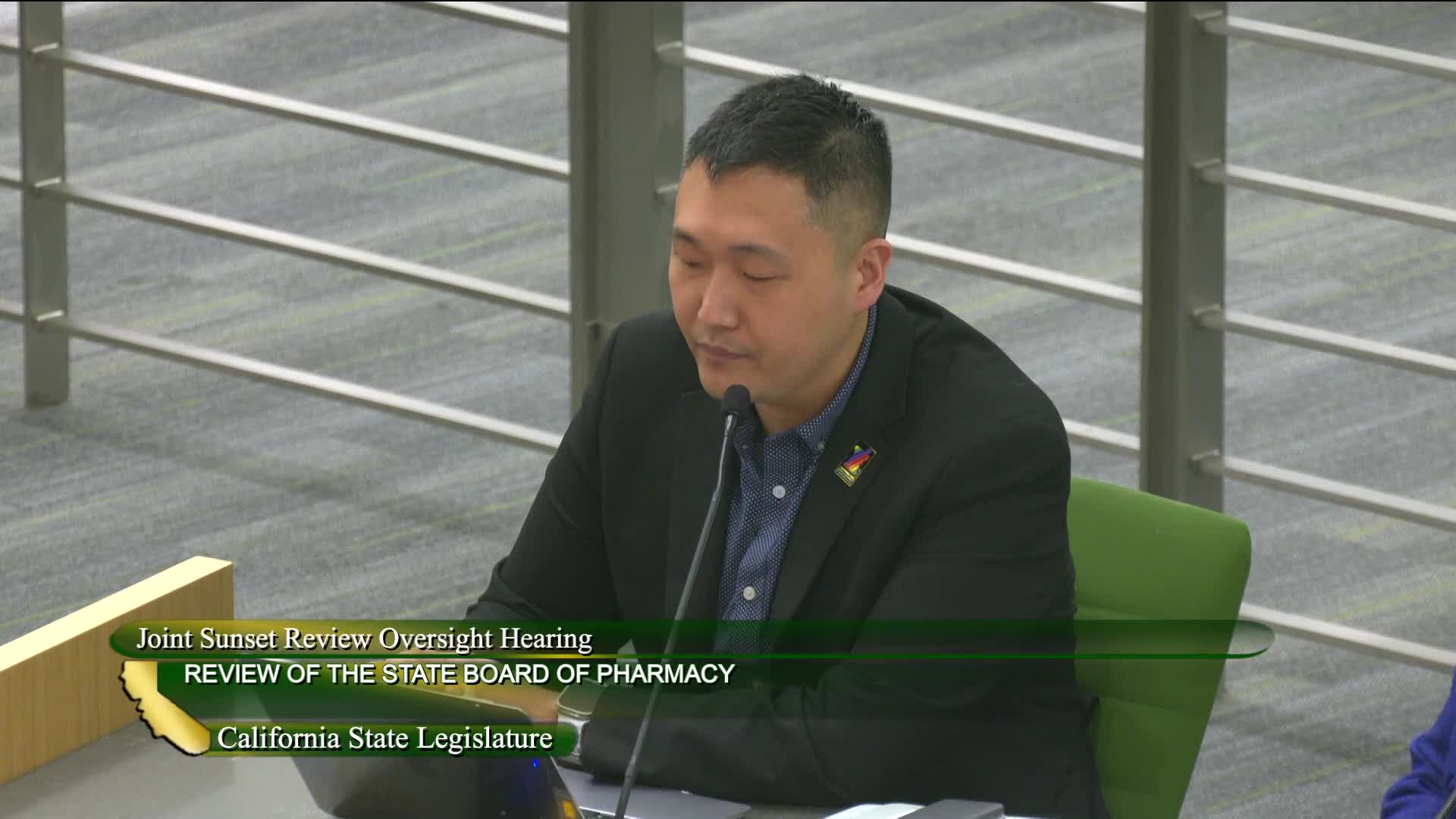
Seung Oh, president of the California State Board of Pharmacy, told lawmakers the board wants pharmacists to ‘‘practice to the best of the what’s out there’’ and cited HIV PEP and PrEP, hormonal contraception and naloxone as examples of care hindered by current protocols. "The proposed transition to a standard of care practice model will remove these and other persistent barriers and allow for the natural transition of practice to occur without the administrative burdens currently placed on the Board and its licensees," Oh said.
Why it matters: supporters argue the model would let clinicians provide timely care without waiting for legislative or regulatory changes when federal guidance or clinical best practices evolve. Opponents say broad standard‑of‑care language risks expanding pharmacist responsibilities beyond current training and could create patient safety concerns if safeguards are not explicit.
Supporters at the hearing included Richard Dang, assistant professor of clinical pharmacy and speaking for the California Pharmacists Association, who said pharmacists are "medication experts who optimize drug therapy to ensure safety and efficacy" and urged the committee to "modernize pharmacy regulation" by adopting a standard‑of‑care approach. Andre Peters, representing California Society for L System Pharmacists, said a standard‑of‑care enforcement model would align pharmacy regulation with physician and nursing models and focus enforcement on patient outcomes rather than technical violations.
Physician groups urged caution. George Soares of the California Medical Association said the CMA interprets the board's proposal as an expansion of services and warned that pharmacists often lack access to complete patient records and the corporate protections physicians have. "We fear that large retail pharmacies will exploit the broad language a standard of care model employs and pressure their pharmacist to practice in a way which increases their profit rather than prioritizing patient care," Soares said.
Board officials said the proposal is intended to preserve patient access and protect health equity across California, and they signaled willingness to work with the legislature and stakeholders to define the model and its limits. No formal action or legislation was taken at the hearing; committee chairs emphasized the session was informational and part of the sunset review process.
Looking ahead: lawmakers and stakeholders said they expect further drafting and negotiations as the board and the legislature consider whether statutory changes will be needed to implement a standard‑of‑care framework.