Get Full Government Meeting Transcripts, Videos, & Alerts Forever!
Get email alerts on the Climate Action Plan topic
No spam. Unsubscribe anytime.
Eagan unveils draft Climate Action Plan with 2035 and 2050 targets; public comment opens Feb. 13–Mar. 10
Summary
Consultant and city staff presented a draft Climate Action Plan recommending sector goals, measurable actions and a public input period. The draft sets a 2035 emissions target and a 2050 net‑zero aim and outlines 8 sectors, 24 strategies and 74 actions.
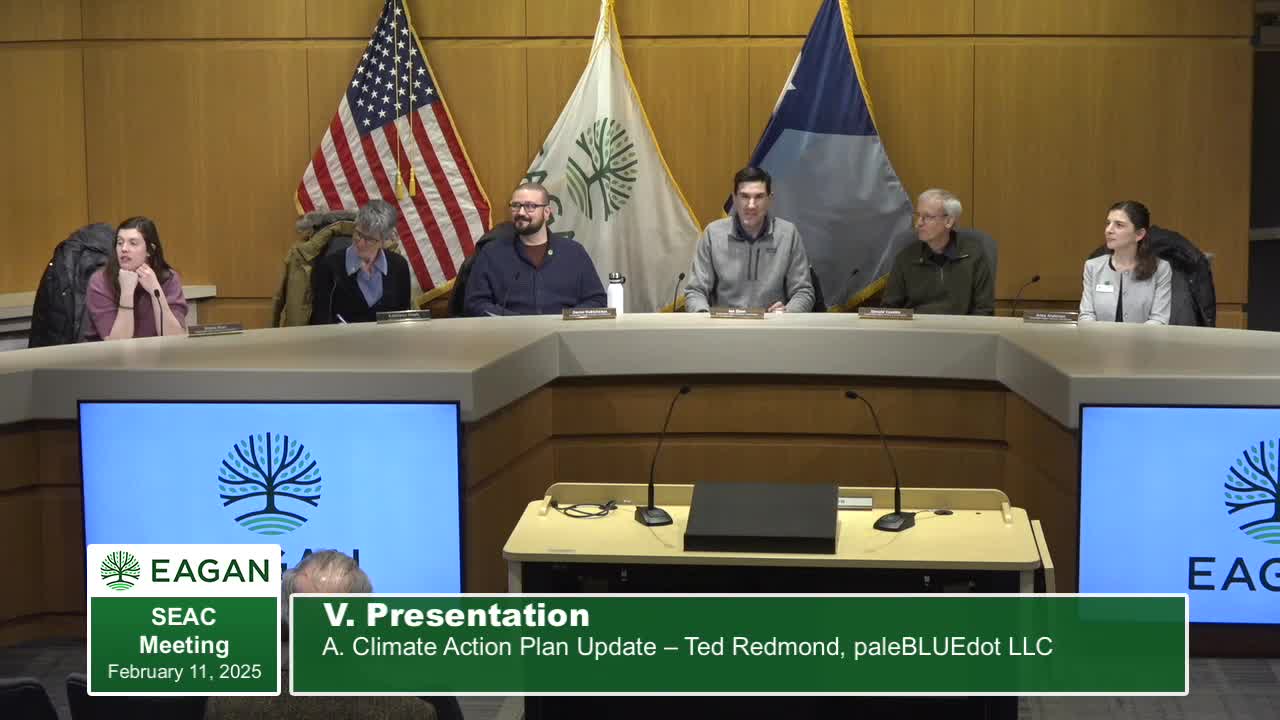
A draft Climate Action Plan that lays out sector goals, 74 actions and community targets was presented to the Sustainable Eagan Advisory Commission on Feb. 11, 2025, and city staff recommended the draft move forward for public input and comment.
The plan, developed with consultant Ted Redmond of Pale Blue Dot and a 64‑member planning team, summarizes about 14 months of work including eight community meetings, two online surveys and a set of five foundational research documents (vulnerability assessment, greenhouse‑gas inventory, ground‑cover study, renewable energy potential study and a baseline assessment). “We also have the plan itself,” Redmond told commissioners as he reviewed the process and major findings.
Why it matters: the draft sets explicit near‑ and long‑term climate goals for the city and identifies actions the city or community can take over the next decade to reduce greenhouse‑gas (GHG) emissions and increase resilience. City staff told the commission they want the draft posted for community review before refining implementation steps.
Key targets and scope - The draft lists eight sectors (transportation and land use; buildings and energy; waste management; water and wastewater; food and agriculture; green space and ecosystems; health and safety; and economy) with 24 strategies and 74 discrete actions intended to be implemented over roughly a 10‑year horizon. - The presentation reported a communitywide emissions baseline (most recent inventory year 2022) of about 1.09 million metric tons of CO2e. The plan estimates reducing citywide emissions to roughly 567,000 metric tons by 2035 (about a 55% reduction from 2014 levels reported in the plan) and aims for community‑wide net zero GHG emissions by 2050. The draft also calls for 100% renewable electricity for municipal buildings by 2035.
Community input and equity Redmond said the planning process included targeted equity listening sessions and that a second round of equity input is planned to review the draft with historically underrepresented groups. City staff confirmed the draft and an online input survey will be open for public comment from Feb. 13 through March 10, 2025, in addition to two public meetings scheduled for Feb. 19 and March 5. A QR code and a survey link were noted as the online submission route.
Examples of survey results the team cited include: 77% of respondents said it is important for Eagan to take action on preparing for climate change (resilience); 75% said reducing emissions is important; and 72% would like to see Eagan act as a leader on climate. The consultant cautioned that the survey was voluntary and not a scientific sample but said results aligned with county‑level findings.
Sector highlights and measurable goals - Transportation: goals include decreasing vehicle miles traveled (VMT) by at least 2.5%, increasing public transit use and achieving 15% electric‑vehicle registration communitywide; 67% of survey respondents supported development rules that favor walkable neighborhoods. - Buildings and energy: targets include roughly a 48% reduction in sector emissions by 2035, a combined goal of 10% of electricity from renewable sources (communitywide share as presented), a 5% decrease in electricity consumption and a 25% reduction in natural gas consumption (of which 10 percentage points come from efficiency and 15 from fuel switching such as heat pumps). - Waste management: actions emphasize recycling and organics diversion; the survey showed 73% support for community food‑waste/compost collection. - Water and wastewater: the draft includes goals to reduce water use and wastewater generation to improve resilience; the plan attributes a small but measurable emissions share to the water sector because of energy used in pumping and treatment.
Implementation and next steps City staff recommended the draft be released for public comment. Redmond and staff described the draft as a “menu” of actions to be tracked and measured where feasible, and they said staff and the commission will later prioritize actions for implementation, monitoring and reporting. Redmond suggested re‑evaluating and updating the plan near 2035 as the city moves toward longer‑term goals.
Direct quote from the presentation: City staff told the commission that “staff recommends that the draft plan move forward for public input and comment.”
What remains unsettled: the draft contains some strategy statements that currently lack precise numerical metrics; Redmond said staff will identify measurable indicators or process metrics (for example, whether the city updates plans and implements identified projects) for those strategies during implementation planning.
Evidence from the meeting The presentation and Q&A comprise the primary evidence for this article; the draft was provided to the commission in advance and the consultant reviewed both research inputs and expected outcomes during the Feb. 11 meeting.
Looking ahead: Residents and stakeholders may submit feedback through the survey link or attend the two public meetings scheduled during the March public comment window. City staff and the Sustainable Eagan Advisory Commission will use public input to refine priorities and begin implementation planning.