Get Full Government Meeting Transcripts, Videos, & Alerts Forever!
Get email alerts on the Emergency Medical Services topic
No spam. Unsubscribe anytime.
SFFD reports rising ambulance calls, long hospital offloads; Sixth Street triage center operating on limited hours
Summary
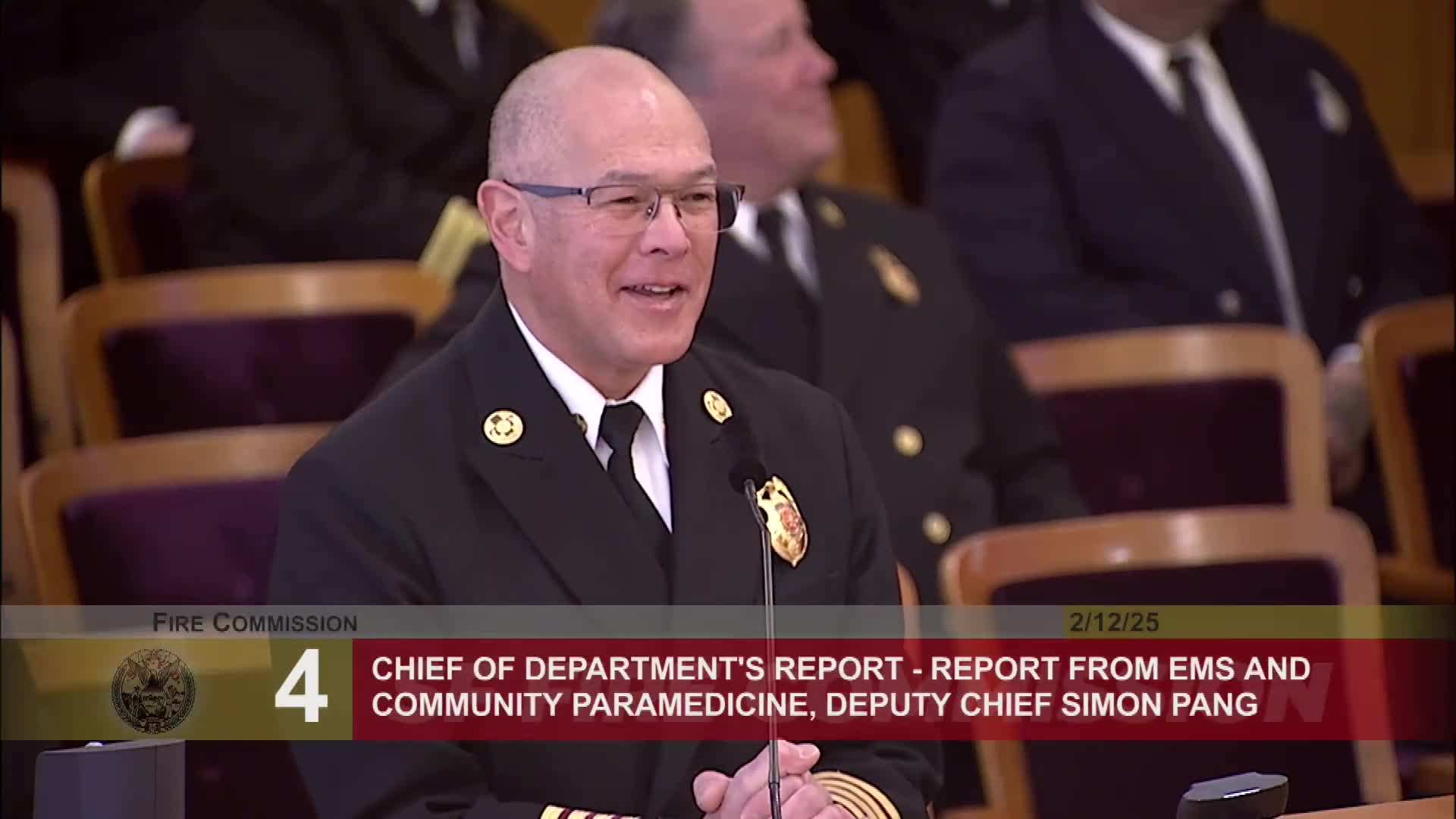
Deputy Chief Simon Pang told the Fire Commission on Feb. 12 that ambulance call volume and hospital offload delays rose in January, straining field resources and prompting proposals to streamline APOT alerts and hospital redirection.
Deputy Chief Simon Pang reported to the Fire Commission that the San Francisco Fire Department saw increasing ambulance dispatch volume in January and substantial ambulance patient offload time (APOT) delays at area hospitals.
Pang said nearly 12,000 ambulance dispatches occurred citywide in January and San Francisco Fire Department ambulances responded to slightly more than 9,000 of those calls, representing about a 78% market share. He said the department's rescue captains handled roughly 1,100 high-acuity calls that month and that paramedics performed advanced skills (airway, intraosseous access) on 135 occasions.
Pang described hospital offload delays as a major operational problem. He said APOT averages in January were around 50 minutes for many transports and provided counts of extended delays: 1,366 incidents delayed 45'60 minutes, 863 delayed 60'90 minutes, 146 delayed up to 2 hours, and 87 delayed more than 2 hours. "This is a really big problem for us," Pang said, noting the department estimated the delayed transports were equivalent to roughly eight ambulances per day taken out of service.
Pang reviewed existing response tools, including monthly APOT working groups with hospitals and regulators and the department's ability to declare APOT alerts when multiple ambulances are delayed. He said the department has proposed policy changes to streamline alerts and hospital redirection to the local EMS authority.
On overdose response and street teams, Pang said first responders administered Narcan about 200 times per month and the department recently added ketamine as a non-opioid analgesic option for field pain control. He described the Lifeline volunteer program, a community outreach effort that visits senior housing to make medical histories accessible; Lifeline is funded through private donors and supported by the department's community outreach committee.
Pang also addressed the Sixth Street triage center, which began a soft launch Feb. 7. He clarified what the center is and is not: "It is not a safe consumption site. It is not a place where treatment and services will be conducted. It is led by police. It is a safe place for people to be," Pang said. He said the department had offered to staff one street-crisis van and one captain 24/7 if the center expands to round-the-clock operations but that the site was operating Monday'Friday, 7 a.m.—1 p.m. at the time of the report.
Commissioners asked for deeper analysis of APOT causes; Pang said hospitals have responded constructively to the APOT working group and the department will continue to press for operational changes.
Key numbers and operational context from the meeting: b7 Total citywide ambulance dispatches (January): ~12,000. b7 SFFD ambulance responses (January): ~9,000 (78% market share). b7 APOT extended delays (January): 2,462 incidents delayed over 45 minutes; equivalent to ~8 ambulances/day removed from service (department calculation). b7 Narcan administrations: ~200 per month. b7 Fire Academy/Class-size: 54 recruits in the 130th Fire Academy (training noted in related reports).
Pang concluded by praising field crews and community teams for on-scene work and relayed one observation from a field captain as an example of trauma-informed care at a difficult scene.