Get Full Government Meeting Transcripts, Videos, & Alerts Forever!
Get email alerts on the Water Utilities topic
No spam. Unsubscribe anytime.
Committee advances bill to aid troubled water systems, adds limited liability language after stakeholder talks
Summary
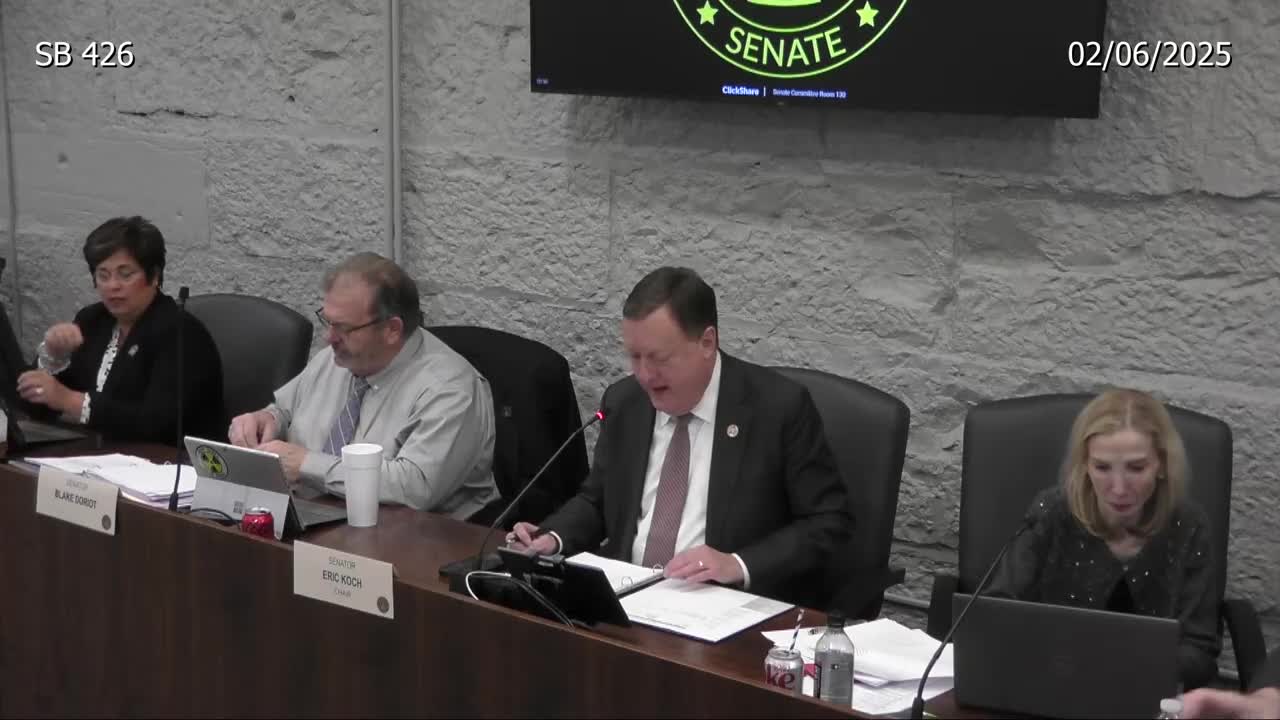
The Senate Utilities Committee voted to advance Senate Bill 426, a measure to provide new acquisition mechanisms and other tools to support financially troubled water utilities, after adopting technical amendments and narrowing an immunity provision following stakeholder talks.
The Senate Utilities Committee advanced Senate Bill 426 after adopting technical and substantive amendments intended to help small, financially challenged water and wastewater utilities transition ownership and access capital while addressing liability concerns.
Chairman Cook said the bill continues prior efforts to help “troubled utilities, many of these are small and without asset management plans, without capital.” The bill includes acquisition mechanisms and a provision clarifying that the Department of Natural Resources cannot remove a dam if such action would negatively affect a public water supply.
Witnesses representing utilities and municipal interests urged committee approval. Justin Schneider of Indiana American Water said the measure “will allow the commission to consider…mechanisms that will help facilitate a change in ownership so that the needed capital investment and management decisions can be made by utilities with the capacity to address system needs.” Schneider also said the bill’s timing language on recovery was aligned with existing mechanisms and that supporters sought protection from lawsuits that challenge compliance with established water‑quality standards.
Municipal representatives (AIM) and municipal utility coalitions also testified in favor, emphasizing that some small systems could not absorb litigation costs brought by challenges to standards even when utilities met regulatory requirements.
Consumer and environmental advocates expressed concern about language that could insulate utilities from liability. Kerwin Olsen of Citizens Action Coalition said the organization “support[s] the intent” of consolidation measures but warned that immunity language raised fears that “if you open up your tap and you drink poisoned water, you can't sue the utility company.” After stakeholder conversations, committee members adopted an amendment to remove specific timing phrases that had alarmed advocates and to narrow the immunity language; several advocates then shifted from opposition toward neutral positions.
The committee adopted amendment 1 (technical and conforming changes, and revised liability language) and an on‑the‑fly amendment to remove the phrase specified on page 6, lines 2–3. Committee discussion included the distribution improvement storage charge (a tracker) and concerns about shifting costs to customers.
The committee moved the bill, held the roll open for one member, and later recorded the final vote after a senator asked to abstain because he had missed some testimony. The clerk recorded the final tally as nine ayes, zero nays, one abstention and one excused member; the committee chair announced the bill passes 9–0 with one abstention and one excused.
Supporters said the bill would help move ownership and capital to entities able to make needed investments; opponents cautioned that any immunity language must leave consumers a clear path for recourse.
Formal action: motion to pass as amended (seconded) — committee recorded 9 ayes, 0 nays, 1 abstention, 1 excused; bill passed.