Get Full Government Meeting Transcripts, Videos, & Alerts Forever!
Get email alerts on the Rezoning 350 Powerhouse topic
No spam. Unsubscribe anytime.
Planning Commission recommends RG‑1 buffer and IND‑1 zoning at 350 Powerhouse Road, denies Carbon Rivers rezoning request
Summary
Oak Ridge Planning Commission members on Feb. 20, 2025 recommended zoning that places a 200‑yard RG‑1 (residential/open space) buffer along the Clinch River and zones the remainder of the 364.6‑acre parcel at 350 Powerhouse Road IND‑1 (light industrial). The commission also recorded a separate motion denying the rezoning application filed by the property owner, Powerhouse Land LLC (doing business as Carbon Rivers).
Oak Ridge Planning Commission members on Feb. 20, 2025 recommended zoning that places a 200‑yard RG‑1 (residential/open space) buffer along the Clinch River and zones the remainder of the 364.6‑acre parcel at 350 Powerhouse Road IND‑1 (light industrial). The commission also recorded a separate motion denying the rezoning application filed by the property owner, Powerhouse Land LLC (doing business as Carbon Rivers). The commission’s recommendation will be forwarded to Oak Ridge City Council, which makes the final decision.
The commission’s recommendation follows a lengthy public hearing and staff presentation. Planning staff said industrial zoning on the interior of the site was “appropriate” given the parcel’s isolation and proximity to other reindustrialization efforts at the East Tennessee Technology Park, but staff recommended a less intense band along the river to reduce impacts on the adjacent Preserve at Clinch River residential development. “Staff does believe that industrial zoning is appropriate on this site,” Planning staff said during the presentation, and added that a buffer or band of lesser‑intensity zoning was advisable where the parcel faces the preserve.
Why the decision matters: the 364.6‑acre parcel (described in the meeting as roughly 365 acres) has been used to store and process recycled wind turbine blades and has drawn neighborhood concerns about noise, dust and environmental impacts. The property had previously been under Department of Energy (DOE) ownership and carries deed restrictions that were discussed during the hearing. The Planning Commission’s recommendation modifies the owner’s requested zoning and creates a formal record for council consideration.
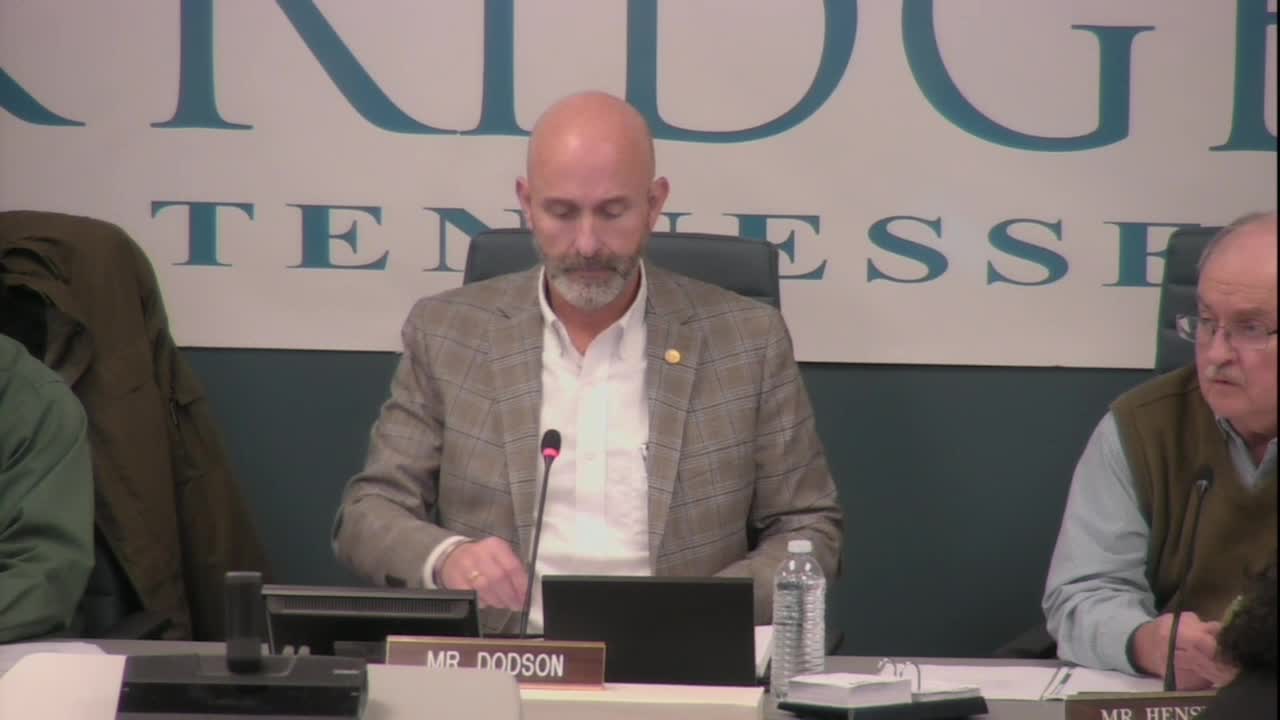
What the commission voted on and the results - Motion to deny the rezoning request of IND‑1/IND‑2 as submitted by Carbon Rivers (parcel 039064): passed on roll call, 6–0 (Commissioners Kitsmiller, Omby, Yeager, Mayor Pro Tem Dodson, Councilman Hensley and Commissioner Carrington recorded as voting Aye). The commission’s recorded vote appears in the meeting minutes and transcript. - Motion that would have zoned areas 2, 3 and 4 RG‑1 and the remaining land UB‑2 (the owner’s alternate suggestion discussed at one point): failed (vote recorded in meeting as 4–2; motion did not pass). - Motion to zone a 200‑yard band along the Clinch River plus areas labeled 3 and 4 RG‑1 and the remainder IND‑1: passed 5–1 (Commissioner Carrington voted No; other commissioners recorded as Aye). - To create a clear administrative record, the commission later recorded a separate vote denying Carbon Rivers’ original rezoning application; that motion also passed on roll call, 6–0. Staff emphasized that the commission’s actions are a recommendation to City Council, which will adopt any final ordinance on two readings.
Public testimony and major points raised - Property owner / operator: Nick Zapparo, who identified himself as “one of the owners” of Powerhouse Land LLC / Carbon Rivers, urged the commission to approve industrial zoning, saying processing of the blades requires industrial zoning and that without it the owner cannot remove or process blades cost‑effectively. He said, “If you want us to have those blades forever on that site, you just let me know,” and that the company’s plan relies on industrial zoning to permit on‑site processing. - Neighbors and preserve residents: multiple speakers who live in or near the Preserve at Clinch River urged denial of industrial zoning next to the neighborhood, citing noise, dust, foam reported in a waterway, and long‑term concerns about property values and wildlife. Comments included requests for conservation‑style zoning for wetlands and creek frontage (RG‑1) and skepticism that the blade recycling operation could be adequately buffered. - Safety/environmental questions: speakers referenced past code enforcement and fire department notices, reported foam and dust in waterways, and asserted contamination in some ponds (claims attributed to public speakers). Staff and the city attorney noted that enforcement and environmental oversight have involved city code enforcement, the Oak Ridge Fire Department, and contact with the Tennessee Department of Environment and Conservation; staff said zoning alone does not resolve existing code or remediation issues. - Staff and legal clarification: staff said rezoning to IND‑1 or IND‑2 would not eliminate subsequent review steps: if the use would be a solid waste transfer or recycling center it would also require Board of Zoning Appeals review and permitting. Staff also said it was not aware of any regulation that strictly precludes removing blades absent industrial zoning, and the city attorney said staff could research whether specific limits exist.
Key factual details and constraints discussed - Parcel size: the property discussed was described as roughly 364.6–365 acres. Several speakers and staff noted large portions of the site are constrained by DOE legacy conditions, wetlands and utility easements that limit where development can occur. - Buffer width debated: commissioners debated a buffer width; staff memo referenced a 300‑foot band in one recommendation, while commissioners and a motion ultimately used a 200‑yard (600‑foot) band along the Clinch River in the approved recommendation. The commission’s approved RG‑1 band was described during the vote as 200 yards from the water along the Clinch River. - Uses and process if rezoned: staff explained that even if the interior were zoned IND‑1 or IND‑2, uses such as processing could require approvals from the Board of Zoning Appeals, site plan review and permits. Staff also noted RG‑1 is an available private‑land conservation‑style zoning but not an absolute conservation easement; RG‑1 restricts some intensive uses but does not prohibit all development.
Quotes (verbatim, attributed) - From Chairman H. Stephen Whitson (letter read into the record): “It is my opinion that UB‑2 is the appropriate designation for this parcel.” (letter argued UB‑2 could support commercial activities but acknowledged competing interests.) - From Planning staff: “Staff does believe that industrial zoning is appropriate on this site.” - From property owner Nick Zapparo: “If you want us to have those blades forever on that site, you just let me know.”
Discussion vs. formal decision - Discussion: commissioners questioned the extent of developable acreage, the effect of deed restrictions and DOE legacy contamination, and whether UB‑2 (a commercial/urban business zone) or IND‑1/IND‑2 (industrial zones) were more appropriate. Multiple commissioners voiced concern for long‑term neighborhood impacts and property values. - Direction/assignment: the commission directed staff and legal to document the record and forwarded the recommendation to City Council; staff and legal were asked to research specific regulatory questions raised by the owner (for example whether industrial zoning is strictly required to remove or process blades on site). - Formal decision: the commission’s recommendation (200‑yard RG‑1 band along Clinch River + areas 3 & 4 RG‑1; remainder IND‑1) passed 5–1 and the commission separately recorded a denial of Carbon Rivers’ rezoning application (6–0). Those actions appear in the meeting minutes and will travel with the staff report to council.
What’s next - The Planning Commission’s recommendation is non‑binding; City Council will consider the commission’s recommendation and may adopt a zoning ordinance on two readings. Staff and the city attorney indicated they would follow up on the specific regulatory questions raised during public comment and the hearing.
Ending - Commissioners, staff and many residents said they wanted a clear record for appeals or later review. The commission closed the public hearing after the votes and moved on to other agenda items; the Planning Commission’s recommendation will be included with the staff packet forwarded to City Council for their consideration.