Get Full Government Meeting Transcripts, Videos, & Alerts Forever!
Get email alerts on the Climate Action topic
No spam. Unsubscribe anytime.
Penn State team delays Harrisburg greenhouse-gas inventory after utility data snag; proposes solar, EV and nature-based studies
Summary
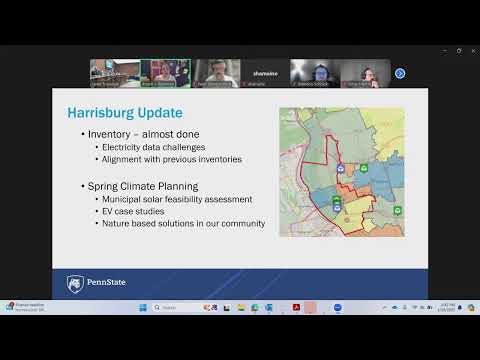
Penn State researchers told Harrisburg City Council on an evening meeting that the city's updated greenhouse-gas inventory for 2023 is nearly complete but remains delayed because the electric utility supplied consumption data by ZIP code, not by the city's jurisdictional boundary.
Penn State researchers told Harrisburg City Council on an evening meeting that the city's updated greenhouse-gas inventory for 2023 is nearly complete but remains delayed because the electric utility supplied consumption data by ZIP code, not by the city's jurisdictional boundary.
The Local Climate Action Program (LCAP) team, led by Brandy (Penn State LCAP co-director) and Peter Buck (co-director), said they are working with the utility, PPL, to disaggregate residential, commercial and industrial electricity figures so the inventory will not overstate Harrisburg’s emissions. "The utility company has given us your electricity data by ZIP code. And as you can see, these things do not line up at all," Brandy said, adding that the program will not present inventory results until the numbers can be trusted.
The inventory is the fall-semester product of Penn State courses the LCAP program runs; students then use that data in spring to develop climate-action recommendations. The team described three topic areas they plan to research this spring for Harrisburg: a feasibility assessment for rooftop solar on municipal buildings, case studies of municipal fleet transitions to electric vehicles, and identification of opportunities for nature-based solutions such as tree planting and community gardens. Madeleine (city staff) said the team also plans a community climate-opinion survey to collect resident priorities and basic demographics.
Why it matters: an accurate inventory establishes a baseline for comparing emissions year to year and for evaluating the potential impact of local actions. The presenters said they will explicitly document methodology differences between previous inventories to allow apples-to-apples comparisons.
Council members pressed for community engagement and equitable outreach methods. Councilwoman Rawls (Parks, Recreation and Enrichment chair) recommended multiple modes of public engagement — in-person meetings, door-to-door distribution and inclusion with utility/trash bills — arguing not all residents will complete online surveys. "You have to listen to what the people want and not make what you think they want," Rawls said. Councilman Jones praised the team's environmental-justice focus and offered to connect the team with local stakeholders.
On the scope of pollutants, Councilwoman Davis asked whether the inventory covers traditional air pollutants. Brandy said the inventory focuses on greenhouse gases — carbon dioxide, methane and nitrous oxide — and does not catalogue particulate matter or some other air pollutants, but added students use the EPA's EJScreen to investigate cumulative health impacts at the census-tract level and can overlay that information with demographic data. Peter Buck said the team is also aware of Pennsylvania's PenEnviroScreen as an alternative for environmental-justice screening.
The LCAP team said Penn State’s students and DEP’s Energy Programs Office provide technical support and that ICLEI (Local Governments for Sustainability) software and technical assistance support their inventory and forecasting work. The team expects to deliver the final inventory and a climate-planning report to the city in April, once the electricity data are resolved.
The council and LCAP team agreed to continue coordination; Brandy said the students would welcome review of the survey and suggested the city could help with outreach partnerships. The presenters emphasized that the spring work will be designed to dovetail with existing city plans and parks projects to maximize co-benefits.
Looking ahead: the team will return with the completed inventory and recommended actions; timing for that follow-up depends on receiving disaggregated utility data and reconciling methodology with prior inventories.