Get Full Government Meeting Transcripts, Videos, & Alerts Forever!
Get email alerts on the Voluntary Remediation Closure topic
No spam. Unsubscribe anytime.
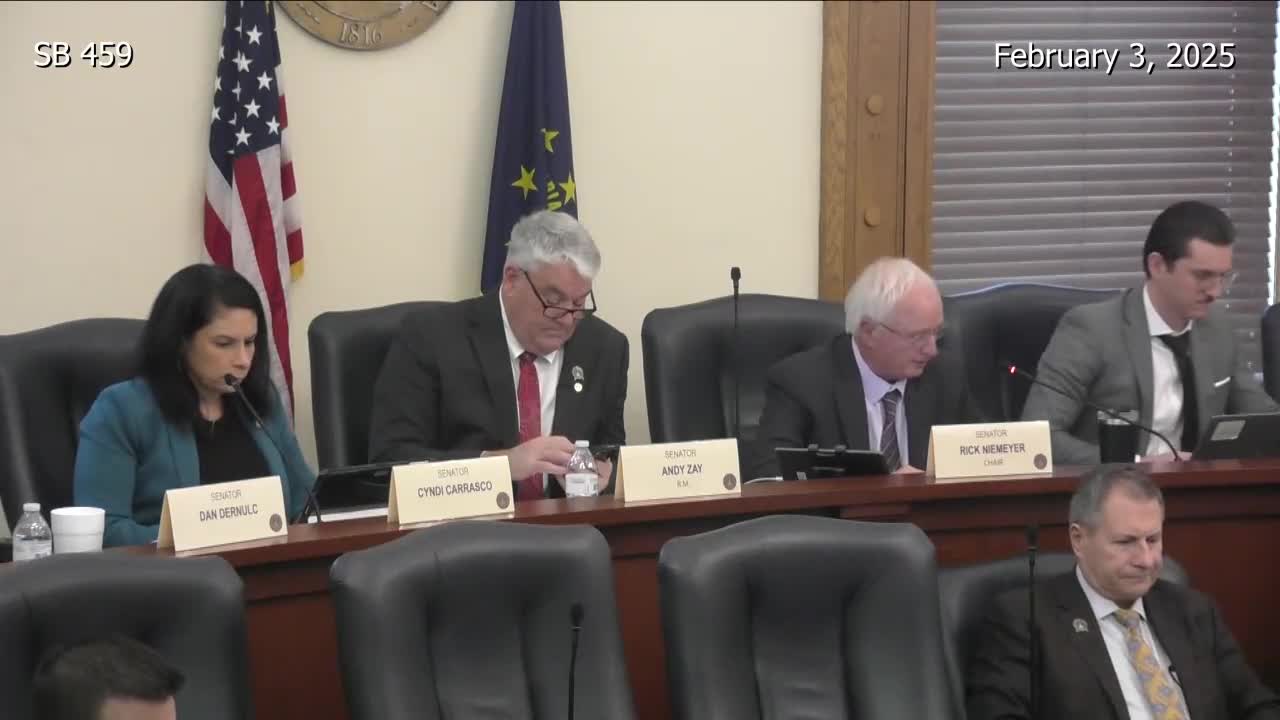
Senate committee hears dispute over voluntary remediation closure after multi‑million dollar cleanup; bill held for further work
Summary
Senate Bill 349, which would clarify when IDEM may grant closure under the Voluntary Remediation Program if neighboring landowners refuse environmental restrictive covenants, drew extended testimony and was held for further work rather than voted out of committee.
Senate Bill 349 prompted extended testimony and debate over the state’s Voluntary Remediation Program (VRP) and the use of environmental restrictive covenants (ERCs) to control exposure after a cleanup. The committee did not take a final vote and the bill was held for further work.
Representatives for AutoCar and affiliate Hagerstown Land described a long cleanup at a former industrial site in Hagerstown that they say otherwise meets VRP requirements but is blocked from final closure because some neighboring private property owners will not accept ERCs. Miriam Dant, representing AutoCar, said the company and its insurer have spent “around $8,000,000 on remediation costs to date” and that 30 of 36 affected parcels had signed restrictive covenants while six property owners refused. Dant asked the legislature for clarification so that a successful remediation is not stalled by a few landowner refusals.
AutoCar’s counsel, Tom Baker, said the ERCs applied in the case are narrowly tailored to restrict only future wells in a defined portion of parcels while allowing most existing uses — for example, farming — to continue. He said the company had offered compensation to property owners as part of negotiations.
IDEM testified that the agency uses risk‑based criteria and institutional controls, including ERCs, to control exposure when contamination remains in place, and that the agency’s legal standard already requires an assessment of likely future use in evaluating whether controls are necessary. Drake Abramson, IDEM’s legislative director, said the language in SB 349 — which would allow closure when “the expected future use of the site is more likely than not to result in exposure” — is ambiguous and could permit closure even where the probability of exposure approaches 50 percent. IDEM officials asked for clearer language and raised public‑health concerns about lowering closure standards.
The Hoosier Environmental Council opposed the bill, saying it risks shifting contamination‑related risk onto unwitting future landowners who would not receive an obvious public notice tied to a deed if ERCs were not required. David Van Gilder, HEC’s policy and legal director, said the council wants the public to have clear notice of contamination before they buy property.
A professional environmental engineer who testified as a neutral witness explained the risk‑assessment framework agencies use (risk = hazard × exposure) and noted that IDEM’s guidance already includes situations where a pathway is judged so unlikely that an institutional control is unnecessary. Lauren Nielsen said remediators and regulators can already adopt narrower exposure assumptions in a risk assessment when appropriate but cautioned that the mathematics of risk can make small probabilities material when hazards are potent.
Committee members discussed tradeoffs: lawmakers who want to remove barriers that prevent redeveloping remediated industrial sites versus the agency’s role protecting public health and ensuring future landowners are warned. Several senators suggested narrower, targeted fixes—such as deed‑level notice or more specific limiting language for ERCs—rather than a broad statewide change in closure standards.
Outcome: The sponsor and IDEM said they had been negotiating and that further work was possible. The committee held the bill for additional drafting and stakeholder meetings rather than voting it out of committee on the day’s hearing.
Ending: Committee members asked IDEM and proponents to continue discussions and to return with clarified language that balances closure certainty for remediators with public‑health protections and clear notice for future landowners.