Get Full Government Meeting Transcripts, Videos, & Alerts Forever!
Get email alerts on the Agriculture Cafo Inspections topic
No spam. Unsubscribe anytime.
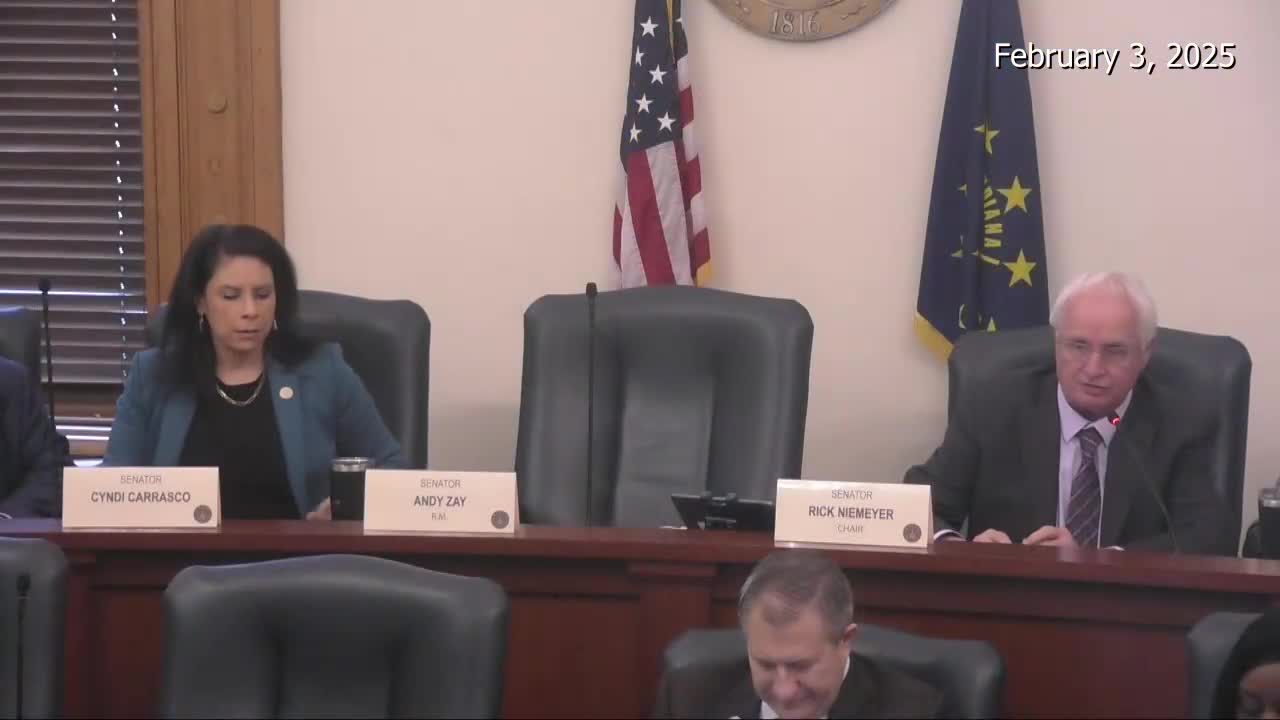
Senate panel approves extra CAFO inspection mid‑permit after amendment
Summary
The Senate Environmental Committee approved an amendment and passed Senate Bill 193, adding one additional confined feeding operation (CFO) inspection during the five‑year permit term, limited to manure storage and requiring 30 days’ notice; industry witnesses opposed a statutory inspection frequency, saying it reduces IDEM flexibility.
Senate Bill 193, which would require one additional inspection of confined feeding operations (CFOs) during the five‑year permit period, passed the Senate Environmental Committee 9‑1 after the committee accepted an amendment narrowing the change.
The bill’s sponsor, Senator Niemeyer, told the committee the amendment “says that we’re adding 1 more inspection in that 5 year period,” and that inspectors would be limited to examining the activities authorized by the CFO permit—chiefly manure storage—and would give 30 days’ notice before the midterm visit.
The measure is intended to address concerns raised by adjoining property owners about runoff and odor. Opponents from the livestock and farm groups argued a statutory inspection cadence would hamper the Indiana Department of Environmental Management’s (IDEM’s) ability to allocate inspection resources by risk and could shift resources away from discretionary, risk‑based investigations. Josh Trenaryk of the Indiana Pork Producers Association said, “Indiana pork is opposed to this bill. We’re opposed to any statutory requirement for inspection frequency because we feel like it hampers the agency’s ability to employ their resources.”
Industry witnesses also told the committee that producers routinely hire environmental consultants and that the agricultural economics of manure—described by a presenter as fertilizer with real value—give farmers an incentive to maintain storage and application systems. Trenaryk estimated state‑wide figures for context: about 1,635 permitted livestock, poultry and dairy operations and, for an illustrative 4,000‑head swine finisher, roughly $87,000 in annual fertilizer value from manure.
IDEM staff said the agency could absorb the workload under the amended language without hiring new inspectors. Drake Abramson, IDEM’s legislative director, told the committee the amendment reduced the fiscal impact that an earlier version of the bill had shown, and that IDEM generally inspects about 20% of permitted CFOs per year as part of its delegated program. A fiscal note circulated earlier had estimated that a broader inspection mandate could require up to six additional inspectors at an annual cost of roughly $540,000–$565,000; sponsors said the amendment avoided that hire.
Committee members asked whether private environmental consultants’ site visits could be coordinated with IDEM inspections to reduce duplicate visits; IDEM said it would consider the suggestion. Several senators emphasized balancing property‑owner concerns with maintaining an effective, risk‑focused inspection program.
Votes at a glance: The committee recorded the bill as passing 9‑1. Recorded votes in committee statements and roll call included Senator Jackson (Aye), Senator Niezgodski (Yes), Senator Taylor (Excused), Senator Zay (No), Senator Baldwin (Aye), Senator Bassler (Aye), Senator Buck (Aye), Senator Crossco (Aye), Senator Bush (Aye), and Senator Niemeyer (Yes). The committee approved the amendment by unanimous consent prior to final passage.
The committee approved the amendment and the amended bill on the record; the sponsor said the change was designed to reassure adjoining property owners while avoiding a large, immediate hiring cost to the agency.
Supporters and opponents: IDEM presented technical context and said the agency typically inspects new permitted facilities within their first six months and follows up; the Indiana State Poultry Association and the Indiana Farm Bureau remained opposed to a statutory increase, citing biosecurity and cost concerns. The Indiana Pork Producers Association likewise opposed the bill, saying a fixed statutory schedule would reduce risk‑based inspections. The sponsor and some committee members said the change was limited, targeted, and aimed at providing adjoining property owners assurance that there would be an additional check during a permit term.
What happens next: The committee advanced the amended bill to the next stage of consideration. The amendment and the change to require a midterm inspection will be part of the bill text moving forward; sponsors and IDEM said they would continue to discuss implementation details such as possible coordination with third‑party inspections.
Ending: The committee’s vote moves the amended measure into the legislative process; sponsors said they view the change as a narrow measure to address neighboring property owners’ concerns while preserving the agency’s ability to perform higher‑priority, risk‑based work.