Get Full Government Meeting Transcripts, Videos, & Alerts Forever!
Get email alerts on the School Budget topic
No spam. Unsubscribe anytime.
Centennial SD 28J projects $3.5–$4 million shortfall for 2025–26 as enrollment falls and payroll costs rise
Summary
Superintendent Owens told the Centennial School District Budget Committee on Jan. 22 that the district is forecasting a structural budget gap for the 2025–26 school year driven by lower enrollment, rising payroll-related costs and the end of federal pandemic relief funds.
Superintendent Owens told the Centennial School District Budget Committee on Jan. 22 that the district is forecasting a structural budget gap for the 2025–26 school year driven by lower enrollment, rising payroll-related costs and the end of federal pandemic relief funds.
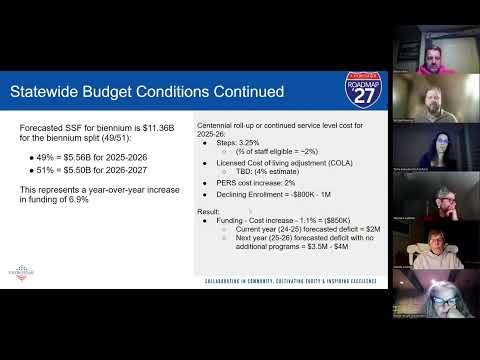
The gap stems from a projected increase in district expenses of about 8% for 2025–26 while the governor's proposed state school fund increase would amount to roughly 6.9% in the first year of the biennium, Superintendent Owens said. “The state of Oregon is not projected to provide sufficient funds to do the same things next year that we are doing this year,” Owens said during the presentation.
Nut graf: The committee heard that expiring federal ESSER dollars, employer retirement (PERS) costs, negotiated salary step/cola increases and continued declines in student numbers together create a projected general-fund shortfall of about $3.5 million to $4 million for 2025–26. District leaders said they will deliver a proposed budget in April that reflects targeted reductions and priorities the committee identifies.
Most important fiscal drivers - ESSER expiry: Owens said elementary and secondary school emergency relief (ESSER) funds expired in September 2024 and will not be available in 2025–26; district leaders said some summer 2024 expenses were shifted into ESSER this year, which has temporarily helped offset other pressures. “That will not be the case in the coming year,” Owens said. - PERS and payroll: Director of Business and Operations Paul Sotherton and Owens explained rising employer rates for the Public Employee Retirement System (PERS). Owens illustrated the growth: “When PERS began, the district paid $60 to PERS for every thousand dollars of salary. This year it was $280 per thousand dollars of salary and next year it will be $300 per thousand.” District staff said the projected PERS increase is approximately the equivalent of a 2-percentage-point expense increase. - Salary and step increases: The district assumes an annual step increase (for eligible employees) and forecasted cost-of-living adjustments. Owens described a 3.25% step schedule for eligible staff (about two-thirds of employees), producing roughly a 2% overall impact; classified staff bargained a 5% increase this year and 2.5% for 2025–26; licensed staff bargaining was set to begin and the district modeled a 4% licensed cola for planning. - Declining enrollment: Leaders said enrollment now sits at roughly 5,400–5,500 students, down from about 6,700 a decade ago. Sotherton estimated the enrollment trend will reduce revenue by roughly $800,000 to $1 million in the coming year and described “hot spot” midyear staffing adjustments that increased costs despite the decline.
Projected totals and shortfall - The governor’s proposed state school fund biennium total cited in the presentation was $11,360,000,000 split approximately 49%/51% across the two years (about $5.56 billion and $5.82 billion). District leaders noted that a 6.9% statewide increase does not close Centennial’s expense growth because projected expenses outpace that increase. - Sotherton and Owens said the district currently plans to use a portion of its ending fund balance as part of a multi-year strategy, but a sustained $3.5–$4.0 million deficit would be unsustainable and would require targeted reductions.
Budget process and next steps Director Paul Sotherton reviewed the budget committee’s role and timeline: the committee will receive the full proposed budget at its April 23 meeting, may deliberate and request information during the April–May feedback window, hold a final budget meeting in late May and forward a recommended budget and tax levies to the school board for adoption in June. Sotherton said the committee must take public comment before final approval.
Committee members and leaders discussed priorities the district should protect during any reductions (early learning, attendance/engagement supports, social-emotional services, high-quality academics and co-curricular activities). Sotherton said the administration will follow up with a short survey so budget committee members can rank priorities ahead of the April proposal.
What the district asked of legislators Owens and Sotherton urged attention to state funding formula issues during the 2025 legislative session, including removal of the cap on special-education funding and updates to poverty measures and other weights in the formula. Owens noted that federal law (IDEA) is underfunded nationally and that Oregon’s add-on funding for special education is capped at 11%, while many districts have special-education rates above 13–15%.
Ending note Committee leadership and district staff stressed the timeline: if the budget is not approved by the June deadline the district would lack authorization to spend in July. Administration recommended continued community and committee engagement through the April–May review period.
Votes at a glance - Motion to adopt the meeting agenda: moved, seconded and approved by voice vote during the Jan. 22 work session (budget committee work session — procedural approval). - Motion to approve Jan. 8 minutes: moved, seconded and approved by voice vote during the board portion of the meeting (procedural approval). - Motion to approve confirmation items: moved, seconded and approved by voice vote during the board meeting (procedural approval).
(end)