Lifetime Citizen Portal Access — AI Briefings, Alerts & Unlimited Follows
Puerto Rico committee hears concerns over proposed procurement rules for gated-community associations
Loading...
Summary
Witnesses at a House Commission on Municipal Affairs hearing urged the commission to soften proposed procurement requirements in Proyecto de la Cámara 306, warning that mandatory three-quote rules and required auctions for contracts of $10,000 or more could impose undue costs and delay urgent repairs in access-controlled residential communities.
The House of Representatives' Commission on Municipal Affairs held a public hearing March 12 on Proyecto de la Cámara 306, a proposal to amend article 3.10 of Law 107 (the Puerto Rico Municipal Code) by adding a new subsection to set procurement rules for councils, boards or associations of residents of gated or access-controlled developments. Presenters representing building and condominium associations urged lawmakers to revise the bill to avoid imposing excessive administrative and financial burdens on voluntary resident associations.
The bill under review would, in its current draft, require a minimum of three bona fide quotations for every acquisition and a formal auction process for any contract that reaches or exceeds $10,000, and would require associations to adopt internal regulations documenting procurement procedures. At the hearing, industry and community representatives said those requirements, while intended to improve transparency, could be impracticable in many Puerto Rico communities.
Why it matters: proponents of the measure told the commission they want greater transparency and controls to reduce conflicts of interest and mismanagement. Opponents and adviser groups said the bill’s rigid three-quote rule and mandatory auction threshold would be disproportionate for small, volunteer-run associations with limited budgets and administrative capacity, and could delay urgent maintenance or security work.
Key testimony and recommendations
Licenciado Roberto Lefrán Morales, representing the Asociación de Constructores de Hogares de Puerto Rico, told the commission that his group "no podemos estar de acuerdo con el requerimiento de subastas o cotizaciones" because it would impose legal and administrative costs on nonprofit associations and likely raise owner dues. He said many associations depend on volunteer directors and limited budgets to maintain security and basic infrastructure.
Wilson Cruz Chocano, manager of services for the Asociación de Condominios y Control de Acceso de Puerto Rico, described how the draft bill "requeriría que cada adquisición de bienes o servicios... obtenga un mínimo de tres cotizaciones... Además, para cualquier contratación que alcance o exceda los diez mil dólares, se exige llevar a cabo un proceso de subasta formal." Cruz and other witnesses said specialized services — for example, repairs to an access gate or a specialized sports-surface contractor — are scarce in some municipalities, and requiring three quotes could unduly delay repairs.
Marco Rosado, president of the Alianza de Profesionales de Condominio y Controles de Acceso, and CPA Luis Torres Quiñones, the alliance’s treasurer, supported the bill’s transparency goals but urged more flexible thresholds and clearer procedural definitions. Rosado proposed a proportional approach: require higher procurement controls when a proposed expenditure exceeds a percentage of a community’s annual budget (the alliance suggested 1% of the annual budget or 20% of the particular budget line, with the additional guardrail that expenditures above $10,000 require assembly approval). CPA Torres said such proportional thresholds reduce the risk that a fixed dollar amount will be overly burdensome for very small communities.
Witnesses proposed several specific changes and safeguards to be added to the bill, including:
- Replace or clarify the term "subasta" (auction) with a less formal "request for proposals/cotizaciones" process and define the mechanics (who issues invitations, how to document evaluations) to avoid confusion with government public-procurement law. - Allow documented exceptions when three bona fide quotations cannot be obtained (for example, when only one or two qualified providers exist locally), provided the association records its solicitation efforts in a project file. - Tie stricter procurement triggers to relative community size via percentage thresholds (e.g., 1% of the annual budget or 20% of a budget line) so small developments are not forced into disproportionate compliance costs for minor projects. - Permit community assemblies to ratify awards when boards determine the lowest-priced proposal is not the best option, preserving owner oversight. - Include requirements for recordkeeping (custody of documents for a recommended period of years), conflict-of-interest prohibitions and disclosures, and insurance/performance bonds on larger projects. - Build emergency provisions or streamlined procedures for urgent repairs so communities need not delay safety-critical work while seeking multiple bids.
Concerns raised about implementation and equity
Multiple presenters warned that the bill as written could widen disparities between well-resourced and small or rural developments. Witnesses said urban areas may have many available contractors, but rural municipalities sometimes have only one or two specialists for certain tasks (e.g., gate motors, specialized coatings or certain security systems). Wilson Cruz said that in such cases requiring three quotes could "causar demoras indefinidas en proyectos urgentes" and that the condominium law provides a model for documenting efforts when fewer than three bids are available.
Speakers also flagged secondary costs: drafting individualized internal regulations and overseeing formal auctions could force associations to hire lawyers or consultants and thereby increase monthly assessments. Several presenters noted recent increases in labor costs (including minimum-wage hikes) that have already raised security and maintenance expenses for many associations.
Process and next steps
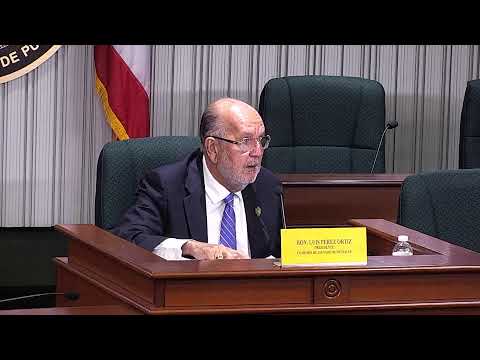
Commission chair Representative Luis Pérez Ortiz opened and moderated the hearing and asked presenters to provide written recommendations. Multiple witnesses said they would submit suggested language and clarifying rules to the commission. Marco Rosado and CPA Luis Torres indicated the alliance would send a draft of suggested amendments clarifying thresholds, documentation requirements and the emergency process. The commission closed the hearing after asking for those written proposals; no vote on the bill occurred at the session.
The record: the hearing brought together representatives of the Asociación de Constructores de Hogares de Puerto Rico, the Asociación de Condominios y Control de Acceso de Puerto Rico, and the Alianza de Profesionales de Condominio y Controles de Acceso, plus commission members and other representatives who questioned witnesses about operational details, proportional thresholds and enforcement. Presenters urged matching transparency goals with flexibility that accounts for differing budgets, geographic limitations and the volunteer nature of many community boards.
For follow-up, committee staff requested written, specific suggestions to reconcile the bill’s transparency aims with practical administrative and cost constraints; presenters said they would provide them in the days ordered by the chair.