Get Full Government Meeting Transcripts, Videos, & Alerts Forever!
Get email alerts on the Education topic
No spam. Unsubscribe anytime.
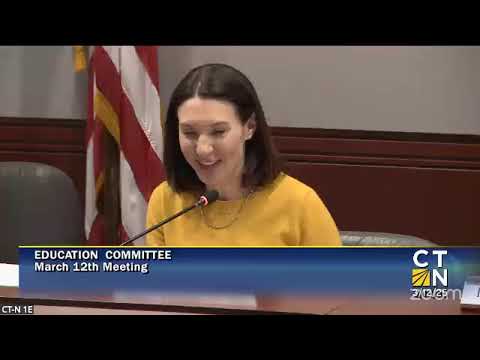
Education committee advances school construction changes that add reimbursement bonus for early childhood spaces
Summary
The Education Committee voted to send SB 13-93, which revises school building project statute and creates an extra reimbursement for projects adding early childhood education spaces, to the floor after discussion about eligibility, operational readiness and time limits.
The Education Committee voted to send Senate Bill 13-93, an act authorizing state grant commitments and revisions to the school building project statute, to the floor after discussion about adding an additional reimbursement bonus for projects that include early childhood education spaces.
Committee members said the measure is intended to support districts expanding prekindergarten space as enrollment demand grows, but several members pressed for clarity about eligibility, operational requirements and possible recoupment if a district cannot staff or open the new space.
Senator Berthel, who spoke in committee debate, described the change in the bill as “an additional reimbursement bonus for, projects adding early childhood education spaces,” and raised concerns that districts could build facilities but later fail to staff or open them. “If they can't, functionalize or operationalize or open that center, would they possibly be subject to some sort of, recourse by or the state because they received the bonus, and now they're not providing the intended service?” Berthel asked, noting there is nothing in the bill language he could point to that answers that question.
Madam Chair and bill proponents said districts are expected to do local analysis before beginning a construction project and that the change responds to district requests after kindergarten start-age shifts increased demand for preschool seats. The chair said the intent is to incentivize districts to expand capacity while balancing fiscal stewardship of the school construction reimbursement program.
Representative Kennedy asked whether the bill’s language — which refers specifically to “elementary school” building projects in the relevant section — limits the incentive to elementary projects, noting that some districts have high-school–based child centers and wanted clarity on whether those would be eligible. “Is this just for elementary school projects, or is this for all school projects?” Kennedy asked.
Madam Chair replied that the language likely reflects that preschool spaces are typically in elementary schools and that the committee can continue the conversation about expanding eligibility, while cautioning that broader eligibility might create incentives for costly high-school additions that were not intended. Representative Kennedy said she wanted clarity because “in my district, our high schools have child centers. And 1 of our schools is going to be doing an expansion. I would like to make sure that they would be eligible for the, 15%.”
Representative Corpus raised an operational question from a superintendent: when districts contract with third-party providers to run preschool programs in school-owned space (with parents paying tuition to the private provider), would that arrangement be eligible for school construction reimbursement. The chair answered that if the program is not publicly administered, it likely would not be eligible; if the program is brought back into the public system or is publicly administered with an MOU for outside staff, the district could be eligible.
Committee members also discussed the program’s planning horizon and the 10-year projection typically used for school construction planning; members asked whether recipients would be required to keep the spaces available for that period or face payback obligations, and sought clearer safeguards or recapture language if districts do not operationalize spaces after receiving incentives.
The committee approved a motion to report SB 13-93 favorably to the floor. The bill was moved by Senator McCrory and seconded by Representative Brown; the motion was reported out of committee by roll call.
Votes at the committee level do not by themselves change law; they move the bill to the next stage in the legislative process. Staff and members indicated follow-up clarifications could be sought about the bill’s language before final action on the floor.
Looking ahead, committee members asked staff to work with the Department of Administrative Services (DAS) and the State Department of Education to clarify eligibility rules, whether the 15% bonus applies only to elementary projects or to any public-school project adding early childhood space, and whether the bill should include explicit recoupment or time-to-operationalize provisions.