Get Full Government Meeting Transcripts, Videos, & Alerts Forever!
Get email alerts on the School Safety Cardiac topic
No spam. Unsubscribe anytime.
Committee lays over bill requiring school cardiac emergency response plans, AEDs and training
Summary
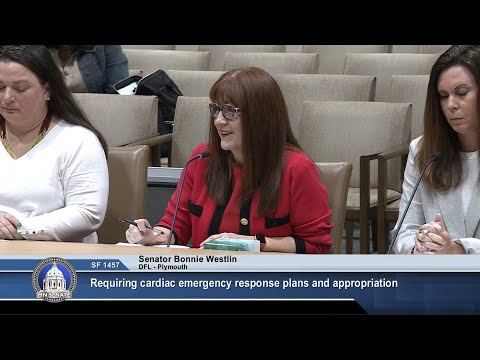
Sen. Wesseland presented SF 1457 on March 12 to require written cardiac emergency response plans, AED accessibility and training in Minnesota schools beginning in the 2026–27 school year.
Sen. Wesseland introduced Senate File 1457 to the Senate Education Finance Committee on March 12, proposing statewide requirements for cardiac emergency response plans (CERP) in school districts and charter schools, equipment placement, training and an appropriation to assist implementation.
Sen. Wesseland told the committee that more than 356,000 cardiac arrests occur outside hospitals annually in the U.S. and that survival improves sharply when bystanders call 911, begin CPR and use a publicly available automated external defibrillator (AED). "This bill ensures that each school has a plan in place for when any of our students have a sudden cardiac arrest or when anyone in the building, including staff or visitors," the senator said.
Multiple witnesses described personal experience with sudden cardiac arrest and school responses. Katie Hawk, a Stillwater first responder and mother, told the committee her son Keegan suffered a sudden cardiac arrest during football practice and was revived by coaches and athletic trainers who administered CPR and used an AED. "Senate file 14 57 will ensure that all Minnesota schools have the planning and tools in place in the event of a sudden cardiac arrest," Hawk said.
Dale Wakasugi, a cardiac arrest survivor and advocate with the American Heart Association, recounted his own experience of cardiac arrest while refereeing and praised bystander CPR and AED use. Representatives from the Minnesota State High School League and district emergency planners raised cost questions; Roger Arneson noted the league and its foundation have purchased AEDs for many schools but cautioned about unfunded mandates and local cost burdens if the requirement to equip facilities is not accompanied by sufficient funding.
The bill would require districts to develop CERPs for implementation in the 2026–27 school year; make plans available on school websites and in paper form; designate cardiac emergency response teams and simulate a cardiac emergency 30 days before each school year; require CPR and AED training for coaches, athletic staff and faculty; require AED placement within a 1–3 minute walk of athletic venues; and direct the Minnesota State High School League to adopt a CERPs plan for interscholastic events. The bill also includes a $2,000,000 appropriation to assist districts and charter schools with equipment purchases, training and maintenance.
Witnesses and committee members discussed funding levels. Arneson and others noted Senator Howe has a companion bill that proposed a much larger appropriation and that the number of schools and coaches statewide make the cost of training and devices substantial. Several testifiers described low or no out‑of‑pocket cost models where communities and nonprofits donated AEDs; Shakopee Public Schools reported many devices were donated through local fundraising.
Action: The committee laid SF 1457 over for possible inclusion in a future omnibus bill.