Get Full Government Meeting Transcripts, Videos, & Alerts Forever!
Get email alerts on the State Legislation topic
No spam. Unsubscribe anytime.
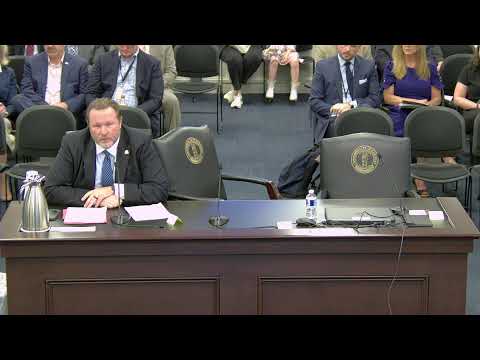
Senate committee advances bills on elections, pensions, audits, housing and an AG election unit
Summary
The Senate State and Local Government Committee advanced six measures on election administration, pensions, local government audits, law library resources, manufactured housing, and election investigations, adopting committee substitutes on several bills and forwarding them for consideration on the Senate floor.
The Senate State and Local Government Committee advanced six bills on topics ranging from election administration to local audit rules and manufactured housing, taking committee action and adopting committee substitutes on several measures.
Representative Jennifer Decker, the primary sponsor of House Bill 684, told the committee the measure is part of a series of "continuous improvement" election bills developed with the Secretary of State's office, county clerks and the Kentucky County Clerk's Association. "When I first ran for state representative, I pledged to work on ensuring that our state elections are fair and free," Decker said, and she described HB 684 as drafted to address concerns that arose during the 2024 election cycle.
The bill drew questions from senators about a subcommittee change that removes credit and debit cards as an acceptable second form of identification for provisional ballots. Representative Candy Massaroni said the change "came from actually a local people that worked elections," and that some voters previously tried to use only a credit or debit card without photo ID. Several senators expressed differing views about the change; one said they wanted more time to consult with local election officials. The committee recorded the committee's passage of the bill (as recorded in the transcript: "House Bill 684 passes 9 11") and indicated it would be taken up on the Senate floor.
House Bill 71, a reorganization requested by the Kentucky Public Pensions Authority (KPPA), would create an Office of Financial Management inside KPPA and elevate the chief financial role to an executive director level. The measure, which the presenter said was vetted by the Public Pension Oversight Board, was described as not changing system funding requirements and imposing minimal short-term personnel costs within KPPA's budget. The committee passed the bill and reported it to the floor (transcript: "House bill 71 passes 1,100, so, we expect to do so on the floor").
House Bill 290 clarifies that county law library funds may be used to purchase online legal resources, computers and internet-related equipment. Representative Nick Wilson said the bill would make clear that local law libraries can use their funds "for legal research, computers, Internet related equipment." The committee called the roll on the bill; the transcript records discussion and a brief colloquy but does not include an explicit floor-ready announcement in the provided excerpt.
House Bill 555, carried with the work of the Kentucky League of Cities (KLC), the Auditor's Office and county treasurers, changes audit rules for small cities. JD Cheney of the Kentucky League of Cities told the committee the bill would raise the population threshold that allows some cities to use alternative audit arrangements from 1,000 to 3,000 and would expand the number of cities eligible for an every-other-year audit, saying it would add "an additional 97 cities out of the 408" currently incorporated. Cheney also said the bill lowers the financial threshold for exemption from $1,150,000 to $500,000 and would allow contract-backstop audits by the Auditor's Office when a local government cannot obtain an independent CPA. The committee adopted a committee substitute and passed the bill as amended, recorded in the transcript as passing 10 to 1.
House Bill 160, on manufactured housing, was presented by Representative Susan Whitten and supporters including the Kentucky Manufactured Housing Institute. The committee substitute was described as the product of negotiations with KLC and local governments. Senators expressed tension between respecting local zoning authority and addressing affordable housing needs; several senators who spoke said they supported the negotiated compromise. The committee passed the bill as amended by committee substitute by a recorded vote of 10 to 1.
House Bill 455 would establish a unit for election investigations and security within the Office of the Attorney General, codifying existing practices, centralizing allegation review, investigations/prosecutorial referral, the existing voter fraud hotline, and a legislative oversight process. Representative Patrick Flannery said the change "codif[ies] existing practices throughout different agencies and puts it within this unit." Some senators requested clarity on staffing and funding; the presenter and the committee substitute sponsor said the sub uses the word "unit" (rather than "department" or "officer") and the change was not expected to require additional funding. One senator voted no on the bill, citing concerns about placing the voter fraud hotline into a partisan office; the committee passed the bill as amended with 9 yeas, 1 no and 1 pass, and expected to report it to the floor.
What the committee did: several committee substitutes were adopted; bills were approved for a floor vote or otherwise advanced. Committee debate ranged from technical clarifications about ballot-issue issuance and identification to policy-level debates about local control over zoning and centralization of election investigation functions.
Next steps: committee sponsors said they expect most of these measures to be considered on the Senate floor. The transcript excerpt includes roll-call activity and recorded votes; the committee-level actions recorded in the transcript will be reflected in each bill's formal Senate filing and calendar ahead of floor action.