Get Full Government Meeting Transcripts, Videos, & Alerts Forever!
Get email alerts on the Agriculture topic
No spam. Unsubscribe anytime.
House Agriculture Committee advances Senate Bill 69 to certify nonveterinarians for routine equine dental care
Summary
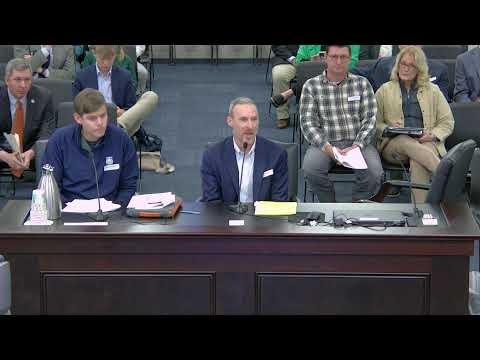
The Kentucky House Agriculture Committee on Monday voted to report Senate Bill 69 favorably after testimony for and against a proposal to create a certification pathway for people who perform routine equine dental care, commonly called "floating" teeth.
FRANKFORT, Ky. — The Kentucky House Agriculture Committee on Monday voted to report Senate Bill 69 favorably after testimony for and against a proposal to create a certification pathway for people who perform routine equine dental care, commonly called "floating" teeth.
Sen. Robin Webb, D-18, the bill sponsor, told the committee the measure is intended to create a regulated pathway for longtime practitioners of equine dental work, add accountability, enable those providers to obtain insurance and improve access to basic care in rural areas. "This has been about a 2-year, consensus piece of legislation," Webb said, adding the bill contains a grandfather clause for people who have been doing the work for years and additional training requirements.
The bill establishes a licensed or certified role for nonveterinarians who provide routine equine dental maintenance. Justin Talp, who testified in support, told the committee his international association requires continuing education and said, "Our membership and our certification requires 24 hours of CE every 2 years," adding that regulatory requirements discussed in committee might be equivalent to "12 hours every year."
Veterinarians who testified raised concerns about the statute's scope and public clarity. Dr. Brad Tanner, a boarded specialist in oral surgery and equine dentistry, said the veterinary community is divided on the measure and cited a Kentucky Veterinary Medical Association survey he said showed limited support: "only 14 out of 214 respondents would have been supportive" of indirect veterinary supervision of dental health. Tanner warned the bill, as drafted, "carves out far more than floating teeth" and could permit procedures that he described as surgical, including tooth removal, which he said require sedation, pain management and protocols to protect both animal and handler.
Dr. William Rainbow, an equine dental specialist, urged the committee to narrow the scope to routine floating and to ensure consumers understand the training differences between veterinarians and nonveterinarian providers. "Owners assume they're getting a comprehensive exam," Rainbow said, arguing that misunderstandings can lead to more costly follow-up veterinary care.
Committee members asked questions about continuing education, licensing requirements and whether the bill's terminology conveys the correct level of service to the public. Tanner suggested a more precise title — "equine teeth floater" — rather than "equine dental provider," saying the latter could mislead owners about the provider's training and the services offered.
Representatives debated access and affordability concerns for rural owners and 4-H families. Representative Bivens, among others, said the bill addresses gaps where equine veterinary services are scarce and that a certified nonveterinarian option could improve care for horses that are not otherwise easy to service.
A motion to advance the bill was made by Representative McPherson and seconded by Representative Tate. The roll-call on the motion recorded a number of affirmative votes and one recorded pass. The committee chair announced that "Senate Bill 69 passes with favorable expression" and that the bill will go to the House floor for further consideration.
Votes at a glance: Motion to advance Senate Bill 69 — mover: Rep. McPherson; seconder: Rep. Tate; outcome: approved. Recorded responses in committee included affirmative votes from Representative Ball, Representative Bivens, Representative Donworth, Representative Pfister, Representative Hale, Representative Cook, Representative Massaroni, Representative McPherson, Representative Moore, Representative Payne, Representative Rayburn, Representative Stalker, Representative Tate and Representative Tipton; Representative Watkins declined to vote ("I'll pass").
The committee record and testimony show agreement on the need for basic equine dental maintenance in rural areas, but continuing disagreement on how broad the permitted scope of practice should be and how the role should be titled and regulated. Several members urged continued conversations and potential amendments before floor consideration.
The measure includes a grandfather clause for existing practitioners, references certification and continuing-education requirements, and—according to the sponsor—carves out limitations on procedures that would remain within the veterinarian scope. The bill text and committee discussion indicate regulators (the Kentucky Board of Veterinary Examiners and licensure boards) would have rulemaking and enforcement roles once the statute is enacted.
Committee members and witnesses who requested follow-up offered to provide additional language and technical clarifications to address concerns about allowed procedures, consumer notices, and continuing-education standards. The House Agriculture Committee record shows the bill will be scheduled next for House-floor consideration.