Get Full Government Meeting Transcripts, Videos, & Alerts Forever!
Get email alerts on the Comprehensive Plan Land Capacity topic
No spam. Unsubscribe anytime.
Spokane Valley planning staff: city’s current buildable land will not absorb projected 20‑year growth; comp‑plan update next step
Summary
City planning staff presented a land-capacity analysis (LCA) showing available commercial, industrial and residential capacity under current zoning, and said the city will not be able to absorb the county population allocation to 2046 without additional planning steps; the LCA is a technical first step toward the comprehensive plan update.
Planning Manager Steve Roberge presented the city’s land-capacity analysis (LCA) on March 11, the technical study required under the Growth Management Act (GMA) that estimates development capacity under current zoning and helps set the baseline for the Spokane Valley comprehensive-plan update.
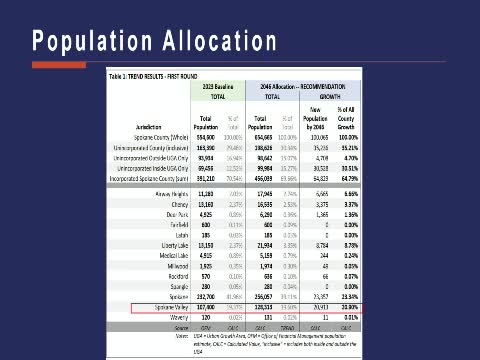
Roberge and staff summarized methodology and findings: the Office of Financial Management (OFM) county population projections (medium series) translate to a city allocation of about 21,000 additional residents and roughly 16,661 housing units needed through 2046. The LCA counts vacant, partially used and underutilized parcels and applies standard deductions for critical areas, shorelines, needed public purposes and a market-factor reduction to estimate realistic, near-term capacity.
The staff analysis shows the city’s current residential capacity under existing zoning (after the standard adjustments) falls well short of the housing allocation to 2046. Roberge said the LCA is the first technical step; forthcoming work will examine how state mandates for housing and zoning may alter capacity, and the broader comprehensive-plan update later this year will consider whether to expand urban growth area boundaries or change land‑use designations.
Council questions focused on methodology and assumptions: members asked why the county’s medium projection was used (it is the county’s current allocation baseline), how the Housing for All Planning Tool (HAPT) generated the 16,661 unit allocation and whether the city should lobby the county about projection selection. Staff said the LCA is a snapshot of existing capacity under current zoning and that future policy choices (rezones, annexation, UGA expansions, or multifamily strategies) will determine whether the city accommodates county‑allocated growth.
Roberge and City Manager Jeremy Holman said the next steps will include deeper analysis during the comprehensive-plan process and public outreach: the city will evaluate housing mandates, potential rezones and any boundary adjustments and return to council with options for alignment and zoning changes.