Get Full Government Meeting Transcripts, Videos, & Alerts Forever!
Get email alerts on the Recycling Mrf Bond topic
No spam. Unsubscribe anytime.
Alpena County delays vote on bond authorization for regional recycling facility
Summary
The Alpena County Board of Commissioners on a motion by Commissioner Kozlowski tabled consideration of a contract and bond authorization that would help fund a proposed regional Material Recovery Facility (MRF) operated by the Northeast Michigan Recycling Authority (NEMA).
The Alpena County Board of Commissioners on a motion by Commissioner Kozlowski tabled consideration of a contract and a bond authorization related to a proposed regional Material Recovery Facility (MRF) operated by the Northeast Michigan Recycling Authority (NEMA). The motion was seconded by Commissioner Fournier and carried on roll call, postponing final action until the board’s next meeting on March 25, 2025 (date in meeting materials not specified).
NEMA representatives told the board the project’s capital cost is about $5.165 million and that roughly 75% of that amount is currently committed from a mix of grants and other sources. Rachel (presenter) told commissioners the authority expects to rely on a mix of EGLE infrastructure grants, corporate grants (Carton Council and Food Service Packaging Institute), a $2,700,000 congressionally directed USDA allocation that must be released after all other funding is secured, a recent $50,000 Besser Foundation grant, and a quarterly MOA landfill allocation of $0.50 per delivered cubic yard up to $75,000. Rachel said the household surcharge authorized under Public Act 138 (now set at $25 per household) is part of the revenue model that will support operations and debt service. She said the project team has reduced the budget by roughly $500,000 through design changes (for example moving office space to a trailer and using a fabric cover for tipping/bunker areas) and that the authority expects equipment procurement and construction RFPs to be issued soon with an operational startup goal of July 2026. Rachel said, “we would only issue the amount that we need to,” describing the $1.6 million figure as a ceiling rather than the expected issuance amount.
Bond counsel Ron Liscum of Miller Canfield told the board the $1.6 million ceiling was set to provide flexibility through the required 45‑day referendum period and because final construction bids are not yet in. “We set this amount at 1,600,000.0 because we have to go through this 45 day referendum period, and we don't have bids on the construction and everything yet,” Liscum said, adding the higher ceiling avoids delay if bids come in above earlier estimates.
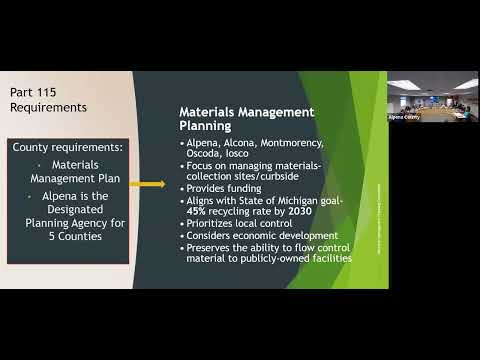
NEMA and its consultants presented the facility design and demand assumptions. Consultant Annie White said the MRF design and revenue/tonnage projections were modeled in part on Emmet County’s program and on a small‑footprint “Revolution” sorting system used in DeForest, Wisconsin; she described the pro forma as conservative and said the authority expects about 4,300 tons per year by year six with a mix of drop‑off and planned curbside service in denser areas. The authority also described an early local partnership to take crushed glass as feedstock for a local manufacturer, and said its Materials Management Plan (MMP) role covers Alpena, Alcona, Montmorency, Oscoda and Iosco counties.
Several commissioners pressed for clearer contractual protections before committing the county to any possible shortfall. Commissioners asked that the contract explicitly define communication steps with the county treasurer, require notice to the treasurer in advance of debt service payments, and simplify or clarify language in Section 10 about the county’s financial obligations and possible additional costs. Commissioner Bray questioned the county’s exposure and said the county does not have funds to absorb a major debt obligation if the authority could not make payments; Bray said he was “definitely against” approving the items without more detail. Commissioners also objected to a petition/referral paragraph that referenced “15,000” signatures; staff agreed to reword that to reflect the statute’s “not less than 10%” threshold for a referendum petition in Alpena County.
Board members asked for additional materials before a final vote, including a corrected contract and resolution, a clearer schedule of payments and communications with the county treasurer, and historical comparisons (the board requested Marquette facility cost history). With those items outstanding, Commissioner Kozlowski moved to table the request; Commissioner Fournier seconded and the motion carried by roll call (vote recorded as yes by a majority of commissioners present). The board set the item for reconsideration at its March 25 meeting and asked staff and counsel to incorporate the requested contract edits.
The MRF proponents told the board the authority has used state and federal planning changes (Part 115/Natural Resources and Environmental Protection Act references in staff materials) to seek funding under Michigan’s new materials management planning requirements, and argued the facility is intended to increase recycling access across the five‑county region, reduce landfill pressure, and supply regional manufacturers with lower‑cost recycled feedstock. The project team emphasized continuing fundraising work and that the authority will seek to borrow “as little as possible” if bonds are needed. Bond counsel and NEMA staff repeatedly said issuance will be limited to the amount actually needed and that the higher ceiling is a common practice while bids are pending.
The board’s request for revised contract language and clearer debt‑service procedures, and the unanimous decision to table, leaves the schedule dependent on staff producing the requested clarifications. NEMA and county staff said they will return with the revised documents and supplemental materials for the next regular meeting, at which the board may take formal action.