Get Full Government Meeting Transcripts, Videos, & Alerts Forever!
Get email alerts on the Auto Insurance topic
No spam. Unsubscribe anytime.
Committee approves measure to raise insurance requirements for drivers convicted of DUI; industry raises affordability concerns
Summary
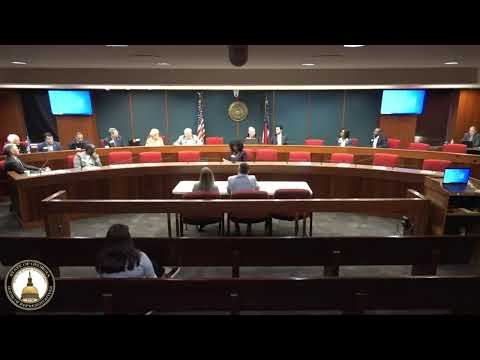
The Full House Insurance Committee voted to report Senate Bill 121 favorably after a public hearing in which sponsor Senator Harbin said the bill would raise minimum automobile liability limits for drivers convicted of driving under the influence and impose a graduated requirement for repeat offenders.
The Full House Insurance Committee voted to report Senate Bill 121 favorably after a public hearing in which sponsor Senator Harbin said the bill would raise minimum automobile liability limits for drivers convicted of driving under the influence and impose a graduated requirement for repeat offenders.
Senator Harbin told the committee that current state minimums are "$25,000" for property damage and typically "$25,000 per person and $50,000 per accident" for bodily injury and that those levels have not been increased in about 14 years. He said the proposal would require higher limits after a DUI conviction and still higher limits after a second conviction; the bill would require proof of the higher limits for a multi‑year period. "We are currently at a level...we need to look even at this just because of the DUI issue," the senator said, arguing the change would better protect other motorists.
During questioning lawmakers raised affordability and enforcement concerns. Representative Hawkins asked why the sponsor did not raise property‑damage limits further; Harbin said he accepted compromises while seeking to follow other states’ approaches. Representative Reeves asked whether the higher limits were permanent; Harbin said the bill contains a three‑year period for required proof of higher limits.
Industry testimony came from Bobby Pilar, who said he spoke on behalf of State Farm and volunteered to present some carriers’ concerns. "We did not oppose this bill," Pilar said, but he urged the committee to consider that higher required limits could push some drivers into nonstandard or high‑cost markets or lead some to forgo coverage entirely.
Sponsor testimony included premium examples intended to illustrate potential consumer costs. Harbin presented a sample showing an estimated increase in premium in one example of roughly $600 per six‑month period to obtain higher limits, and he said insurers already use SR‑22 filings and other mechanisms to document compliance. The transcript records that the committee asked about enforcement; the sponsor and witnesses said the bill would require SR‑22 filings and proof of coverage in paper or electronic form and that judges retain licensing penalties.
Representative Williamson and others said they supported the policy goal but questioned practical impacts on young or low‑income drivers. After public testimony the committee moved, seconded and approved the bill by voice vote; the transcript contains no roll‑call tally.
The insurance file in committee was identified as LC461181SSCS. The transcript shows the sponsor and industry representatives discussed availability of nonstandard markets for drivers who have multiple convictions, and industry witnesses said carriers that write standard personal‑auto business may not serve all applicants who need higher limits.